The Breville Barista Express is the best espresso machine with a built-in grinder for most people — 27,000+ reviews at 4.5 stars, an integrated conical burr grinder with dose control, and the lowest-friction path from beans to espresso in under a minute. If budget matters more than brand, the Ninja Luxe Cafe at $549 (Cyberspace variant, currently Amazon’s Choice) undercuts every Breville and adds drip coffee and cold brew capability.
Before we rank these machines, we need to be upfront about something the category itself: the integrated grinder is the ceiling. Across our Coffee Community Census of 47 forum-research briefs, the Breville Barista machines draw strikingly ambivalent sentiment from the r/espresso community — mixed and neutral labels dominate, with clear praise rare. Not because they’re bad machines, but because owners outgrow the built-in grinder within 12–24 months and wish they’d bought a separate grinder from the start. If that trajectory sounds like you, skip this article and read our best espresso machine for beginners guide, where the Bambino Plus + standalone grinder combination gets the top spot.
If you’re here because you want one machine, one counter footprint, one workflow — and you’re not planning to chase the prosumer ladder — then these machines deliver 80% of the quality for 20% of the complexity. That’s a legitimate choice, and this article respects it.
A note on what we mean by “built-in grinder.” This search query covers two distinct product categories: semi-automatic machines with an integrated burr grinder (you tamp and pull the shot) and super-automatic machines with a bean hopper (push-button, no portafilter). These serve completely different buyers. This article covers the semi-auto category. If you want push-button espresso, see our best super-automatic espresso machine roundup instead.
How We Evaluated
We compared every current semi-auto espresso machine with an integrated grinder across five criteria:
- Grind quality relative to price — The grinder is the whole point of this category. More grind settings, better burr geometry, and dose consistency separate the good from the mediocre.
- Heating architecture — Thermocoil (Express only — ~30 second warm-up) vs ThermoJet (Pro, Touch, Touch Impress — 3 seconds) vs Thermoblock (Ninja, La Specialista — fast heat-up). This determines your morning workflow.
- Community consensus — We aggregated per-mention sentiment data from our community census covering r/espresso, r/Coffee, and r/JamesHoffmann. Products the community criticizes or is ambivalent about get honest treatment.
- The ceiling question — How long before you outgrow it? Forum data shows median upgrade timelines of 2–3 years for daily users, longer for milk-drink-focused households.
- Total value — A $676 machine with a built-in grinder competes against a $400 Bambino Plus + $200 Smart Grinder Pro. The math has to work.

Breville Barista Express
Best for: Home baristas who want an all-in-one machine that delivers solid espresso without a separate grinder
you want one appliance, one workflow, and solid espresso without researching a separate grinder.
you already expect to chase shot quality or upgrade components independently.
Integrated conical burr grinder with dose control — beans to espresso in under a minute
- +27,000+ reviews at 4.5 stars — the most-proven espresso machine on Amazon
- +Integrated burr grinder eliminates the need for a separate grinder
- +PID temperature control for consistent extraction
- +Low-pressure pre-infusion for balanced flavor
- −Integrated grinder is the ceiling — enthusiasts outgrow it within 1-2 years
- −54mm portafilter limits aftermarket accessory options vs 58mm standard
- −Thermocoil heating is slower than ThermoJet models (Barista Pro, Touch)
✓ Free shipping with Prime · Affiliate link
Evidence notes
Community signal: Most proven integrated-grinder machine by owner volume, but the community census shows negative net sentiment because enthusiasts outgrow it.
Main tradeoff: The built-in grinder and 54mm portafilter become the upgrade ceiling.
Evidence note: The built-in-grinder article uses census sentiment, upgrade-path forum stories, and 27,000+ Amazon reviews.
Why We Recommend It
The Barista Express is the best-selling espresso machine on Amazon — 27,000+ reviews at 4.5 stars — and it earned that position by being the most proven integrated-grinder machine on the market. Grinder, tamper, PID temperature control, and low-pressure pre-infusion in one box. Fill the hopper, grind, tamp, pull. No separate grinder to research, no second appliance on the counter.
We need to be honest about what the community says, though. The Barista Express appears in more buying contexts than any other espresso machine in our community census — 20 labeled mentions across 9 briefs — and is the most ambivalently received: 7 of those 20 mentions carry praise and criticism in the same breath. That’s not because the machine is bad. It’s because r/espresso frames it as a stepping stone. One owner who upgraded to a Linea Mini + Niche Zero called it “a machine which I have enduring respect for as it introduced me to the beautiful world of espresso” (thread score 346). Another kept theirs for 5 years before upgrading to a Profitec Pro 400 (score 125). The Express introduces people to espresso; it doesn’t keep them.
Key Features
- Integrated conical burr grinder with 16 grind settings and dose control
- PID temperature control with low-pressure pre-infusion for balanced extraction
- Thermocoil heating — ~30 second warm-up (slower than ThermoJet models)
- Analog pressure gauge for real-time extraction feedback
Who It’s Best For
The buyer who wants one appliance, one purchase, and solid espresso starting tomorrow. If you make 1–2 drinks a day and don’t see yourself chasing extraction perfection, the Express delivers for years. The NCA recommends a ratio of roughly 1:2 (coffee to water) for espresso, and the Express’s dose control makes hitting that target straightforward.
Potential Downsides
The integrated grinder is the ceiling — enthusiasts outgrow it and buy a separate grinder (DF64, Baratza Sette, Niche Zero), leaving the built-in grinder unused. The Thermocoil heating takes ~30 seconds versus 3 seconds on ThermoJet models. The 54mm portafilter limits aftermarket accessory options versus the industry-standard 58mm. And a pricing note: the Express has spiked to $676 from its typical ~$550 street price with low stock on Amazon — at that price, a Bambino Plus ($400) paired with a Smart Grinder Pro ($200) costs the same and has a higher ceiling.
Affiliate link

Breville Barista Pro
Best for: The all-rounder buyer who wants fast heat-up and precise control without paying for a touchscreen
you want the best daily-driver version of the integrated Breville workflow without touchscreen automation.
the same budget could buy a Bambino Plus and standalone grinder with more upgrade flexibility.
ThermoJet 3-second heat-up with LCD display for precise shot control
- +ThermoJet heats in 3 seconds — fastest warm-up in the Breville lineup
- +LCD display for grind size, shot time, and temperature feedback
- +Integrated grinder with 30 grind settings
- +Instant transition from espresso to steam — no wait between brew and milk
- −Same integrated grinder ceiling as Express — enthusiasts will outgrow it
- −54mm portafilter limits aftermarket basket options
- −Manual steam wand requires practice for latte art
✓ Free shipping with Prime · Affiliate link
Evidence notes
Community signal: Forum upgrade stories frame the Pro as a faster Barista workflow, not a different long-term upgrade path.
Main tradeoff: The premium buys speed and interface, not a fundamentally better grinder.
Evidence note: The article anchors this pick on ThermoJet workflow value and negative-but-less-severe census sentiment than the Express.
Why We Recommend It
The Barista Pro is the Express upgraded with ThermoJet heating and a digital LCD — 3-second warm-up instead of 30, plus real-time grind size and shot time feedback on screen. If the Express’s morning wait frustrates you, the Pro eliminates it entirely.
The $174 premium over the Express ($850 vs $676 at current pricing) buys you faster heating, a display, and 30 grind settings instead of 16 — but not a better grinder. The integrated burr grinder has more adjustment range, but the grind quality ceiling is fundamentally the same. Community sentiment reflects this: dead even at net 0 across 11 labeled mentions in our census, with owners upgrading to prosumer machines (Profitec Move, Lelit Bianca) rather than climbing the Breville ladder. For a detailed breakdown of whether the gap is worth it, see our Barista Express vs Barista Pro comparison.
Key Features
- ThermoJet 3-second heat-up — eliminates the Express’s main morning-workflow friction
- LCD display showing grind size, shot time, and temperature
- 30 grind settings for finer adjustment than the Express’s 16
- Instant steam transition — no wait between brew and milk modes
Who It’s Best For
The buyer who has committed to the integrated-grinder philosophy and wants the best daily-driver version of it. If you make multiple drinks each morning — espresso, then steam, then another shot — the ThermoJet heating and instant steam transition save real time. The Pro is the best version of the Barista concept for most daily workflows.
Potential Downsides
At $850, the Pro costs more than a Bambino Plus ($400) + Smart Grinder Pro ($200) with $250 left over. Same integrated-grinder ceiling as the Express — enthusiasts upgrade to separate machines entirely, not to the Touch. The manual steam wand requires practice for latte art. And the upgrade path from the Pro typically goes to prosumer machines outside the Breville ecosystem, meaning the $850 investment has a shorter useful life than the price suggests.
Affiliate link
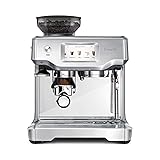
Breville Barista Touch
Best for: Beginners who want touchscreen guidance and pre-programmed drinks without a learning curve
multiple people in the house want saved drink presets and automatic milk texture.
you want manual steam control for latte art or fewer electronics to age.
Touchscreen with pre-programmed recipes and ThermoJet 3-second heat-up
- +Touchscreen with customizable drink presets — lowest friction path to good espresso
- +ThermoJet heats to extraction temperature in 3 seconds
- +Integrated grinder with dose control
- +Automatic steam wand for consistent milk texturing
- −Most expensive all-in-one in this lineup at $800
- −Touchscreen adds complexity that can fail — some owners report screen issues
- −Same 54mm portafilter limitation as the Express
- −Automatic steam wand limits latte art compared to manual wands
✓ Free shipping with Prime · Affiliate link
Evidence notes
Community signal: Owner sentiment is still negative in the census, but less harsh than the Express because milk automation solves a real household problem.
Main tradeoff: Touchscreen convenience adds complexity while keeping the same integrated-grinder ceiling.
Evidence note: The article uses census sentiment and owner comments about learning the grinder limits while keeping the machine for milk automation.
Why We Recommend It
The Barista Touch adds a touchscreen with customizable drink presets and an automatic steam wand to the ThermoJet platform. It’s the most hands-off Breville with an integrated grinder — select your drink on the touchscreen, and the machine handles grind dosing, extraction timing, and milk texturing. For households where multiple people use the machine with different preferences, saved drink profiles eliminate the learning curve.
The Touch draws too few census mentions for a meaningful sentiment score, but the qualitative pattern suggests the automatic milk functionality provides enough added value to reduce buyer’s remorse. One owner noted: “quickly learned the limitations of the built-in grinder and tamper” but stayed because the milk automation was worth the trade-off.
Key Features
- Touchscreen with customizable and saveable drink presets
- Automatic steam wand — consistent microfoam without manual technique
- ThermoJet 3-second heat-up with instant brew-to-steam transition
- Integrated grinder with dose control
Who It’s Best For
The latte and cappuccino household. If you make milk drinks daily and multiple family members use the machine, the automatic steam wand and preset profiles remove the biggest friction point. The $800 price is easier to justify when the machine replaces a daily $6 latte habit.
Potential Downsides
The automatic steam wand produces consistent microfoam but limits latte art compared to the Pro’s manual wand. Some owners report touchscreen issues over time. Same 54mm portafilter lock-in and integrated-grinder ceiling as the rest of the Barista line. At $800, the $400 gap to the Touch Impress ($1,200) is wider than the $174 gap between Express and Pro — making the Touch a harder sell when the Touch Impress adds auto-tamping for a proportionally smaller jump in the feature set.
Affiliate link

Breville Barista Touch Impress
Best for: Experienced home baristas ready to step into prosumer territory with guided precision
you want the most guided semi-auto workflow with assisted tamping and automatic milk settings.
you would rather spend the same money on a separate machine, grinder, and tamper.
Impress Puck System with assisted 22lb tamping and auto dose correction — takes the guesswork out of puck prep
- +Impress Puck System with assisted tamping eliminates inconsistent puck prep
- +3-second ThermoJet heat-up — same speed as the Bambino Plus
- +Auto MilQ with alternative milk settings for oat, soy, and almond
- +Touchscreen with step-by-step barista guidance and real-time feedback
- −At $1,200, it's more than double the Barista Express for incremental improvements
- −Integrated grinder means you can't upgrade the grinder independently
- −Large footprint — needs significant counter space
- −Some r/espresso owners report the assisted tamping feels over-engineered for experienced users
✓ Free shipping with Prime · Affiliate link
Evidence notes
Community signal: Best sentiment among Breville Barista machines in this lineup, mostly because auto-tamping removes a real beginner variable.
Main tradeoff: The price enters prosumer territory while the grinder remains built in and non-upgradable.
Evidence note: The article frames the Impress system as the meaningful upgrade, while keeping the grinder-ceiling warning visible.
Why We Recommend It
The Touch Impress is the top of the Breville Barista line, and its defining feature is the Impress Puck System — an assisted 22-lb tamper that applies consistent pressure and auto-corrects dose. For a machine with an integrated grinder, this matters more than it sounds: inconsistent tamping is one of the biggest variables in shot quality, and the Impress removes it entirely.
The Touch Impress draws too few census mentions for a meaningful sentiment score, but the forum discussion it does get is comparatively warm — which tracks. The auto-tamp system and guided barista workflow reduce the skill ceiling that frustrates users of the Express and Pro. The Auto MilQ system with alternative-milk settings (oat, soy, almond) adds genuine utility for plant-milk households.
Key Features
- Impress Puck System — assisted 22-lb tamping with auto dose correction
- Auto MilQ with alternative milk presets for oat, soy, and almond
- Touchscreen with step-by-step barista guidance and real-time feedback
- ThermoJet 3-second heat-up and 30 grind settings
Who It’s Best For
The buyer who wants the most automated workflow a semi-auto can offer. If you’re tired of puck prep inconsistency, the Impress system is the most meaningful mechanical improvement in the Breville lineup — more valuable, arguably, than the ThermoJet upgrade from Express to Pro. The $1,200 price is steep, but for a one-machine household that makes 3–4 milk drinks daily, the auto-tamp and alternative-milk automation earn their keep.
Potential Downsides
At $1,200, the Touch Impress costs more than double the Express for incremental grinder improvements — the integrated burr grinder is still the ceiling. Some r/espresso owners report the assisted tamping feels over-engineered for experienced users. The large footprint (14.7 x 12.6 x 16.1 in, 26.5 lbs) demands serious counter space. And at this price, the alternative calculation gets uncomfortable: a Bambino Plus ($400) + a Eureka Mignon grinder ($300) + a quality tamper ($40) totals ~$740 and outperforms the Touch Impress on grind quality by a meaningful margin.
Affiliate link
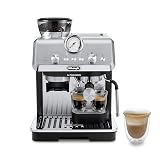
De'Longhi La Specialista Arte
Best for: Latte art learners who want a compact Italian-designed machine with a cool-touch steam wand
you want a compact non-Breville machine with a cool-touch wand for milk practice.
you want the most battle-tested integrated-grinder ecosystem and accessory support.
My Latte Art steam wand stays cool-to-touch after steaming — safer and easier for beginners learning milk texturing
- +My Latte Art wand stays cool-to-touch — genuine differentiator for learning latte art
- +Compact design fits smaller kitchen counters
- +3 infusion temperatures for matching water to bean variety
- +Italian-made conical burr grinder with 8 settings
- −Only 8 grind settings — less precise than Breville's 30 settings
- −4.0-star rating is the lowest in this lineup
- −Only 3 preset recipes (espresso, americano, hot water) vs Ninja's full drink menu
- −No cold brew capability
✓ Free shipping with Prime · Affiliate link
Evidence notes
Community signal: Thinner product-specific forum signal than Breville; the article treats broader Specialista owner reports as directional.
Main tradeoff: Only 8 grind settings, lower Amazon rating, and less established US service discussion than Breville.
Evidence note: Included for compactness and steam-wand differentiation, with the article explicitly noting thin Arte-specific community data.
Why We Recommend It
The La Specialista Arte is the strongest non-Breville option in this category — an Italian-designed semi-auto with an integrated conical burr grinder, a 15-bar pump, and De’Longhi’s Sensor Grinding Technology that automatically adjusts grinding for consistent dose delivery. It’s the pick for buyers who want an alternative to the Breville ecosystem.
One categorization quirk worth noting: Amazon files this product under “Super-Automatic Espresso Machines” in its category tree, despite the manual portafilter that defines it as semi-auto by enthusiast convention. If you’re shopping for a true push-button super-auto (no portafilter, bean hopper, fully automated), this isn’t it — see our best super-automatic espresso machine roundup. The Arte is a semi-auto that Amazon happens to misfile.
The standout feature is the My Latte Art steam wand, which stays cool-to-touch after steaming. For beginners learning milk texturing, this is a genuine differentiator — you can wrap your hand around the wand for control without burning yourself. No Breville offers this.
Community data on the Arte specifically is thin — +1 net sentiment across just 4 labeled mentions in our census, far less than the 11–20 mentions the Barista Express and Pro accumulate. Most forum discussion covers the broader Specialista line rather than the Arte model specifically: a Specialista Opera owner reported internal leaking after a year with difficult US servicing (score 563), while a Specialista Maestro owner described it as “works great, quick and easy” (score 125). The Arte sits below both in price and complexity, so these data points are directional, not direct.
Key Features
- My Latte Art steam wand — stays cool-to-touch after steaming
- Sensor Grinding Technology with 8 grind settings
- 51mm portafilter — smaller than Breville’s 54mm
- Active Temperature Control with 3 infusion temperature settings
- Compact design (11.2 x 14.3 x 14.1 in, 15 lbs) — smallest footprint in this roundup
Who It’s Best For
Latte art learners who want a compact machine from an Italian manufacturer. The cool-touch steam wand is the single best learning tool for milk texturing in this lineup, and the compact dimensions fit smaller kitchens that can’t accommodate a Breville. Also for buyers who simply prefer not to buy Breville — brand preference is a legitimate factor.
Potential Downsides
Only 8 grind settings versus Breville’s 16–30 range — less fine-tuning ability. The 51mm portafilter is even more restrictive than Breville’s 54mm for aftermarket accessories. The 4.0-star rating is the lowest in this lineup. De’Longhi’s US service network is less established than Breville’s, and at least one forum report flagged difficult servicing. The 34 oz water tank is roughly half the size of the Breville machines’ 67 oz tanks — you’ll refill more often. And unlike the Ninja, there’s no drip or cold brew capability.
Affiliate link

Ninja Luxe Café Premier
Best for: Buyers who want espresso, drip coffee, and cold brew from a single machine
your household wants espresso, drip, and cold brew from one machine at the lowest price in this lineup.
you only care about espresso quality or want a mature reliability record.
3-in-1 system (espresso + drip + rapid cold brew) with weight-based dosing and hands-free frothing
- +Three machines in one — espresso, drip coffee, and rapid cold brew
- +Weight-based dosing with built-in scale — more precise than time-based grinding
- +Hands-free Dual Froth System steams and whisks simultaneously
- +Barista Assist Technology provides guided grind and brew adjustments
- −Jack-of-all-trades — espresso quality won't match a dedicated espresso machine at the same price
- −Newer product (2024) — long-term reliability unproven
- −Large footprint for a kitchen counter
- −25 grind settings — fewer than the 30 on Breville Pro
✓ Free shipping with Prime · Affiliate link
Evidence notes
Community signal: Polarizing: owners value the 3-in-1 convenience, while espresso-focused threads flag early reliability and grinder-consistency concerns.
Main tradeoff: Newer 2024 product with thinner long-term durability evidence than the Breville machines.
Evidence note: The article cites r/NinjaLuxeCafe owner discussion, one-week failure reports, and the machine's unique 3-in-1 feature set.
Why We Recommend It
The Ninja Luxe Cafe is the wildcard in this lineup — a 3-in-1 machine (espresso, drip coffee, rapid cold brew) with an integrated burr grinder, weight-based dosing with a built-in scale, and hands-free milk frothing. New pricing varies by color: the Cyberspace variant is currently $549.99 (Amazon’s Choice), Gunmetal is $599.99, and the default Stainless Steel finish is only available used at $402.93. At the Cyberspace price it’s $127 less than the Barista Express and does three things where every other machine on this list does one.
As a category disruptor from a kitchen-appliance brand, the Ninja is polarizing. r/espresso purists dismiss it; r/NinjaLuxeCafe owners defend it. The honest assessment: “If you’re weighing your coffee grounds and measuring your shots volume, the Ninja Luxe Cafe is not for you” (score 70, from the Ninja subreddit itself). It’s a household convenience machine that happens to pull genuine espresso through a 19-bar pump and a 54mm portafilter. One experienced user paired it with a DF54 external grinder and reported “it did make pretty good espresso” — suggesting the machine-side extraction is competent even if the built-in grinder is the weak link.
Key Features
- 3-in-1 system — espresso, drip coffee, and rapid cold brew from one machine
- Weight-based dosing with built-in scale — more precise than time-based grinding
- Hands-free Dual Froth System — steams and whisks simultaneously
- 25 grind settings with Barista Assist technology for guided adjustments
Who It’s Best For
The household that drinks more than just espresso. If you want lattes in the morning, drip for the afternoon, and cold brew on weekends — and you don’t want three appliances — the Ninja is the only machine in this lineup that covers all three. At $549 for the in-stock Cyberspace variant, it’s also the right choice for buyers testing whether they enjoy home espresso before committing $850+ to a Breville Pro or Touch.
Potential Downsides
Reliability is the open question. One high-engagement r/espresso thread (score 174) describes a Ninja Luxe that “only lasted 1 week before breaking.” It’s a 2024 product — long-term durability data doesn’t exist. The Barista Assist grind recommendations have been reported as inconsistent (“flip flops from 12 to 18”), and some users add shims to the grinder to achieve finer grinds. Jack-of-all-trades means the espresso won’t match a dedicated machine at the same price, and the drip won’t match an SCA-certified brewer. If you only care about espresso, spend the money on a dedicated machine.
Affiliate link
Buyer’s Guide: What the Community Actually Argues About
The Grinder Ceiling — What It Means for You
The single most important thing to understand about this entire product category: the integrated grinder is the part you’ll outgrow first. Across every forum thread, Reddit discussion, and owner upgrade story we analyzed, the pattern is the same — owners love the convenience for 1–3 years, then buy a separate grinder and wish they’d started with a Bambino Plus instead.
This isn’t a reason to avoid these machines. It’s a reason to buy them with clear expectations. If you make 1–2 drinks a day, prefer convenience over optimization, and aren’t planning to explore the prosumer rabbit hole, an integrated-grinder machine will serve you well for years. If you already know you want to chase the best possible shot, start with a Bambino Plus and a standalone grinder — the ceiling is higher and both components upgrade independently.
The Alternative Philosophy: Bambino Plus + Standalone Grinder
Worth considering before you commit to any machine on this list: a Breville Bambino Plus ($400) paired with a Breville Smart Grinder Pro ($200) costs $600 total — less than the Barista Express at its current $676 price. This is the modular path the community keeps recommending — the 4,000-flair r/espresso analysis found the Bambino family is the subreddit’s most popular machine, and “upgrade the grinder first” is the most repeated advice in our entire census. The grinder in the Smart Grinder Pro has more adjustment range than any built-in grinder, and when you’re ready to upgrade to a Eureka Mignon or Niche Zero, the Bambino Plus stays. With an integrated machine, upgrading the grinder means upgrading the whole machine.
This pairing occupies slightly more counter space (two devices vs one), but the flexibility, upgrade path, and community-validated quality are strong arguments. For a full breakdown of the Breville lineup with this alternative philosophy front and center, see our best Breville espresso machine roundup.
Which Heating System Matters
The Barista Express uses Thermocoil heating (~30 seconds to warm up). Every other machine in this lineup uses ThermoJet or Thermoblock technology (3 seconds). If you make multiple drinks each morning, the 27-second gap per heat cycle adds up — the Express is the only machine here that asks you to wait.
The Specialty Coffee Association’s brewing standards call for water temperature between 90–96°C (194–205°F) at the point of extraction. All six machines in this lineup hit this range once warmed up. The difference is how fast they get there and how quickly they recover between shots.
How Long Before You Outgrow It?
Based on forum data from our research:
- 1–2 years: Daily espresso drinkers who start watching James Hoffmann videos and joining r/espresso. These users buy a separate grinder within the first year and upgrade the machine within two.
- 3–5 years: Casual users who make one morning drink and don’t obsess over extraction. The Express especially lives long in these households.
- 5+ years: Milk-drink-focused households where the convenience matters more than the last 10% of grind quality. The Touch and Touch Impress are better suited to this use case.
If you’re already reading this deep into a buyer’s guide, you’re probably closer to the 1–2 year end of the spectrum. Consider that before spending $1,200 on a Touch Impress.
Cleaning the Built-in Grinder
The convenience argument for integrated grinders has a hidden cost: the grinder needs cleaning too, and it’s harder to clean than a standalone. Retained grounds go stale between the burrs, affecting every shot until you purge them. One r/JamesHoffmann user vacuumed their Barista Pro grinder too aggressively and sucked out an alignment gasket — a $20 repair for being too thorough (thread score 110).
The practical routine: brush out retained grounds weekly, run a cleaning tablet through the machine monthly, and descale every 2–3 months depending on water hardness. All six machines in this lineup have a descale indicator. The Express and Pro are the easiest to access for grinder cleaning; the Ninja’s grinder is more enclosed. Budget 5–10 minutes per week for maintenance on top of the daily puck-knock-and-wipe.
The 54mm Portafilter Question
All four Breville Barista machines use a 54mm portafilter. The De’Longhi uses a 51mm. The industry standard for prosumer machines (Gaggia, Rancilio, E61 group) is 58mm. This means baskets, tampers, puck screens, and accessories you buy for your Breville won’t transfer to most prosumer machines. If you plan to upgrade eventually, budget for replacing all your accessories.
The Ninja Luxe Cafe also uses a 54mm portafilter, aligning with Breville — but users report modifying it with bottomless portafilters and puck screens designed for the Breville platform.
Frequently Asked Questions
Do I need a separate grinder if my espresso machine has a built-in one?
What's the difference between a semi-automatic with a built-in grinder and a super-automatic?
Is the Breville Barista Express worth it at $676?
Can the Ninja Luxe Cafe make real espresso?
How important is the number of grind settings?
Should I buy an espresso machine with a built-in grinder or buy them separately?
For a deeper comparison of two of the most popular machines in this lineup, see our Barista Express vs Barista Pro comparison. For the full Breville lineup including machines without integrated grinders, see our best Breville espresso machine roundup. And for the broader espresso machine landscape across all brands and price points, see our best espresso machine roundup or browse by budget: under $500 or under $1,000.