The Breville Bambino Plus is the best espresso machine for most beginners — it heats up in 3 seconds, froths milk automatically, and pulls balanced shots with minimal technique. If you’d rather learn the craft from day one and never need another machine, the Gaggia Classic Evo Pro is the better long-term investment, but it demands more from you upfront.
Before we get into picks: if you want one-button espresso with zero learning curve, you’re probably looking for a Nespresso or a super-automatic. Those are fine machines for a different goal. This roundup is for people who want to learn to pull real espresso — which means accepting that your first week will be messy, your grinder matters more than your machine, and the shots will get dramatically better as you do.
We researched over 25 machines and compared these seven across learning curve, shot quality, steam performance, and what actual beginners report on Reddit and Home-Barista forums after living with each machine for months.
How We Evaluated
We focused on five criteria specifically relevant to someone buying their first espresso machine:
- Learning curve — How quickly can a complete beginner pull a drinkable shot? Does the machine require mods, upgrades, or technique adjustments before it works properly?
- Shot quality ceiling — How good can the espresso get once you learn the machine? Some beginner machines cap out quickly; others grow with your skills.
- Grinder dependency — Does it need a separate grinder? If so, how much should you budget? The grinder matters more than the machine for espresso quality — this is the single most repeated piece of advice on r/espresso, and the Specialty Coffee Association’s brewing standards reinforce it by listing grind size and consistency among the primary extraction variables.
- Steam and milk performance — Can it texture milk for lattes and cappuccinos? Automatic frothing or manual steam wand?
- Total cost of entry — Machine price alone is misleading. We evaluated what you’ll actually spend to start pulling good shots, including the grinder, accessories, and fresh beans.

Breville Bambino Plus
Best for: Beginners who want great espresso with minimal learning curve
3-second heat-up with automatic milk frothing — closest to cafe-quality with zero barista skills
- +3-second heat-up — fastest in this price range
- +Automatic milk frothing produces decent microfoam
- +Compact footprint fits small kitchens
- +54mm portafilter with pressurized and non-pressurized baskets
- −Reliability concerns — some owners report failures within 12–18 months
- −Struggles with lighter roasts without temperature surfing
- −Thermoblock heating less durable long-term than traditional boilers
- −Amazon pricing fluctuates — check current price before buying
✓ Free shipping with Prime · Affiliate link
Why We Recommend It
The Bambino Plus is the most recommended beginner espresso machine on r/espresso — and the data backs it up. A community analysis of thousands of Reddit discussions ranks it as the #1 overall espresso machine recommendation on Reddit by volume. The reason is simple: it works well out of the box with minimal technique.
The ThermoJet heating system reaches extraction temperature in 3 seconds — no warm-up ritual, no temperature surfing. The automatic steam wand textures milk to a set temperature, producing decent microfoam without any barista technique. For someone making their first latte, that’s a genuine advantage.
Key Features
- 3-second ThermoJet heat-up — fastest in this price range
- Automatic milk frothing with adjustable temperature
- 54mm portafilter with both pressurized and non-pressurized baskets
- Low-pressure pre-infusion for more even extraction
- Compact footprint (7.5 x 13.5 x 12 in)
Who It’s Best For
Beginners who want good espresso and milk drinks with minimal learning curve. Especially strong for latte and cappuccino drinkers who don’t want to learn manual milk steaming yet.
Potential Downsides
The auto-frothing wand produces decent microfoam, but it’s noticeably worse than what you can achieve with the manual steam wand on a Barista Express. If latte art matters to you, you’ll outgrow the auto-frother. Some owners on r/espresso report reliability issues within 12–18 months — the ThermoJet heating system is fast but less durable long-term than traditional boilers. And at $400, you still need to budget separately for a grinder — without one, you’re using pre-ground coffee and getting mediocre results. For the full Breville lineup ranked by community sentiment, see our best Breville espresso machine guide.
Affiliate link
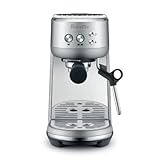
Breville Bambino
Best for: Budget-conscious beginners who want real espresso without the Plus markup
Same 3-second ThermoJet heat-up and 54mm portafilter as the Plus, minus auto-frothing — $150 saved
- +3-second heat-up — same ThermoJet system as the Bambino Plus
- +54mm portafilter with both pressurized and non-pressurized baskets
- +Compact footprint fits small kitchens
- +$150 cheaper than the Plus — spend the savings on a grinder
- −No automatic milk frothing — manual steam wand only
- −Portafilter and tamper feel lightweight and plastic
- −No on/off switch — always drawing standby power
- −No solenoid valve — water pools on puck after shot (cosmetic, not functional)
✓ Free shipping with Prime · Affiliate link
Why We Recommend It
The Bambino is the same machine as the Plus — same ThermoJet heater, same 54mm portafilter, same pre-infusion system — minus the automatic milk frothing. That $150 difference is significant for a beginner because it’s exactly what a decent entry-level grinder costs. If you’re choosing between a $400 machine with no grinder and a $250 machine with a $150 grinder, experienced home baristas on Reddit consistently recommend the second option.
Key Features
- Same 3-second ThermoJet heat-up as the Plus
- 54mm portafilter with pressurized and non-pressurized baskets
- Manual steam wand (smaller than the Plus, but functional)
- Smaller water tank (47 oz vs. 64 oz)
- Even more compact than the Plus
Who It’s Best For
Budget-conscious beginners who prioritize espresso quality over milk convenience. The ideal pairing: Bambino ($250) plus a Baratza Encore ESP or 1Zpresso JX-Pro ($100–$170) — total setup under $420 with a genuinely capable grinder.
Potential Downsides
The portafilter and included tamper feel lightweight and plastic — owners on Reddit note the lack of heft compared to higher-end machines. There’s no on/off switch, so the machine draws standby power continuously. And because there’s no solenoid valve, water pools on the puck after pulling a shot — this is cosmetic, not a quality issue, but it surprises first-time owners. The manual steam wand is smaller than the Barista Express’s wand, which makes milk texturing harder for complete beginners.
Affiliate link

Breville Barista Express
Best for: Home baristas who want an all-in-one machine that delivers solid espresso without a separate grinder
you want one appliance, one workflow, and solid espresso without researching a separate grinder.
you already expect to chase shot quality or upgrade components independently.
Integrated conical burr grinder with dose control — beans to espresso in under a minute
- +27,000+ reviews at 4.5 stars — the most-proven espresso machine on Amazon
- +Integrated burr grinder eliminates the need for a separate grinder
- +PID temperature control for consistent extraction
- +Low-pressure pre-infusion for balanced flavor
- −Integrated grinder is the ceiling — enthusiasts outgrow it within 1-2 years
- −54mm portafilter limits aftermarket accessory options vs 58mm standard
- −Thermocoil heating is slower than ThermoJet models (Barista Pro, Touch)
✓ Free shipping with Prime · Affiliate link
Evidence notes
Community signal: Most proven integrated-grinder machine by owner volume, but the community census shows negative net sentiment because enthusiasts outgrow it.
Main tradeoff: The built-in grinder and 54mm portafilter become the upgrade ceiling.
Evidence note: The built-in-grinder article uses census sentiment, upgrade-path forum stories, and 27,000+ Amazon reviews.
Why We Recommend It
The Barista Express is the only machine in this lineup with a built-in conical burr grinder — and that matters more than any other single feature. The most common beginner mistake, repeated across hundreds of Reddit threads, is buying a $300–$500 machine, using pre-ground coffee, and quitting within three months because the shots taste bad. The Barista Express eliminates this mistake entirely by building the grinder into the machine.
Multiple owners on r/espresso describe the Barista Express as the machine that “introduced me to the beautiful world of espresso” — then upgraded to a La Marzocco or Profitec years later. That upgrade path is a feature, not a bug: the BBE teaches you enough to know what you actually want in a machine, and most people use it happily for 3–5 years before moving on.
Key Features
- Built-in conical burr grinder with dose-control
- PID temperature control for consistent extraction
- Manual steam wand with good reach and power
- 54mm portafilter with low-pressure pre-infusion
- Integrated tamper
Who It’s Best For
Beginners who want an all-in-one setup without buying a separate grinder. Especially good for people who care about learning latte art — the manual steam wand is significantly better than the Bambino Plus’s auto-frother.
Potential Downsides
At $550, it’s the most expensive Breville in this roundup — and the built-in grinder, while adequate, is the weakest link. Experienced home baristas on Reddit debate whether the grinder is “good enough” or a limiting factor once your palate develops. If you already own or plan to buy a dedicated grinder, the Bambino Plus does the same espresso work for $150 less. The machine is also significantly larger than the Bambino series — it needs real counter space. Considering the Barista Pro instead? Our Express vs Pro comparison covers the ThermoJet upgrade and whether the $300 premium is worth it.
Affiliate link

Gaggia Classic Evo Pro
Best for: Home baristas who want a mod-friendly machine that lasts decades
Commercial-spec 58mm portafilter with massive mod ecosystem (PID, OPV spring, Gaggiuino)
- +58mm commercial portafilter — same as cafe machines
- +Legendary mod ecosystem (PID, OPV, Gaggiuino)
- +Stainless steel boiler built to last 20+ years
- +Active community support on r/gaggiaclassic
- −No PID out of the box — temperature swings until modded
- −Stock Panarello steam wand is poor for latte art
- −Earlier Evo batches had boiler coating issues (resolved in newer units)
✓ Free shipping with Prime · Affiliate link
Why We Recommend It
The Gaggia Classic Evo Pro is the machine you buy if you want to learn espresso as a hands-on craft. Unlike the Breville lineup, which optimizes for convenience, the Gaggia rewards curiosity. It has a commercial-style 58mm portafilter (the same size used in most coffee shops), a powerful steam wand, and a community of modders who have documented every possible upgrade.
But we need to be honest: a dedicated thread on r/espresso with 136 upvotes argues that “recommending the Gaggia Classic Pro to beginners is often bad advice” — because out of the box, it needs modifications to reach its potential. The most common mod is a PID temperature controller ($100–$150) for consistent brew temperature. Without it, you’re “temperature surfing” — a technique that adds complexity most beginners don’t want.
Key Features
- Commercial-style 58mm portafilter — no ecosystem lock-in
- Powerful steam wand for genuine milk texturing
- Solenoid valve for clean puck ejection
- Active modding community (Gaggiuino project for full PID + flow control)
- 20+ year production history — proven platform
Who It’s Best For
Tinkerers and DIY-minded beginners who enjoy the process of learning through modification. If you read r/espresso and think “I want to understand exactly how extraction works,” the Gaggia is your machine. One owner on Reddit spent 3 months convinced they were terrible at espresso before discovering the machine needed mods — then fell in love with it.
Potential Downsides
Out of the box, temperature consistency is poor. Budget an additional $100–$150 for a PID mod if you want repeatable results without temperature surfing. The stock steam wand tip can be finicky (many owners upgrade it for $10–$15). And unlike the Bambino series, there’s no pre-infusion — you’re managing extraction purely through grind size and dose. This is the most rewarding machine in the lineup if you put in the work, but it asks the most of you on day one.
Affiliate link

De'Longhi Stilosa EC260
Best for: First-time espresso buyers who want to try the hobby without a big investment
Under $100 with a real 15-bar pump and manual steam wand — lowest entry point for genuine espresso
- +Under $100 — lowest price in this roundup by far
- +15-bar pump produces real espresso crema
- +Manual steam wand for milk frothing
- +13,000+ Amazon reviews — battle-tested and well-documented
- −No PID — temperature consistency is basic
- −Pressurized portafilter only — limits shot quality ceiling
- −Build quality reflects the price — plastic-heavy construction
- −Small boiler means long wait between shots and steaming
✓ Free shipping with Prime · Affiliate link
Why We Recommend It
The Stilosa exists for one purpose: letting you find out if you actually enjoy making espresso at home before spending real money. At under $150, it’s cheap enough that walking away from espresso costs you a nice dinner, not a mortgage payment. The 15-bar pump pulls acceptable shots through the pressurized basket, and the manual steam wand — while basic — can froth milk for simple lattes.
Key Features
- 15-bar pump with pressurized portafilter
- Manual steam wand for basic milk frothing
- Simple two-button operation (espresso + steam)
- Compact and lightweight
- Under $150 — lowest barrier to entry
Who It’s Best For
Complete beginners on a tight budget who want to try espresso at home before committing to the hobby. Also a reasonable choice if you drink espresso only occasionally — once or twice a week rather than daily.
Potential Downsides
The Stilosa is a pressurized-basket-only machine, which means it masks grind inconsistencies rather than rewarding good technique. You won’t learn much about espresso extraction from using it. One owner on r/espresso upgraded from the Stilosa to a Bambino Plus specifically because the Stilosa “wasn’t producing satisfactory espresso” once their palate developed. The steam wand is underpowered — expect foam, not microfoam. If you know you’re serious about espresso, skip the Stilosa and start with a Bambino — the learning curve is barely steeper and the ceiling is dramatically higher.
Affiliate link
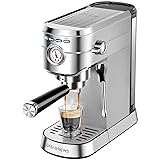
CASABREWS CM5418
Best for: Value-conscious buyers who want built-in pressure feedback to improve their technique
Built-in pressure gauge shows real-time extraction pressure — a feature usually found on machines 3x the price
- +Built-in pressure gauge for extraction feedback
- +20-bar pump with pre-infusion capability
- +Highest rating in this roundup at 4.4 stars across 7,600+ reviews
- +Stainless steel exterior with compact footprint
- −Must wait for machine to cool between steaming and brewing — no simultaneous operation
- −Amazon-native brand with limited long-term track record vs De'Longhi or Breville
- −34 oz water tank is smaller than competitors
- −Pressurized baskets only — non-pressurized requires aftermarket sourcing
✓ Free shipping with Prime · Affiliate link
Why We Recommend It
The Casabrews CM5418 is the budget surprise on this list. At $140, it competes directly with the Stilosa but adds a built-in pressure gauge — a feature you normally don’t see below $400. The pressure gauge lets beginners actually see what’s happening during extraction, which makes the learning process tangible rather than abstract.
Key Features
- 20-bar pump with built-in pressure gauge
- Manual steam wand
- Compact stainless steel body
- 34 oz removable water tank
- Single and double shot filters included
Who It’s Best For
Budget-conscious beginners who want visual feedback during extraction. The pressure gauge is a genuine learning tool that the Stilosa lacks. If counter space is your primary concern, see our compact espresso machine roundup for the slimmest options ranked by footprint.
Potential Downsides
The Casabrews has essentially zero presence on Reddit or Home-Barista forums — it’s an Amazon marketplace product that experienced home baristas haven’t adopted. We can’t verify long-term durability claims the way we can for Breville or Gaggia, which have decades of community data. The “20 bar” marketing is misleading — espresso extracts at 9 bar, and the pump’s maximum pressure isn’t a quality indicator. If you’re choosing between this and the Stilosa, the Casabrews edges ahead on the pressure gauge; if you can stretch to $250 for the Bambino, the jump in quality is significant.
Affiliate link

Ninja Luxe Café Premier
Best for: Buyers who want espresso, drip coffee, and cold brew from a single machine
your household wants espresso, drip, and cold brew from one machine at the lowest price in this lineup.
you only care about espresso quality or want a mature reliability record.
3-in-1 system (espresso + drip + rapid cold brew) with weight-based dosing and hands-free frothing
- +Three machines in one — espresso, drip coffee, and rapid cold brew
- +Weight-based dosing with built-in scale — more precise than time-based grinding
- +Hands-free Dual Froth System steams and whisks simultaneously
- +Barista Assist Technology provides guided grind and brew adjustments
- −Jack-of-all-trades — espresso quality won't match a dedicated espresso machine at the same price
- −Newer product (2024) — long-term reliability unproven
- −Large footprint for a kitchen counter
- −25 grind settings — fewer than the 30 on Breville Pro
✓ Free shipping with Prime · Affiliate link
Evidence notes
Community signal: Polarizing: owners value the 3-in-1 convenience, while espresso-focused threads flag early reliability and grinder-consistency concerns.
Main tradeoff: Newer 2024 product with thinner long-term durability evidence than the Breville machines.
Evidence note: The article cites r/NinjaLuxeCafe owner discussion, one-week failure reports, and the machine's unique 3-in-1 feature set.
Why We Recommend It
The Ninja Luxe Cafe is the most automated machine in this lineup — it has a built-in grinder, an assisted tamper, an auto-frother, and can also brew drip coffee and cold brew. For someone who wants every possible beginner friction point removed, nothing else comes close. The assisted tamper helps eliminate one of the most common sources of channeling for new users.
Key Features
- Built-in conical burr grinder with 25 settings
- Assisted tamping system — helps ensure consistent pressure
- Automatic milk frothing with temperature control
- 3-in-1: espresso, drip coffee, and rapid cold brew
- Hands-free workflow from beans to cup
Who It’s Best For
Beginners who want the absolute lowest learning curve and don’t mind paying for automation. Households where multiple people will use the machine — the automated workflow means anyone can make espresso without training.
Potential Downsides
At $597, you’re paying more than a Bambino Plus ($400) and a dedicated grinder ($150) combined — and the dedicated setup will likely produce better espresso. The Ninja is polarizing among espresso enthusiasts on Reddit: the automation is genuinely beginner-friendly, but it removes the hands-on learning that makes home espresso a satisfying hobby for most people. If you want to eventually pull shots that rival your local café, the Ninja’s automation becomes a ceiling rather than a feature. The 3-in-1 design also means compromises — it does espresso, drip, and cold brew adequately rather than any one thing exceptionally. Consider this machine if convenience is your top priority; skip it if you want to develop barista skills.
Affiliate link
Buyer’s Guide
The grinder is more important than the machine
This is the single most repeated piece of advice on r/espresso, and it’s genuinely true. A $250 Bambino paired with a capable burr grinder will produce better espresso than a $600 machine fed pre-ground coffee. The machine provides water at the right temperature and pressure, but the grind determines what actually gets extracted from the coffee. Experienced home baristas on Reddit consistently rank equipment importance as: (1) beans, (2) grinder, (3) puck prep, (4) water quality, (5) the espresso machine itself.
If your total budget is $300, don’t spend it all on the machine. Spend $150 on a Stilosa or Casabrews, and the other $150 on a grinder like the Baratza Encore ESP or a hand grinder like the 1Zpresso JX-Pro. You’ll get dramatically better results than a $300 machine with pre-ground coffee. Check our coffee grinder roundup for specific recommendations at every budget. Our grinder vs machine guide makes the full case for prioritizing grind quality.
The only exception is the Barista Express, which includes a built-in grinder — it’s the one machine in this lineup where you can skip the separate grinder purchase and still get respectable results from day one.
Pressurized vs. unpressurized baskets — and when to graduate
Most beginner machines ship with both pressurized and unpressurized (or “single-wall”) baskets. The pressurized basket has a small hole at the bottom that builds artificial pressure — it forgives bad grinds and produces a crema-like foam regardless of technique. The unpressurized basket lets water flow through the coffee naturally, which means your grind quality, dose, and distribution actually matter.
Start with the pressurized basket. Make espresso for a week, get comfortable with the workflow, and stop worrying about perfection. Then switch to the unpressurized basket and pair it with a real burr grinder. The difference in shot quality will be immediately obvious — and that’s when home espresso gets genuinely rewarding.
Your first week will be messy — and that’s normal
One beginner on r/espresso described their first session: “30 minutes and a huge mess later, 2 shots are finally pulled… half of the grounds spilled out.” The top comment, with 179 upvotes: “Don’t worry, it gets harder and more expensive.”
That’s the honest truth about home espresso. Your first shots will likely taste sour (underextracted) or bitter (overextracted), and telling the difference takes practice. You’ll spill grounds, make a mess of milk frothing, and wonder why the shots look nothing like the YouTube tutorials. This is completely normal. Most beginners hit a stride around week 2–3, and by month 2, you’ll be pulling shots that make café espresso taste disappointing. The learning curve is real, but it’s also the whole point — the satisfaction of pulling a great shot is what separates home espresso from pressing a button on a pod machine.
When to consider a super-automatic instead
If everything in the previous section sounds exhausting rather than exciting, a super-automatic espresso machine might be the better fit. Super-automatics grind, tamp, extract, and froth milk at the push of a button — no technique required. The trade-off is shot quality (a semi-automatic with good technique will always beat a super-automatic) and repairability (super-automatics have more moving parts and higher servicing costs). But if you want good-enough espresso with zero learning curve, a De’Longhi Magnifica Evo or Philips 3200 LatteGo will deliver that without the mess.
The mod question — some machines reward tinkering, others don’t
The Breville machines in this lineup (Bambino, Bambino Plus, Barista Express) are designed to work well out of the box. They don’t need modifications, and the modding community is relatively small. What you buy is what you get — and for most beginners, that’s exactly right.
The Gaggia Classic Evo Pro is the opposite. Out of the box, it’s good. With a PID mod, it’s significantly better. With the Gaggiuino open-source project (full PID + flow control + pressure profiling), it transforms into a machine that rivals products costing 3–4× more. If “I want to understand how this works and make it better” excites you, the Gaggia is the right starting point. If it sounds like homework, get the Bambino Plus.
Budget breakdown — what you’ll actually spend
| Setup level | Machine | Grinder | Accessories | Total | Shot quality |
|---|---|---|---|---|---|
| Entry | Stilosa or Casabrews ($140–$148) | Baratza Encore ESP ($150) | Scale + tamper ($30) | ~$320–$330 | Acceptable |
| Recommended | Bambino ($250) | 1Zpresso JX-Pro ($170) | Scale + WDT + tamper ($50) | ~$470 | Good |
| All-in-one | Barista Express ($550) | Included | Scale ($20) | ~$570 | Good |
| Premium beginner | Bambino Plus ($400) | Eureka Mignon ($250–$350) | Full kit ($70) | ~$720–$820 | Very good |
“WDT” in the table above is a Weiss Distribution Technique tool — a set of fine needles you spin through the grounds to break up clumps before tamping. It costs $10–$15 and makes a noticeable difference in shot consistency, especially with cheaper grinders.
Fresh beans and water quality matter more than you think
Two things that new espresso owners consistently overlook: beans and water.
Beans: Pre-ground coffee starts going stale within minutes of grinding. Whole beans stay fresh for 2–4 weeks after roasting. If you buy a good grinder and then feed it supermarket beans that were roasted six months ago, the grinder can’t save you. Buy from a local roaster or a reputable online roaster, and use the beans within a month of the roast date.
Water: Tap water varies dramatically by region. Very hard water (above 250 ppm TDS) leaves mineral deposits in your machine and produces harsh, chalky espresso. Very soft water (below 50 ppm) produces flat, lifeless shots. If your tap water tastes good to drink, it’s probably fine for espresso. If it doesn’t, use filtered water — a simple carbon filter pitcher is enough for most machines.
The industry-standard brewing temperature for espresso is 195–205°F (90–96°C) — all machines in this lineup meet that range. The National Coffee Association’s brewing guide emphasizes that good brewing goes beyond the machine: water quality, grind consistency, and technique are where the real differences show up.
Where to go from here
Once you know your budget and how hands-on you want to be, these roundups narrow the field further:
- Fixed budget? Our under $200, under $500, and under $1,000 roundups compare machines within strict price tiers.
- Want to go fully manual? Our manual espresso machine roundup covers lever machines and portables — more hands-on than anything on this page, but with a higher quality ceiling.
- Want the full picture? Our best espresso machine mega-roundup compares 7 machines across all price points without the beginner filter.