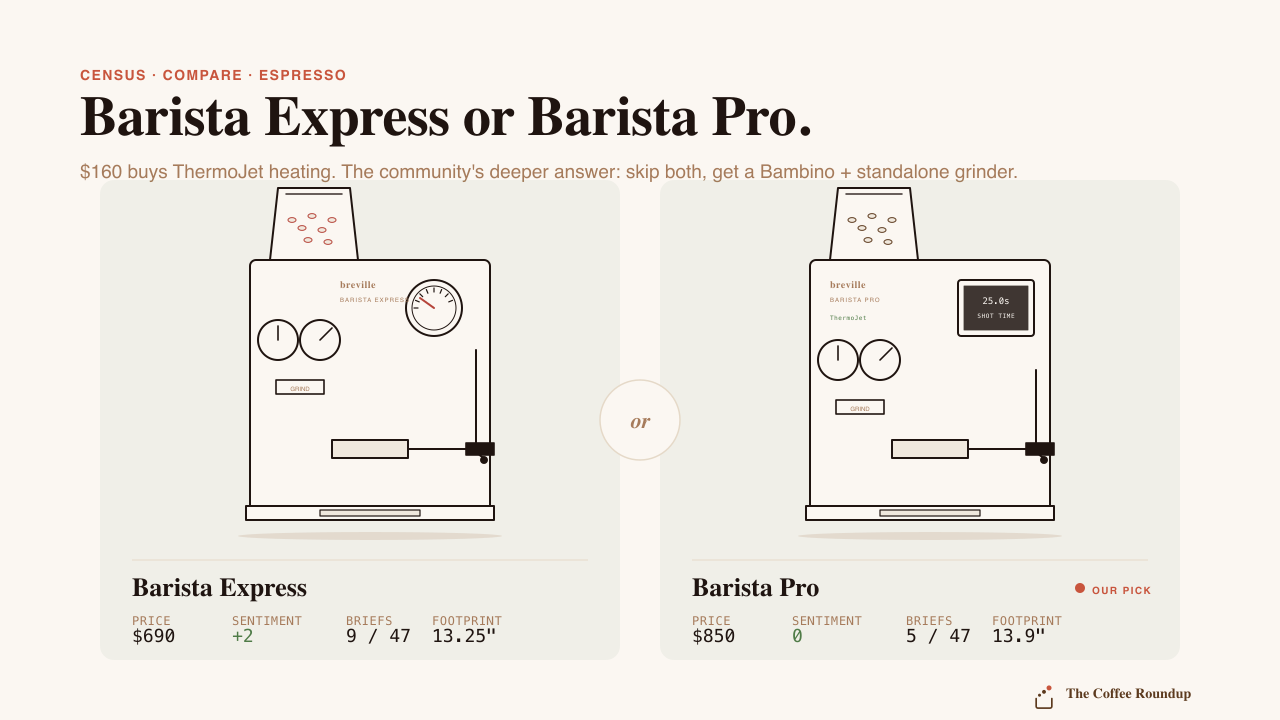
The Breville Barista Express (BES870) and Barista Pro (BES878) are both all-in-one espresso machines with built-in grinders — and they share Breville’s 54mm platform, the same 15-bar Italian pump, and the same 67 oz water tank. The differences that matter are under the hood: the Express uses a Thermocoil heater with PID (~30 seconds to reach temperature), while the Pro uses Breville’s ThermoJet system (3 seconds). That one change ripples through your morning workflow, your milk-drink timing, and your electricity bill. Both machines target the same extraction fundamentals — the National Coffee Association recommends 20-30 seconds of contact time at a 1:2 coffee-to-espresso ratio, and both the Express and Pro deliver that.
At current Amazon pricing, the gap is roughly $300 — the Express at ~$550, the Pro at ~$850. “Pro is newer” does not automatically mean “Pro is better.” For a solo drinker who doesn’t mind 30 seconds of warm-up, the Express is genuinely the better value. The Pro earns its premium for specific use patterns we’ll lay out below.
Side-by-Side Specs
| Spec | Breville Barista Express | Breville Barista Pro |
|---|---|---|
| Heat-up Time | ~30 seconds (Thermocoil) | 3 seconds (ThermoJet) |
| Steam Wand | Manual | Manual |
| Portafilter | 54mm | 54mm |
| Dose Range | 18g, auto-grind (16 settings) | Auto-grind with dose control (30 settings) |
| Display | Analog pressure gauge | LCD display |
| Pump Pressure | 15 bar | 15 bar |
| Heating | Thermocoil with PID | ThermoJet |
| Grinder | Integrated conical burr, dose control | Integrated conical burr, 30 settings |
| Water Tank | 67 oz / 2.0L | 67 oz / 2.0L |
| Dimensions | 13.25 x 12.5 x 15.75 in | 13.9 x 12.5 x 15.5 in |
| Weight | 23 lbs | 22.2 lbs |
| Latest price |
View price →
Affiliate link |
View price →
Affiliate link |
Five specs differ meaningfully: heating system, heat-up time, grinder settings, dose control, and display type. The rest — portafilter size, pump pressure, water tank, steam wand type — are identical. Both machines are built on the same 54mm platform, and both lock you into Breville’s proprietary accessory ecosystem.
When the Express Is the Better Buy

Breville Barista Express
Best for: Home baristas who want an all-in-one machine that delivers solid espresso without a separate grinder
you want one appliance, one workflow, and solid espresso without researching a separate grinder.
you already expect to chase shot quality or upgrade components independently.
Integrated conical burr grinder with dose control — beans to espresso in under a minute
- +27,000+ reviews at 4.5 stars — the most-proven espresso machine on Amazon
- +Integrated burr grinder eliminates the need for a separate grinder
- +PID temperature control for consistent extraction
- +Low-pressure pre-infusion for balanced flavor
- −Integrated grinder is the ceiling — enthusiasts outgrow it within 1-2 years
- −54mm portafilter limits aftermarket accessory options vs 58mm standard
- −Thermocoil heating is slower than ThermoJet models (Barista Pro, Touch)
✓ Free shipping with Prime · Affiliate link
Evidence notes
Community signal: Most proven integrated-grinder machine by owner volume, but the community census shows negative net sentiment because enthusiasts outgrow it.
Main tradeoff: The built-in grinder and 54mm portafilter become the upgrade ceiling.
Evidence note: The built-in-grinder article uses census sentiment, upgrade-path forum stories, and 27,000+ Amazon reviews.
If you want one purchase that covers everything and 30 seconds of warm-up doesn’t bother you, the Express saves $300.
The Barista Express is the most popular espresso machine on Amazon — 27,000+ reviews at 4.5 stars — for a reason. Built-in conical burr grinder, PID temperature control, low-pressure pre-infusion, and dose control. Beans to espresso in under a minute without buying a single accessory. On r/espresso, one long-term owner bought a Barista Express for $500, used it for six years, then sold it for $500. Six years of espresso, effectively free.
Where the Express genuinely wins:
- The analog pressure gauge. Beginners learning puck prep get immediate, visible feedback on extraction pressure. The gauge tells you in real time whether your tamp and grind are in the right range — no menu-diving required. Experienced users tend to ignore it, but for your first 100 shots, it accelerates learning.
- PID temperature control. The Express’s Thermocoil includes PID regulation, which Breville describes as delivering “water at exactly 200°F.” The Pro’s ThermoJet heats faster but doesn’t advertise tighter temperature control — both systems are adequate for home espresso, but the PID gives the Express’s slower system a consistency advantage on consecutive shots at the same temperature.
- Proven longevity. Multiple owners on r/espresso report 5, 8, and even 10+ years of daily use. One user described running the machine for 10.5 years before decommissioning it — and only then because of a noisy solenoid and a broken water spout, not the brewing components. The Pro hasn’t been on the market long enough to match this track record, though 3-5 year reports are positive.
- $300 saved. That’s roughly the cost of a standalone burr grinder like the Baratza Encore ($150) or a year’s worth of specialty beans.
The honest downside: 16 grind settings are too few for fine-tuning. Owners frequently need to adjust the internal burr position — a maintenance-level operation — to find the right grind between numbered positions. After 3-5 years of heavy use, the burrs can drift and lose precision at the finest settings. The grinder is the Express’s ceiling, and it’s the most common reason owners eventually upgrade.
Affiliate link
When the Pro Is the Better Buy

Breville Barista Pro
Best for: The all-rounder buyer who wants fast heat-up and precise control without paying for a touchscreen
you want the best daily-driver version of the integrated Breville workflow without touchscreen automation.
the same budget could buy a Bambino Plus and standalone grinder with more upgrade flexibility.
ThermoJet 3-second heat-up with LCD display for precise shot control
- +ThermoJet heats in 3 seconds — fastest warm-up in the Breville lineup
- +LCD display for grind size, shot time, and temperature feedback
- +Integrated grinder with 30 grind settings
- +Instant transition from espresso to steam — no wait between brew and milk
- −Same integrated grinder ceiling as Express — enthusiasts will outgrow it
- −54mm portafilter limits aftermarket basket options
- −Manual steam wand requires practice for latte art
✓ Free shipping with Prime · Affiliate link
Evidence notes
Community signal: Forum upgrade stories frame the Pro as a faster Barista workflow, not a different long-term upgrade path.
Main tradeoff: The premium buys speed and interface, not a fundamentally better grinder.
Evidence note: The article anchors this pick on ThermoJet workflow value and negative-but-less-severe census sentiment than the Express.
If your morning demands espresso in 60 seconds flat, or you make back-to-back drinks for two, the ThermoJet heat-up is not a luxury — it’s a workflow requirement.
The Barista Pro’s ThermoJet heating system reaches extraction temperature in 3 seconds. That’s not marketing rounding — owners consistently confirm it’s near-instant. For someone who stumbles to the kitchen, presses the power button, and expects a shot before their brain turns on, the Express’s 30-second wait feels like an eternity. The Pro also switches between brew and steam temperatures significantly faster, which means less dead time between pulling a shot and steaming milk.
Where the Pro genuinely wins:
- 3-second heat-up (ThermoJet). The single biggest quality-of-life improvement over the Express. Multiple r/espresso threads identify heat-up time as the #1 reason people resist upgrading to prosumer machines with 10-25 minute warm-up cycles. ThermoJet gives you prosumer-level shot quality with pod-machine convenience.
- 30 grind settings vs. 16. Nearly double the adjustability. Newer Pro models ship with Baratza European Precision Burrs, which owners note produce lower retention and more consistent particle size than earlier versions. If you’re dialing in single-origin light roasts, 30 settings makes a real difference.
- LCD display. Shows grind size, shot time, and temperature in real time. The Express’s analog gauge gives pressure feedback; the Pro’s LCD gives everything else. For systematic dialing-in — adjusting one variable at a time and tracking the result — the LCD is the better tool.
- Faster brew-to-steam transition. ThermoJet switches between brew and steam temperatures almost instantly. On the Express, owners report waiting roughly 15-30 seconds. For a single latte, that’s negligible. For two lattes back-to-back, the cumulative wait adds up.
- Breville’s warranty support. Multiple owners on r/espresso report Breville honoring the warranty at 25-26 months — past the official 2-year period. The Pro’s younger track record means warranty service is more relevant than the Express’s “it’ll run for a decade” reputation.
The honest downside: At $850, you’re paying a $300 premium over the Express primarily for faster heating, more grind settings, and an LCD. The brewing components share the same fundamental architecture — same 15-bar pump, same 54mm portafilter, same extraction pressure. On r/espresso, Express-to-Pro upgrades are surprisingly rare. Most Express owners who upgrade skip the Pro entirely and jump to prosumer machines (Profitec Go, Lelit Bianca, ECM Synchronika) paired with standalone grinders. The Pro is excellent at what it does, but at $850, the money might serve you better in a different direction — which brings us to the third option.
Affiliate link
The Third Option Neither Buyer Should Ignore

Breville Bambino Plus
Best for: Beginners who want great espresso with minimal learning curve
3-second heat-up with automatic milk frothing — closest to cafe-quality with zero barista skills
- +3-second heat-up — fastest in this price range
- +Automatic milk frothing produces decent microfoam
- +Compact footprint fits small kitchens
- +54mm portafilter with pressurized and non-pressurized baskets
- −Reliability concerns — some owners report failures within 12–18 months
- −Struggles with lighter roasts without temperature surfing
- −Thermoblock heating less durable long-term than traditional boilers
- −Amazon pricing fluctuates — check current price before buying
✓ Free shipping with Prime · Affiliate link
If you already own a separate grinder — or plan to buy one — the Breville Bambino Plus at ~$400 produces espresso of comparable quality with the same ThermoJet heat-up, and saves you $150-450.
The Bambino Plus uses the same ThermoJet heating system as the Pro (3-second heat-up, fast brew-to-steam transition) but drops the integrated grinder. At ~$400 for the machine plus $150-170 for a quality burr grinder like the Baratza Encore ESP, the total is $550-570 — comparable to the Express and $280-300 less than the Pro.
This is the path the r/espresso community recommends most often. The reasoning is simple: “The grinder is more important than the machine.” A $200 standalone grinder outperforms the built-in grinders on both the Express and Pro. Multiple long-term owners of both machines echo the same sentiment: “If I did it all over, I would have gotten the Bambino and a different brand grinder.”
Why it works:
- Same ThermoJet as the Pro — 3-second heat-up, fast steam transition
- Automatic milk frothing option (the Express and Pro are manual-only)
- Compact footprint for smaller kitchens
- $550-570 total with a standalone grinder that outperforms either built-in option
- The grinder doesn’t become obsolete when you upgrade machines later
Why it might not work for you:
- The Bambino feels lighter and less substantial than the Express or Pro — some owners find the portafilter attachment fiddly and the drip tray too small
- No built-in grinder means two appliances on the counter instead of one
- One detailed owner comparison on r/espresso reported returning the Bambino Plus within a month due to vibration, portafilter issues, and inconsistent steaming — the Express and Pro are more solidly built
- Thermal stability is less consistent than the Express or Pro for back-to-back shots
- If you don’t already own a grinder and don’t want to research one, the Express’s all-in-one simplicity is hard to beat
For a deeper look at the Bambino Plus and how it compares to other beginner options, see our best espresso machine for beginners roundup.
Affiliate link
Buyer’s Guide: Which Machine Fits Your Routine?
Solo morning espresso vs. multi-drink household
This is the primary decision axis. The Express’s 30-second warm-up is a non-issue if you’re making one drink while grinding beans — you’ll barely notice it. For two people making back-to-back lattes, or weekend entertaining where you’re pulling 4-5 shots in a row, the Pro’s ThermoJet pays for itself in saved time and more consistent steam recovery.
That said, the forum consensus adds nuance: ThermoJet’s advantage diminishes with multiple drinks. Neither thermoblock system matches a dual-boiler machine for back-to-back shot consistency. One experienced owner summarized it well: “Heat-up is insanely fast but stability and variability if you make a few drinks is mediocre to bad.” If you’re regularly making 3+ drinks per session, neither the Express nor the Pro is the ideal machine — consider the Breville Dual Boiler or a prosumer E61 machine instead.
Are you upgrading the grinder eventually?
The community consensus is that the built-in grinder on both machines is the performance ceiling. The Specialty Coffee Association’s standards emphasize grind consistency as a primary variable in extraction quality — and both built-in grinders work well with medium-dark and darker roasts but struggle with the precision that lighter roasts demand. For light-roast single-origin beans that require fine-tuned grinding, both built-in grinders will frustrate you within months. For beans that work well within the built-in grinder’s sweet spot, see our best espresso beans for Breville guide.
That said, the current-production Pro ships with Baratza European Precision Burrs that may have partially closed the gap with entry-level standalone grinders — owners of newer units report noticeably lower retention. If you plan to add a standalone grinder within the first year, the Pro’s grinder advantage becomes irrelevant — you won’t be using it. In that scenario, the Express at $550 (or the Bambino Plus at $400 + $150 standalone grinder) makes more financial sense than paying $850 for a better built-in grinder you’ll replace anyway.
Longevity and the upgrade path from here
Express owners report 5-10+ years of reliable daily use before the grinder begins degrading. The Pro is newer, but 3-5 year reports are consistently positive, and Breville’s warranty support — often honored past the official 2-year period — provides extra coverage.
Here’s what the community data actually shows about upgrade paths: almost nobody upgrades from an Express to a Pro. Express owners who outgrow their machine typically skip the Pro and jump directly to prosumer machines — a Profitec Go, Lelit Bianca, or ECM Synchronika (typically $1,400-$2,500) — paired with a standalone grinder. The same is true of Pro owners. Both machines are entry points to the Breville ecosystem, not stepping stones to each other. For a broader comparison of all semi-auto machines with integrated grinders — including non-Breville options — see our best espresso machine with built-in grinder roundup.
What daily ownership looks like
Both machines ship with pressurized and non-pressurized filter baskets. If you’re new to espresso, you’ll start with the pressurized basket — it’s more forgiving of grind inconsistency and requires less precise puck prep. Both machines perform comparably with pressurized baskets; the grinder and heat-up differences matter more once you graduate to the non-pressurized basket and start dialing in extraction.
The daily routine differs primarily at power-on and during milk drinks. On the Express, you press the power button and wait roughly 30 seconds — enough time to weigh and grind beans. On the Pro, you press and pull within seconds. After pulling a shot, the Express requires a 15-30 second wait to transition from brew to steam temperature; the Pro transitions almost instantly. On both machines, steam for a single latte takes 30-45 seconds. For a solo latte, the total workflow difference is roughly one minute. For two lattes back-to-back, the gap widens to 2-3 minutes.
Both machines require regular maintenance: backflushing with a cleaning disc (weekly), descaling every 2-3 months depending on water hardness, and grinder cleaning every 2-4 weeks. The routines are identical — same process, same Breville cleaning products. The Bambino Plus, by comparison, enforces cleaning cycles with a lockout that some owners find intrusive.
The $300 question
At $550 vs. $850, you’re paying a 55% premium for the Pro. Here’s what that $300 buys:
- 3-second heat-up instead of 30 seconds
- 30 grind settings instead of 16
- LCD display instead of an analog gauge
- Faster brew-to-steam transitions
And here’s what it doesn’t change:
- Same 54mm portafilter and accessory ecosystem
- Same 15-bar pump and extraction pressure
- Same water tank capacity
- Same manual steam wand
- Same fundamental grinder ceiling (both will be outgrown by serious hobbyists)
If the heat-up time and grind precision matter to your daily routine, the $300 is well spent. If they don’t, the Express does the same job for $300 less — and the $300 saved buys a standalone grinder that elevates either machine beyond what either built-in grinder can do. For where the Express and Pro fit in the full Breville lineup — including the Bambino, Touch, and Touch Impress — see our best Breville espresso machine guide.