The Breville Bambino Plus is the best Breville espresso machine for most people — it heats in 3 seconds, froths milk automatically, and leaves room in your budget for a standalone grinder that will outclass anything Breville builds into their all-in-one machines. If you want everything in one box and don’t mind the grinder trade-off, the Barista Express remains the most popular integrated machine on Amazon with over 27,000 reviews.
Breville dominates home espresso for a reason: every machine in their lineup shares a 54mm portafilter, 15-bar pump pressure, and a build quality that punches above its price point. But the lineup splits into two distinct philosophies — machines without an integrated grinder (the Bambino line) and machines with one (the Barista line) — and choosing the wrong philosophy for your trajectory is the most expensive mistake you can make. We also included Breville’s best drip brewer and their most popular grinder, because brand-loyal buyers often build an all-Breville station.
For a deeper dive into how Breville machines compare to competitors like Gaggia and Rancilio, see our best espresso machine roundup. If you’re specifically choosing between the Express and the Pro, we published a detailed Barista Express vs Barista Pro comparison.
The Breville Lineup: Two Philosophies, Not Just Two Price Points
Every conversation about Breville espresso machines on Reddit’s r/espresso eventually arrives at the same fork: Bambino or Barista?
The Bambino line (Bambino and Bambino Plus) skips the integrated grinder entirely. You supply your own grinder, which means you can upgrade the single most important variable in espresso quality independently. According to a community survey of over 4,000 r/espresso setup flairs, the Bambino is the most popular espresso machine on the subreddit — and the median total setup cost is $2,800, suggesting Bambino owners invest heavily in grinders and accessories instead of the machine itself.
The Barista line (Express, Pro, Touch, Touch Impress) integrates a conical burr grinder into the machine. It’s the lowest-friction path to espresso — beans to cup in under a minute with no separate equipment. But it comes with a ceiling. Across our Coffee Community Census of 47 forum-research briefs, the Barista line draws deeply ambivalent sentiment — a higher share of mixed and neutral labels than the rest of the most-discussed products: owners praise the convenience but warn that the integrated grinder becomes the bottleneck within 12–24 months as your palate develops.
One notable absence: the Breville Dual Boiler ($1,500+) is the one Breville that bridges these philosophies — a dual-boiler machine without an integrated grinder, competing directly with prosumer Italian machines while staying in the Breville ecosystem. We excluded it from this roundup because it targets a different buyer (prosumer, not home-barista upgrader) at a price point that puts it in Profitec and Lelit territory. But its existence matters: the upgrade path from Barista machines doesn’t always go outside Breville — it just usually does at the price points most buyers are shopping.
This isn’t about one line being “better.” It’s about matching the right philosophy to your trajectory. If you’re building a setup you’ll grow into over years, the Bambino philosophy wins. If you want one machine, one purchase, minimal counter space, and good-enough espresso tomorrow, the Barista philosophy is a legitimate choice — just know the ceiling exists. For a cross-brand comparison of every semi-auto with an integrated grinder (including the De’Longhi La Specialista Arte and Ninja Luxe Cafe), see our best espresso machine with built-in grinder roundup.
How We Evaluated
We compared every current Breville espresso machine across five criteria, weighted toward what brand-loyal buyers actually care about:
- Espresso quality relative to price — Does the machine justify its position in the lineup? A $550 Express needs to meaningfully outperform a $400 Bambino Plus, not just add a grinder.
- Heating architecture — Breville uses two systems: Thermocoil (Express only — ~30 second warm-up) and ThermoJet (everything else — 3 seconds). This single spec determines your morning workflow more than any other feature.
- Community consensus — We aggregated per-mention sentiment data from our Coffee Community Census (47 forum-research briefs covering r/espresso, r/Coffee, and r/BrevilleCoffee, among others). Products the community criticizes or is ambivalent about get honest treatment, not a marketing gloss.
- Upgrade path and ceiling — Will you outgrow it? The community tracks this relentlessly. A machine with a low ceiling and a high price is worse than a machine with a low ceiling and a low price.
- Total cost of ownership — The machine is only part of the equation. A Bambino Plus ($400) paired with a Smart Grinder Pro ($200) costs $600 total and outperforms a $550 Barista Express on grind quality — the math matters.

Breville Bambino Plus
Best for: Beginners who want great espresso with minimal learning curve
3-second heat-up with automatic milk frothing — closest to cafe-quality with zero barista skills
- +3-second heat-up — fastest in this price range
- +Automatic milk frothing produces decent microfoam
- +Compact footprint fits small kitchens
- +54mm portafilter with pressurized and non-pressurized baskets
- −Reliability concerns — some owners report failures within 12–18 months
- −Struggles with lighter roasts without temperature surfing
- −Thermoblock heating less durable long-term than traditional boilers
- −Amazon pricing fluctuates — check current price before buying
✓ Free shipping with Prime · Affiliate link
Why We Recommend It
The Bambino Plus is the machine the r/espresso community recommends more than any other Breville — and the reason is simple: it does the machine part well and stays out of the way of the grinder decision. ThermoJet heating gets you to extraction temperature in 3 seconds, the automatic milk frother produces decent microfoam for lattes and cappuccinos, and the compact footprint leaves counter space for a proper standalone grinder.
In our community census, the Bambino Plus draws 13 labeled mentions across 5 separate research briefs, with opinions split rather than gushing — praised as the modular path’s entry point, dinged on build niggles and reliability questions. Its real community endorsement shows up in what people own rather than what they argue about: the 4,000-flair r/espresso analysis found the Bambino family is the subreddit’s most popular machine. One highly upvoted comment on a thread about “downgrading” from a Rocket Appartamento to a Bambino Plus captured that quiet satisfaction: “I am a bambino user with a trigger finger for consumerism and personally cannot find a good enough reason to change machine.”
Key Features
- 3-second ThermoJet heat-up — from off to pulling a shot faster than any Barista-line machine with Thermocoil
- Automatic milk frothing — the steam wand has both automatic and manual modes
- 54mm portafilter with pressurized and non-pressurized baskets included
- Compact dimensions (7.5 x 13.5 x 12 in) — smallest footprint in the Breville lineup
Who It’s Best For
The buyer who understands that the grinder matters more than the machine. Pair it with a $150–$200 standalone grinder (the Breville Smart Grinder Pro is the natural match, or a Baratza Encore ESP for a pure espresso focus) and you’ll have a setup that outperforms every integrated-grinder Breville on grind quality for less total cost than the Barista Pro alone.
Potential Downsides
Some owners report reliability issues within 12–18 months of daily use — the ThermoJet heating system is fast but may not match the longevity of traditional boiler designs. The auto-frother produces “decent” microfoam but won’t satisfy latte-art ambitions. And at $400, the Bambino Plus is only $150 less than the Barista Express, which includes an integrated grinder — if you’re not planning to buy a separate grinder, the Express may be more practical.
Affiliate link
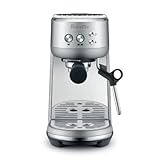
Breville Bambino
Best for: Budget-conscious beginners who want real espresso without the Plus markup
Same 3-second ThermoJet heat-up and 54mm portafilter as the Plus, minus auto-frothing — $150 saved
- +3-second heat-up — same ThermoJet system as the Bambino Plus
- +54mm portafilter with both pressurized and non-pressurized baskets
- +Compact footprint fits small kitchens
- +$150 cheaper than the Plus — spend the savings on a grinder
- −No automatic milk frothing — manual steam wand only
- −Portafilter and tamper feel lightweight and plastic
- −No on/off switch — always drawing standby power
- −No solenoid valve — water pools on puck after shot (cosmetic, not functional)
✓ Free shipping with Prime · Affiliate link
Why We Recommend It
The Bambino is the Breville lineup’s entry point at $250, and it shares the same ThermoJet heating, 54mm portafilter, and core espresso extraction as its Plus sibling. The $150 savings comes from dropping the automatic milk frother — you get a manual steam wand instead. For buyers who drink straight espresso or americanos, that’s $150 saved with zero compromise on shot quality.
Community discussion of the base Bambino is quieter than the Plus’s — 6 labeled mentions across 5 briefs in our census, split evenly between praise and criticism. But the qualitative pattern is consistent: enthusiasts pair it with serious grinders (DF64, Eureka Mignon, 1Zpresso) and report results that compete with machines costing three times as much.
Key Features
- Same 3-second ThermoJet system as the Bambino Plus and Barista Pro
- Manual steam wand — more control for experienced users, steeper learning curve for beginners
- Smallest and lightest Breville at 6.25 x 13.5 x 12 in and 11 lbs — for a cross-brand compact comparison, see our compact espresso machine roundup
- Both pressurized and non-pressurized baskets included
Who It’s Best For
Budget-conscious beginners who plan to invest separately in a grinder, or espresso-only drinkers who don’t need milk frothing. The $150 savings over the Plus is enough to put toward a Baratza Encore or a quality hand grinder — a smarter allocation than spending it on auto-frothing you might not use.
Potential Downsides
The portafilter and tamper feel lightweight and plastic compared to the Plus and Barista line. There’s no on/off switch — the machine draws standby power constantly. And the lack of a solenoid valve means water pools on the puck after extraction (cosmetic, not a quality issue). If you make milk drinks daily, the Plus’s auto-frother is worth the $150 upgrade.
Affiliate link

Breville Barista Express
Best for: Home baristas who want an all-in-one machine that delivers solid espresso without a separate grinder
you want one appliance, one workflow, and solid espresso without researching a separate grinder.
you already expect to chase shot quality or upgrade components independently.
Integrated conical burr grinder with dose control — beans to espresso in under a minute
- +27,000+ reviews at 4.5 stars — the most-proven espresso machine on Amazon
- +Integrated burr grinder eliminates the need for a separate grinder
- +PID temperature control for consistent extraction
- +Low-pressure pre-infusion for balanced flavor
- −Integrated grinder is the ceiling — enthusiasts outgrow it within 1-2 years
- −54mm portafilter limits aftermarket accessory options vs 58mm standard
- −Thermocoil heating is slower than ThermoJet models (Barista Pro, Touch)
✓ Free shipping with Prime · Affiliate link
Evidence notes
Community signal: Most proven integrated-grinder machine by owner volume, but the community census shows negative net sentiment because enthusiasts outgrow it.
Main tradeoff: The built-in grinder and 54mm portafilter become the upgrade ceiling.
Evidence note: The built-in-grinder article uses census sentiment, upgrade-path forum stories, and 27,000+ Amazon reviews.
Why We Recommend It
The Barista Express is the best-selling espresso machine on Amazon — 27,000+ reviews at 4.5 stars — and it earned that position by being the lowest-friction path to home espresso. Grinder, tamper, PID temperature control, and pre-infusion in one $550 box. You open it, fill the hopper with beans, and you’re pulling shots. No separate grinder purchase, no separate grinder research, no second appliance on the counter.
We need to be honest about what the community says, though. The Barista Express appears in more buying contexts than any other espresso machine in our census — 20 labeled mentions across 9 briefs — and is the most ambivalently received: 7 of those 20 mentions carry praise and criticism together. That’s not because the machine is bad. It’s because the community sees it as a stepping stone. On r/espresso, owners describe it as “the gateway drug” to home espresso and report outgrowing the integrated grinder within 12–24 months. One owner who upgraded to a Linea Mini called it “a machine which I have enduring respect for as it introduced me to the beautiful world of espresso.”
Key Features
- Integrated conical burr grinder with 16 grind settings and dose control
- PID temperature control with low-pressure pre-infusion for balanced extraction
- Thermocoil heating — ~30 second warm-up (slower than ThermoJet models)
- Analog pressure gauge for real-time extraction feedback
Who It’s Best For
The buyer who wants one appliance, one purchase, and good espresso starting tomorrow — without committing to the grinder-research rabbit hole. If you make 1–2 drinks a day and don’t see yourself chasing extraction perfection, the Express delivers genuinely solid espresso for years. The NCA recommends a ratio of roughly 1:2 (coffee to water) for espresso, and the Express’s dose control makes hitting that target straightforward.
Potential Downsides
The integrated grinder is the ceiling. Serious users outgrow it within months and buy a separate grinder (DF64, Baratza Sette, Niche Zero), which leaves the built-in grinder unused — an expensive dead weight. The Thermocoil heating takes ~30 seconds to warm up versus 3 seconds on ThermoJet models. And the 54mm portafilter limits aftermarket accessory options compared to the industry-standard 58mm. If you’re willing to buy a separate grinder, a Bambino Plus + Smart Grinder Pro costs the same $600 and has a higher ceiling.
Affiliate link

Breville Barista Pro
Best for: The all-rounder buyer who wants fast heat-up and precise control without paying for a touchscreen
you want the best daily-driver version of the integrated Breville workflow without touchscreen automation.
the same budget could buy a Bambino Plus and standalone grinder with more upgrade flexibility.
ThermoJet 3-second heat-up with LCD display for precise shot control
- +ThermoJet heats in 3 seconds — fastest warm-up in the Breville lineup
- +LCD display for grind size, shot time, and temperature feedback
- +Integrated grinder with 30 grind settings
- +Instant transition from espresso to steam — no wait between brew and milk
- −Same integrated grinder ceiling as Express — enthusiasts will outgrow it
- −54mm portafilter limits aftermarket basket options
- −Manual steam wand requires practice for latte art
✓ Free shipping with Prime · Affiliate link
Evidence notes
Community signal: Forum upgrade stories frame the Pro as a faster Barista workflow, not a different long-term upgrade path.
Main tradeoff: The premium buys speed and interface, not a fundamentally better grinder.
Evidence note: The article anchors this pick on ThermoJet workflow value and negative-but-less-severe census sentiment than the Express.
Why We Recommend It
The Barista Pro is the Express with ThermoJet heating and a digital LCD display — 3-second warm-up instead of 30, plus real-time grind size and shot time feedback on screen. It’s the best version of the Barista concept: integrated grinder, fast heating, and enough control to dial in consistently without external tools.
But the $300 premium over the Express ($850 vs $550) buys you faster heating and a display, not a better grinder. The integrated conical burr grinder has 30 settings instead of 16, but the grind quality ceiling is fundamentally the same. Community sentiment reflects this: dead even (net 0 across 11 labeled mentions in our census), with owners upgrading to prosumer machines (Profitec Move, Lelit Bianca) rather than to the Touch or Touch Impress. For a detailed breakdown of whether the $300 gap is worth it, see our Barista Express vs Barista Pro comparison.
Key Features
- ThermoJet 3-second heat-up — eliminates the Express’s main morning-workflow friction
- LCD display showing grind size, shot time, and temperature
- 30 grind settings (vs Express’s 16) for finer adjustment
- Instant steam transition — no wait between brew and milk modes
Who It’s Best For
The buyer who has decided on the Barista philosophy (integrated grinder, one-box solution) and wants the best version of it without paying $800–$1,200 for a touchscreen. The ThermoJet heating alone justifies the upgrade for anyone who makes multiple drinks each morning — saving 30 seconds per heat cycle adds up.
Potential Downsides
At $850, the Pro costs more than a Bambino Plus ($400) + Smart Grinder Pro ($200) + $250 left over. Same integrated-grinder ceiling as the Express. The manual steam wand requires practice for latte art. And the upgrade path from the Pro doesn’t go to the Touch — it goes to prosumer machines entirely outside the Breville ecosystem, meaning the $850 investment has a shorter useful life than the price suggests.
Affiliate link
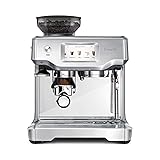
Breville Barista Touch
Best for: Beginners who want touchscreen guidance and pre-programmed drinks without a learning curve
multiple people in the house want saved drink presets and automatic milk texture.
you want manual steam control for latte art or fewer electronics to age.
Touchscreen with pre-programmed recipes and ThermoJet 3-second heat-up
- +Touchscreen with customizable drink presets — lowest friction path to good espresso
- +ThermoJet heats to extraction temperature in 3 seconds
- +Integrated grinder with dose control
- +Automatic steam wand for consistent milk texturing
- −Most expensive all-in-one in this lineup at $800
- −Touchscreen adds complexity that can fail — some owners report screen issues
- −Same 54mm portafilter limitation as the Express
- −Automatic steam wand limits latte art compared to manual wands
✓ Free shipping with Prime · Affiliate link
Evidence notes
Community signal: Owner sentiment is still negative in the census, but less harsh than the Express because milk automation solves a real household problem.
Main tradeoff: Touchscreen convenience adds complexity while keeping the same integrated-grinder ceiling.
Evidence note: The article uses census sentiment and owner comments about learning the grinder limits while keeping the machine for milk automation.
Why We Recommend It
The Barista Touch adds a touchscreen with pre-programmed drink recipes and an automatic steam wand to the Barista Pro’s ThermoJet platform. If you want to hand someone a cup and say “press the latte button,” this is the machine that makes that possible. The touchscreen stores up to 8 custom drink profiles, and the auto-steam produces consistent milk texture without the wand technique that the Pro and Express demand.
At $800, it’s actually $50 cheaper than the Pro — a pricing anomaly that makes the Touch a stronger value proposition for milk-drink households despite having a similar spec sheet. The Touch draws too few census mentions for a meaningful sentiment score, but the qualitative pattern matches its siblings: the same integrated-grinder ceiling applies, while the automation earns goodwill from convenience-oriented buyers.
Key Features
- Touchscreen interface with customizable drink presets
- Automatic steam wand — consistent milk texture without manual technique
- ThermoJet 3-second heat-up — same fast heating as the Pro
- Integrated grinder with dose control
Who It’s Best For
Multi-person households where not everyone wants to learn manual espresso technique. The touchscreen and auto-steam lower the skill floor to near zero — anyone can make a decent latte. Also a strong choice for offices or shared kitchens.
Potential Downsides
The automatic steam wand limits latte-art quality compared to manual wands on the Pro and Express. Some owners report touchscreen reliability issues after 2+ years. And the same 54mm portafilter and integrated-grinder ceiling apply — paying $800 for the same grinder as the $550 Express is a steep premium for a screen and auto-steam.
Affiliate link

Breville Barista Touch Impress
Best for: Experienced home baristas ready to step into prosumer territory with guided precision
you want the most guided semi-auto workflow with assisted tamping and automatic milk settings.
you would rather spend the same money on a separate machine, grinder, and tamper.
Impress Puck System with assisted 22lb tamping and auto dose correction — takes the guesswork out of puck prep
- +Impress Puck System with assisted tamping eliminates inconsistent puck prep
- +3-second ThermoJet heat-up — same speed as the Bambino Plus
- +Auto MilQ with alternative milk settings for oat, soy, and almond
- +Touchscreen with step-by-step barista guidance and real-time feedback
- −At $1,200, it's more than double the Barista Express for incremental improvements
- −Integrated grinder means you can't upgrade the grinder independently
- −Large footprint — needs significant counter space
- −Some r/espresso owners report the assisted tamping feels over-engineered for experienced users
✓ Free shipping with Prime · Affiliate link
Evidence notes
Community signal: Best sentiment among Breville Barista machines in this lineup, mostly because auto-tamping removes a real beginner variable.
Main tradeoff: The price enters prosumer territory while the grinder remains built in and non-upgradable.
Evidence note: The article frames the Impress system as the meaningful upgrade, while keeping the grinder-ceiling warning visible.
Why We Recommend It
The Touch Impress is Breville’s flagship — the most automated, most expensive, and most opinionated machine in the lineup. Its Impress Puck System uses assisted tamping at 22 lbs of force with automatic dose correction, removing the single most technique-dependent step in espresso prep. The auto MilQ system handles alternative milks (oat, soy, almond) with dedicated settings.
Like the Touch, the Touch Impress draws too few census mentions for a meaningful sentiment score. The forum discussion it does get is comparatively warm, largely because the auto-tamping system genuinely solves a real problem. But at $1,200, you’re paying more than double the Express for incremental automation improvements on top of the same fundamental grinder.
Key Features
- Impress Puck System — assisted 22lb tamping with auto dose correction
- Auto MilQ with dedicated alternative-milk settings
- Touchscreen with step-by-step barista guidance and real-time feedback
- ThermoJet 3-second heat-up
Who It’s Best For
The buyer who wants the absolute lowest-effort path to espresso and is willing to pay for it. The auto-tamping and auto-dosing genuinely reduce variables — if consistency without technique is the priority, the Impress delivers it. Also the best Breville for alternative-milk households.
Potential Downsides
At $1,200, the Touch Impress costs 3x the Bambino Plus for an integrated grinder that experienced users call the same ceiling as the $550 Express. Some r/espresso owners find the assisted tamping “over-engineered for experienced users.” The large footprint (14.7 x 12.6 x 16.1 in) demands significant counter space. And the upgrade path from a $1,200 Breville goes to $1,500–$3,000 prosumer machines — a steep next step.
Affiliate link

Breville Precision Brewer Thermal
Best for: The control-oriented brewer who wants to dial in drip coffee the way espresso users dial in shots — 6 brew modes, PID temperature control, and adjustable flow rates
PID digital temperature control with 6 brew presets (Gold, Fast, Strong, Iced, Cold Brew, My Brew) and 3 adjustable flow rates for precision extraction
- +SCA Gold Cup certified with PID temperature control — the most precise temperature management in a home drip brewer
- +6 brew modes including dedicated cold brew and a fully customizable My Brew profile
- +3 adjustable flow rates let you control contact time for different grind sizes and roast levels
- +60oz capacity — largest in this lineup, brews up to 12 cups
- −3.9★ rating reflects a reliability concern — some owners report issues after 1–2 years of daily use
- −Complex interface with many settings can be overwhelming for casual coffee drinkers
- −At $295, you're paying for features most daily users will never touch
- −Breville has launched the Luxe Drip successor — this model may see reduced availability
✓ Free shipping with Prime · Affiliate link
Why We Recommend It
The Precision Brewer Thermal is not an espresso machine — it’s a drip coffee maker, and we’re flagging that upfront. We included it because this is a Breville brand hub, and brand-loyal buyers building an all-Breville station will want to know Breville’s best drip option. It’s SCA Gold Cup certified, meaning it meets the Specialty Coffee Association’s standards for water temperature and contact time during brewing.
Six brew modes (Gold, Fast, Strong, Iced, Cold Brew, and a fully customizable My Brew profile) with PID temperature control and three adjustable flow rates make this the most tweakable drip brewer on the market. It pairs naturally with a Bambino Plus or Bambino for households that drink both drip and espresso.
Key Features
- SCA Gold Cup certified — meets the SCA’s research-backed standards for optimal extraction
- 6 brew modes including cold brew and a fully customizable profile
- PID temperature control with 3 adjustable flow rates
- 60oz stainless steel thermal carafe — largest capacity in the Breville lineup
Who It’s Best For
Breville households that also drink drip coffee. The Precision Brewer sits alongside a Bambino or Barista machine for mornings when you want a full pot instead of a shot. Also strong for entertaining — the 60oz carafe serves a crowd.
Potential Downsides
The 3.9-star Amazon rating (lowest in this lineup) reflects reliability concerns — some owners report failures after 1–2 years of daily use. The complex interface can overwhelm casual coffee drinkers who just want a pot of coffee. And Breville has launched a successor (the Luxe Drip) that may reduce this model’s availability over time.
Affiliate link

Breville Smart Grinder Pro
Best for: Households that brew multiple methods — espresso in the morning, pour-over on weekends, French press for guests
60 grind settings from espresso-fine to French press-coarse with Dosing IQ digital timer adjustable in 0.2-second increments
- +60 grind settings — the widest range here — covers espresso through French press in one machine
- +Dosing IQ digital timer with 0.2-second precision for repeatable doses
- +Grinds directly into a portafilter, airtight container, gold tone filter, or paper filter
- +Brushed stainless steel construction matches Breville espresso machines aesthetically
- −At $200, it's in the same price range as the Baratza Encore ESP — which is a better pure espresso grinder
- −Conical burrs produce slightly less uniform particle size than flat burr designs at this price
- −Larger footprint than the Baratza Encore — takes up more counter space
- −Hopper removal can be awkward compared to Baratza's simpler design
✓ Free shipping with Prime · Affiliate link
Why We Recommend It
The Smart Grinder Pro is the piece that makes the Bambino philosophy work. At $200, it’s the most popular standalone grinder in the Breville ecosystem — 60 grind settings covering espresso through French press, a Dosing IQ timer adjustable in 0.2-second increments, and a brushed stainless finish that matches every Breville espresso machine aesthetically.
For Bambino Plus owners especially, the Smart Grinder Pro is the natural companion. Total cost: $600 for a Bambino Plus + Smart Grinder Pro setup — $50 more than a Barista Express, with a meaningfully better grinder and a machine that’s independently upgradeable. For more grinder options, see our best coffee grinder roundup.
Key Features
- 60 grind settings — the widest range here — from espresso-fine to French press-coarse
- Dosing IQ timer with 0.2-second precision for repeatable doses
- Grinds directly into portafilter, airtight container, gold-tone filter, or paper filter
- Brushed stainless steel matches Breville espresso machines
Who It’s Best For
Bambino or Bambino Plus owners who want to stay in the Breville ecosystem while getting a standalone grinder that outperforms any integrated Barista-line grinder. Also a strong choice for multi-method households — the 60-setting range covers every brew method.
Potential Downsides
At $200, it’s in the same bracket as the Baratza Encore ESP, which is arguably a better pure espresso grinder. Conical burrs produce slightly less uniform particle distribution than flat-burr designs at this price. The hopper removal mechanism is less elegant than Baratza’s design. And for dedicated espresso use, a $200+ hand grinder (1Zpresso JX-Pro, Comandante) will outperform it.
Affiliate link
Buyer’s Guide: Bambino vs Barista — Choosing Your Breville Philosophy
This is the decision that matters more than any individual model comparison. Every Breville espresso machine fits into one of two camps, and the right camp depends on what you’re optimizing for.
The Bambino Philosophy: Invest in the Grinder
The Bambino and Bambino Plus are simple espresso machines. No integrated grinder, no touchscreen, no auto-tamping. The espresso extraction is solid — ThermoJet heating, 15-bar pump, 54mm portafilter — and the machine gets out of the way.
The advantage is flexibility. Your grinder is independent, upgradeable, and the single most impactful variable in espresso quality. A Bambino Plus ($400) paired with a Smart Grinder Pro ($200) costs $600 and produces better espresso than a Barista Express ($550) because the standalone grinder is superior to the Express’s integrated unit.
The community endorses this. On r/espresso, the Bambino Plus is the most-recommended Breville by a significant margin. The analysis of 4,000+ setup flairs found it’s the most popular machine on the subreddit, and the median setup cost of $2,800 tells you where Bambino owners put their money: into grinders, accessories, and beans.
The Barista Philosophy: One Box, One Purchase
The Barista line is the lowest-friction path to espresso. Open the box, fill the hopper, pull a shot. No grinder research, no second appliance, no counter space negotiations with your partner.
The trade-off is a ceiling. The integrated grinder in every Barista machine — Express, Pro, Touch, Touch Impress — is the same fundamental design. It’s good enough for medium-to-dark roasts using pressurized baskets, but light roasts and unpressurized baskets expose its limitations. Community members consistently report outgrowing the grinder within 12–24 months once they start chasing extraction quality.
This isn’t a deal-breaker for everyone. If you make 1–2 drinks a day, use medium roasts, and have no interest in the espresso rabbit hole, the Barista line delivers genuinely good espresso for years. The ambivalent census sentiment — heavy on mixed labels, light on outright praise — reflects the expectations of r/espresso enthusiasts, not casual home brewers. Know your audience — and know yourself.
What About the Upgrade Path?
Here’s what the forum data reveals: Barista-line owners don’t upgrade within the Breville lineup. They upgrade out of it. Barista Express owners jump to Linea Mini, Lelit Bianca, or Profitec machines — skipping the Pro, Touch, and Touch Impress entirely. Barista Pro owners do the same.
This means the Barista Express ($550) and the Barista Touch Impress ($1,200) have functionally similar useful lifespans for enthusiast buyers. If you’re going to outgrow the grinder in 1–2 years regardless, the Express is the smarter financial bet. The $650 difference between the Express and the Touch Impress doesn’t buy you a longer relationship with the machine — it buys you more automation during the same window.
For Bambino owners, the upgrade path is different: you upgrade the grinder first (Smart Grinder Pro → DF64 or Niche Zero), then eventually the machine (Bambino Plus → Lelit Anna or Profitec Go). Each upgrade is independent and incremental. The total cost over 5 years may be similar, but you’re never throwing away a perfectly functional appliance.
Pressurized vs Unpressurized Baskets: Where the Grinder Ceiling Actually Hits
Every Breville espresso machine ships with both pressurized and non-pressurized baskets. The distinction matters more than the article’s “grinder ceiling” language might suggest. With pressurized baskets, the basket itself creates back-pressure — the integrated Barista grinder works fine, and most users will never notice its limitations. Switch to unpressurized baskets (which let you control extraction more precisely) and the grinder ceiling becomes real: inconsistent particle size shows up as channeling, uneven extraction, and sour or bitter shots.
If you drink medium-to-dark roasts and use pressurized baskets, the Barista Express’s integrated grinder is genuinely adequate for years. The “outgrow in 12–24 months” timeline applies to users who switch to unpressurized baskets and lighter roasts — which is a common trajectory on r/espresso but not universal. For specific bean recommendations that work well with Breville’s integrated grinder and basket system, see our best espresso beans for Breville guide.
Maintenance: What Keeps a Breville Running
Breville’s thermoblock machines (every model in this lineup) require regular descaling — typically every 2–3 months depending on your water hardness. Hard water accelerates scale buildup inside thermoblocks and is the primary cause of premature failure. Using filtered water (not distilled — minerals are needed for extraction and machine health) extends the life of every Breville on this list.
The Barista line has an additional maintenance step: cleaning the integrated grinder. Retained grounds go stale and affect flavor. A quick brush-out weekly and a deeper cleaning monthly keeps the grinder performing. The Bambino line skips this entirely — one less thing to maintain.
For households making 2–3 drinks in sequence, the ThermoJet heating system can show temperature instability between consecutive shots. A brief 10–15 second pause between pulls helps — the machine recovers quickly, but it’s worth knowing that “3-second heat-up” describes the first shot, not the third.
The Breville Heating Divide: ThermoJet vs Thermocoil
One more factor that cuts across the lineup. Every Breville except the Barista Express uses ThermoJet heating — 3 seconds from off to pulling a shot. The Express uses Thermocoil — roughly 30 seconds. This matters more than it sounds: if you make espresso every morning, a 30-second wait versus instant extraction changes your daily workflow. The Express’s Thermocoil isn’t bad, but it’s the oldest heating architecture in the current lineup.
Our Recommendation
For most buyers, the Bambino Plus is the right choice. It’s the machine the community loves, it heats instantly, it froths milk automatically, and it frees your budget for the component that actually determines espresso quality: the grinder. Pair it with a Breville Smart Grinder Pro and you’ve built a $600 setup that outclasses the $850 Barista Pro on the metric that matters most.
If you specifically want an all-in-one and you’re at peace with the grinder trade-off, get the Barista Express at $550 — not the Pro at $850. The ThermoJet heating is nice, but it doesn’t justify a $300 premium when the grinder is the same ceiling.