The Breville Barista Express is the best espresso machine for most people — it’s the only all-in-one under $600 with a built-in grinder, PID temperature control, and pre-infusion that pulls genuinely balanced shots out of the box. If you’d rather invest in a separate grinder and a machine you can mod for years, the Gaggia Classic Evo Pro is the better long-term play.
Here’s what most “best espresso machine” articles won’t tell you: the grinder matters more than the machine. On r/espresso and r/JamesHoffmann, this is the single most repeated piece of advice. A $500 machine with a bad grinder will produce worse espresso than a $300 machine paired with a proper burr grinder. We evaluated every machine below through that lens — not just what it does alone, but how it fits into a complete setup.
If you are not sure you want to spend $400+ on espresso equipment, consider a moka pot first — a $50 stovetop brewer that produces strong, concentrated coffee with a fraction of the complexity. It is not espresso, but it is the closest you can get on a stovetop.
We researched over 30 machines and compared these seven across shot quality, steam performance, build longevity, and real owner feedback from Reddit, Home-Barista forums, and manufacturer documentation. Every recommendation below connects to what actual buyers report — not just spec sheets.
How We Evaluated
We focused on five criteria that matter most to someone spending $400–$1,200 on espresso equipment:
- Shot quality and consistency — Does it produce properly extracted espresso with repeatable results? Does it need mods to get there?
- Steam wand performance — Can it texture milk for lattes and cappuccinos? Manual wand or automatic frother?
- Build quality and longevity — Stainless steel boiler or thermoblock? How do owners report durability after 2–5 years?
- Upgrade path — Will you outgrow it in a year, or can it grow with your skills? Does the portafilter size lock you into one ecosystem?
- Total cost of ownership — Machine price is just the start. We factored in whether you’ll need a separate grinder, accessories, and mods to get the performance the machine is capable of.
1. Breville Barista Express — The All-in-One That Actually Works

Breville Barista Express
Best for: Home baristas who want an all-in-one machine that delivers solid espresso without a separate grinder
you want one appliance, one workflow, and solid espresso without researching a separate grinder.
you already expect to chase shot quality or upgrade components independently.
Integrated conical burr grinder with dose control — beans to espresso in under a minute
- +27,000+ reviews at 4.5 stars — the most-proven espresso machine on Amazon
- +Integrated burr grinder eliminates the need for a separate grinder
- +PID temperature control for consistent extraction
- +Low-pressure pre-infusion for balanced flavor
- −Integrated grinder is the ceiling — enthusiasts outgrow it within 1-2 years
- −54mm portafilter limits aftermarket accessory options vs 58mm standard
- −Thermocoil heating is slower than ThermoJet models (Barista Pro, Touch)
✓ Free shipping with Prime · Affiliate link
Evidence notes
Community signal: Most proven integrated-grinder machine by owner volume, but the community census shows negative net sentiment because enthusiasts outgrow it.
Main tradeoff: The built-in grinder and 54mm portafilter become the upgrade ceiling.
Evidence note: The built-in-grinder article uses census sentiment, upgrade-path forum stories, and 27,000+ Amazon reviews.
Why we recommend it
The Barista Express is the most popular espresso machine on Amazon for a reason: it ships complete. Built-in conical burr grinder, PID temperature control, low-pressure pre-infusion, and dose control — everything you need to pull good espresso without buying a single accessory. For someone upgrading from drip or Nespresso, it has the shortest path from unboxing to drinking real espresso.
On Reddit, one long-term owner put the value proposition perfectly: they bought a Barista Express for $500, used it for six years, then sold it for $500. Six years of espresso, effectively free. That resale value comes from Breville’s brand recognition and the machine’s enduring reputation as the default recommendation for “I want to start making espresso at home.”
Key features
- Integrated conical burr grinder with dose control — beans to espresso in under a minute, no separate grinder needed
- PID temperature control for consistent extraction shot to shot
- Low-pressure pre-infusion saturates the puck before full pressure, reducing channeling
- 54mm portafilter with both pressurized and non-pressurized baskets included
Who it’s best for
First-time and second-time espresso buyers who want one purchase to cover everything. If your priority is “I want good espresso tomorrow morning without researching grinders,” the Barista Express is the answer.
Potential downsides
- The integrated grinder is the known ceiling. Experienced home baristas on r/espresso consistently report outgrowing it within 1–2 years, then buying a separate grinder — which makes half the machine redundant.
- The 54mm portafilter uses Breville’s proprietary size, not the commercial standard 58mm. Every basket, tamper, puck screen, and accessory you buy is locked to Breville machines. If you upgrade to a Gaggia, Rancilio, or any E61 machine later, none of your 54mm accessories transfer.
- Thermocoil heating is slower to reach temperature than ThermoJet models (Barista Touch, Bambino Plus).
If you’ve narrowed your decision to the Barista Express vs. the Barista Pro, our dedicated Express vs Pro comparison breaks down the $300 price gap, heating-system differences, and when each is worth it. For the full Breville lineup ranked by community sentiment, see our best Breville espresso machine guide. And if an integrated grinder is specifically what you want, our best espresso machine with built-in grinder roundup compares all six semi-auto options honestly — including the grinder ceiling most reviews don’t mention.
Affiliate link
2. Breville Bambino Plus — Fastest Path to Good Espresso

Breville Bambino Plus
Best for: Beginners who want great espresso with minimal learning curve
3-second heat-up with automatic milk frothing — closest to cafe-quality with zero barista skills
- +3-second heat-up — fastest in this price range
- +Automatic milk frothing produces decent microfoam
- +Compact footprint fits small kitchens
- +54mm portafilter with pressurized and non-pressurized baskets
- −Reliability concerns — some owners report failures within 12–18 months
- −Struggles with lighter roasts without temperature surfing
- −Thermoblock heating less durable long-term than traditional boilers
- −Amazon pricing fluctuates — check current price before buying
✓ Free shipping with Prime · Affiliate link
Why we recommend it
The Bambino Plus heats up in 3 seconds. Not 3 minutes — 3 seconds. Its ThermoJet system gets to extraction temperature before you’ve finished dosing your portafilter. Combined with automatic milk frothing that produces genuinely decent microfoam at the push of a button, the Bambino Plus has the lowest friction between “I want a latte” and “I’m drinking a latte” of any machine on this list.
It ships without a grinder, which the community actually considers a strength: you’re not paying for an integrated grinder you’ll outgrow. Pair it with a KinGrinder K6 ($70 hand grinder) or Baratza Encore ESP ($150 electric), and you have a capable setup for under $550.
Key features
- 3-second ThermoJet heat-up — fastest in any price range
- Automatic milk frothing with adjustable temperature for lattes and cappuccinos
- Compact 7.5-inch width fits small kitchens and tight counter spaces — see our compact espresso machine roundup for the slimmest options
- 54mm portafilter with pressurized and non-pressurized baskets for growing into better technique
Who it’s best for
Beginners who want results fast, new parents who need a latte before the baby wakes up, and anyone whose morning routine can’t accommodate a 25-minute warm-up cycle. If your definition of “good enough” is consistently decent lattes with zero fuss, the Bambino Plus nails it.
Potential downsides
- Reliability is the Bambino Plus’s weak point. Multiple r/espresso threads document early failures — thermoblock heating is inherently less durable long-term than traditional boilers like the Gaggia’s stainless steel unit.
- Low skill ceiling: great for beginners, but experienced users find it limiting. One commenter on r/espresso put it bluntly: “by far isn’t the best.”
- Same 54mm portafilter lock-in as the Barista Express — all accessories are Breville-specific.
- Struggles with lighter roasts. Runs best with medium-dark espresso blends.
Affiliate link
3. Gaggia Classic Evo Pro — The Machine That Lasts Decades

Gaggia Classic Evo Pro
Best for: Home baristas who want a mod-friendly machine that lasts decades
Commercial-spec 58mm portafilter with massive mod ecosystem (PID, OPV spring, Gaggiuino)
- +58mm commercial portafilter — same as cafe machines
- +Legendary mod ecosystem (PID, OPV, Gaggiuino)
- +Stainless steel boiler built to last 20+ years
- +Active community support on r/gaggiaclassic
- −No PID out of the box — temperature swings until modded
- −Stock Panarello steam wand is poor for latte art
- −Earlier Evo batches had boiler coating issues (resolved in newer units)
✓ Free shipping with Prime · Affiliate link
Why we recommend it
The Gaggia Classic has been the default recommendation on r/espresso and Home-Barista forums for over a decade. Its commercial-spec 58mm portafilter — the same size used in cafe machines — gives you access to the entire ecosystem of aftermarket baskets, tampers, and bottomless portafilters. The stainless steel boiler is the kind of component that lasts 20+ years with basic descaling.
What makes the Gaggia remarkable isn’t what it does out of the box — it’s what it becomes. One r/espresso owner reported their Gaggia Classic lasted 13 years, still working like new with just basic maintenance. The mod community is unmatched: a $15 OPV spring swap improves extraction pressure, a $50–$100 PID controller eliminates temperature swings, and the Gaggiuino project transforms it into a machine with pressure profiling and flow control that rivals $2,000+ setups. No other machine at this price offers that kind of growth path.
Key features
- 58mm commercial portafilter — industry standard, compatible with thousands of aftermarket accessories
- Stainless steel boiler with brass group head, built for multi-decade service life
- 15-bar vibratory pump (adjustable to the commercial standard 9 bar via OPV spring mod)
- Three-way solenoid valve for clean, dry puck removal
Who it’s best for
Buyers who see their espresso machine as a long-term investment and enjoy the process of learning, modding, and improving over time. The Gaggia rewards patience and curiosity. If you’d rather tinker with your setup over the next decade than replace it every three years, this is your machine.
Potential downsides
- No PID temperature control out of the box. Without the mod, you’re temperature surfing — flushing water before each shot to stabilize temperature. Community consensus on r/espresso is that “PID is a must” for consistent results.
- The stock Panarello steam wand is poor for latte art. Most owners replace it within weeks. If you’d rather skip steam technique entirely, a standalone milk frother produces latte-quality foam without the learning curve.
- Puck removal with the stock portafilter is notoriously difficult — several owners report needing to dig out the puck with a spoon. A bottomless portafilter ($25–$30) solves this.
- No integrated grinder. Budget an additional $150–$400 for a standalone grinder.
Affiliate link
4. De’Longhi La Specialista Arte — Capability Without the Learning Curve
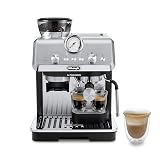
De'Longhi La Specialista Arte
Best for: Latte art learners who want a compact Italian-designed machine with a cool-touch steam wand
you want a compact non-Breville machine with a cool-touch wand for milk practice.
you want the most battle-tested integrated-grinder ecosystem and accessory support.
My Latte Art steam wand stays cool-to-touch after steaming — safer and easier for beginners learning milk texturing
- +My Latte Art wand stays cool-to-touch — genuine differentiator for learning latte art
- +Compact design fits smaller kitchen counters
- +3 infusion temperatures for matching water to bean variety
- +Italian-made conical burr grinder with 8 settings
- −Only 8 grind settings — less precise than Breville's 30 settings
- −4.0-star rating is the lowest in this lineup
- −Only 3 preset recipes (espresso, americano, hot water) vs Ninja's full drink menu
- −No cold brew capability
✓ Free shipping with Prime · Affiliate link
Evidence notes
Community signal: Thinner product-specific forum signal than Breville; the article treats broader Specialista owner reports as directional.
Main tradeoff: Only 8 grind settings, lower Amazon rating, and less established US service discussion than Breville.
Evidence note: Included for compactness and steam-wand differentiation, with the article explicitly noting thin Arte-specific community data.
Why we recommend it
The Specialista Arte fills a gap that the other machines on this list leave open: it offers a built-in grinder and an integrated tamping system without requiring you to learn espresso technique to get good results. The sensor grinding system auto-doses to your chosen strength, and the Smart Tamping Station applies consistent pressure every time — eliminating two of the most common beginner mistakes.
We’ll be honest: the Specialista Arte doesn’t have the prosumer cult following of the Gaggia or the sheer volume of community discussion around the Barista Express. You won’t find a dedicated subreddit with thousands of members sharing mods and dial-in recipes. Its buyer is different — someone who wants capability without tinkering, who’ll use the machine daily without taking it apart on weekends. The My Latte Art steam wand stays cool-to-touch after steaming, which is a genuine differentiator for households with kids or for anyone learning milk texturing.
Key features
- Sensor grinding with 8 settings auto-doses to your chosen strength
- Smart Tamping Station applies consistent tamping pressure automatically
- My Latte Art wand stays cool-to-touch — safer for households and easier for beginners
- Active Temperature Control with 3 infusion temperature settings
Who it’s best for
Buyers who want a capable espresso machine they can use daily without developing a hobby around it. If your ideal morning is “press a button, get a latte, go to work” — but you care that the latte is actually good — the Specialista Arte is designed for that exact use case.
Potential downsides
- Only 8 grind settings vs. 30 on the Breville Barista Express. Less precision for fine-tuning extraction.
- The 51mm portafilter is De’Longhi’s proprietary size — even more limited than Breville’s 54mm for aftermarket accessories.
- 4.0-star Amazon rating is the lowest in this lineup, driven by some durability complaints.
- 34 oz water tank is noticeably small — needs frequent refilling with daily use.
Affiliate link
5. Breville Barista Touch — Touchscreen Simplicity, Solid Results
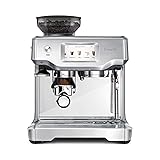
Breville Barista Touch
Best for: Beginners who want touchscreen guidance and pre-programmed drinks without a learning curve
multiple people in the house want saved drink presets and automatic milk texture.
you want manual steam control for latte art or fewer electronics to age.
Touchscreen with pre-programmed recipes and ThermoJet 3-second heat-up
- +Touchscreen with customizable drink presets — lowest friction path to good espresso
- +ThermoJet heats to extraction temperature in 3 seconds
- +Integrated grinder with dose control
- +Automatic steam wand for consistent milk texturing
- −Most expensive all-in-one in this lineup at $800
- −Touchscreen adds complexity that can fail — some owners report screen issues
- −Same 54mm portafilter limitation as the Express
- −Automatic steam wand limits latte art compared to manual wands
✓ Free shipping with Prime · Affiliate link
Evidence notes
Community signal: Owner sentiment is still negative in the census, but less harsh than the Express because milk automation solves a real household problem.
Main tradeoff: Touchscreen convenience adds complexity while keeping the same integrated-grinder ceiling.
Evidence note: The article uses census sentiment and owner comments about learning the grinder limits while keeping the machine for milk automation.
Why we recommend it
The Barista Touch takes the Barista Express formula and adds a touchscreen with pre-programmed drink recipes. Select your drink, and the machine walks you through the process — grind amount, extraction time, milk texture, all dialed in by default with the option to customize. For a household where multiple people use the machine at different skill levels, the touchscreen makes the difference between “my partner can use this” and “only I can use this.”
The ThermoJet heating system is the same 3-second technology in the Bambino Plus, which means you’re pulling shots within a minute of turning it on. The automatic steam wand produces consistent milk texture — not barista-competition quality, but reliably good for everyday lattes and cappuccinos.
Key features
- Touchscreen interface with customizable drink presets and step-by-step guidance
- 3-second ThermoJet heat-up — same fast technology as the Bambino Plus
- Integrated conical burr grinder with dose control
- Automatic steam wand for consistent milk texturing without manual technique
Who it’s best for
Multi-user households where convenience matters. If you want your partner, teenage kid, or house guest to be able to make a decent latte without a tutorial, the touchscreen interface solves that problem. Also works well for buyers who want the Barista Express experience with a more guided, less hands-on workflow.
Potential downsides
- At $800, it’s a $250 premium over the Barista Express for a touchscreen and faster heating — the core espresso engine is similar.
- Users on r/espresso report outgrowing the built-in grinder quickly, same as with the Express. One owner noted they “quickly learned the limitations of the built-in grinder and tamper.”
- A documented milk sensor failure issue has caused some owners to replace the machine entirely.
- The automatic steam wand limits latte art potential compared to manual wands — experienced baristas find the milk texture too thick.
- Same 54mm portafilter ecosystem lock-in as all Breville machines.
Affiliate link
6. Rancilio Silvia — The Buy-It-for-Life Machine

Rancilio Silvia
Best for: Enthusiasts who want commercial-grade build quality and a machine they'll keep for a decade
Commercial-spec 58mm group head and brass boiler from Rancilio's commercial lineup — the same components that run cafe machines
- +58mm commercial portafilter — industry standard, massive accessory ecosystem
- +Iron frame and brass boiler built for 10–20+ year service life
- +The most moddable machine in this range (PID kits, Gaggiuino, 3D-printed accessories)
- +20+ year production run — proven platform with known failure points and easy parts sourcing
- −No PID temperature control — requires temperature surfing for best results (or a $50-$100 PID kit)
- −No integrated grinder — budget an additional $200–$400 for a standalone grinder
- −Single boiler means switching between brew and steam takes 30-60 seconds
- −Compact cup clearance limits taller cups and mugs
✓ Free shipping with Prime · Affiliate link
Why we recommend it
The Rancilio Silvia is built like commercial equipment because it shares components with Rancilio’s commercial lineup. The iron frame and brass boiler aren’t marketing features — they’re the reason Silvia owners measure their ownership in decades, not years. One r/espresso commenter reported using their Silvia for over 10 years before upgrading. Another called it “a tank that’s gonna last you for a VERY long time.”
Among moddable single-boiler machines, experienced users on r/espresso rate the Silvia above the Gaggia as a mod host: “Rancilio Silvia is a great machine for modding — a better host than the often used Gaggia classic for sure. More room in the case, easy to disassemble to the frame to expose the internals.” The 58mm commercial portafilter means your accessories, baskets, and tampers work with any future machine in the 58mm ecosystem.
Key features
- 58mm commercial portafilter — industry standard, full accessory compatibility
- Iron frame and brass boiler from Rancilio’s commercial machine lineup
- 20+ year production run — proven platform with well-documented failure points and widely available replacement parts
- Commercial-grade steam wand with real frothing control for latte art
Who it’s best for
Buyers who want one machine for the next 10–20 years and are willing to learn how to use it. The Silvia rewards technique and patience. If “buy it once, maintain it well, keep it forever” is your approach to gear, the Silvia is that machine. The higher purchase price amortizes quickly over a decade of daily use.
Potential downsides
- No PID temperature control stock. Like the Gaggia, you’ll need to temperature surf or add a PID kit ($50–$100) for consistent shots.
- At $995, it’s the second most expensive machine on this list — and you still need to budget $200–$400 for a separate grinder.
- Single boiler means a 30–60 second wait when switching between espresso and steam.
- The learning curve is real. This is not a beginner-friendly machine — expect a week or two of mediocre shots before you learn how the Silvia behaves.
- Cup clearance is tight. Taller mugs may not fit under the group head without removing the drip tray.
Affiliate link
7. Breville Barista Touch Impress — The Precision All-in-One

Breville Barista Touch Impress
Best for: Experienced home baristas ready to step into prosumer territory with guided precision
you want the most guided semi-auto workflow with assisted tamping and automatic milk settings.
you would rather spend the same money on a separate machine, grinder, and tamper.
Impress Puck System with assisted 22lb tamping and auto dose correction — takes the guesswork out of puck prep
- +Impress Puck System with assisted tamping eliminates inconsistent puck prep
- +3-second ThermoJet heat-up — same speed as the Bambino Plus
- +Auto MilQ with alternative milk settings for oat, soy, and almond
- +Touchscreen with step-by-step barista guidance and real-time feedback
- −At $1,200, it's more than double the Barista Express for incremental improvements
- −Integrated grinder means you can't upgrade the grinder independently
- −Large footprint — needs significant counter space
- −Some r/espresso owners report the assisted tamping feels over-engineered for experienced users
✓ Free shipping with Prime · Affiliate link
Evidence notes
Community signal: Best sentiment among Breville Barista machines in this lineup, mostly because auto-tamping removes a real beginner variable.
Main tradeoff: The price enters prosumer territory while the grinder remains built in and non-upgradable.
Evidence note: The article frames the Impress system as the meaningful upgrade, while keeping the grinder-ceiling warning visible.
Why we recommend it
The Touch Impress adds something genuinely novel to the Breville lineup: the Impress Puck System. It applies a calibrated 22 pounds of tamping force and provides real-time feedback on dose accuracy — too much, too little, or just right. Inconsistent tamping is one of the biggest variables in home espresso, and the Impress system essentially eliminates it.
This is the all-in-one machine for someone who’s tried the Barista Express or Touch and wants the same convenience with meaningfully better consistency. One long-term owner on r/superautomatic described the experience: “I moved into the super automatic world for 2 years and couldn’t stand it. Sub-par quality. I’m back to Breville again with the Touch Impress. Same quality, amazing coffee.” The Auto MilQ system also handles alternative milks (oat, soy, almond) with specific presets — a feature that no other machine on this list offers.
Key features
- Impress Puck System with assisted 22lb tamping and real-time dose feedback
- 3-second ThermoJet heat-up — same fast system as the Bambino Plus and Barista Touch
- Auto MilQ with specific alternative milk presets for oat, soy, and almond
- Touchscreen with step-by-step barista guidance and customizable drink profiles
Who it’s best for
Experienced Breville owners upgrading within the ecosystem, and buyers who want the absolute maximum convenience-to-quality ratio in an all-in-one machine. If you’ve used a Barista Express and wished it were more consistent, or you’ve tried and abandoned a super-automatic because the shots were mediocre, the Touch Impress occupies that sweet spot.
Potential downsides
- At $1,200, it costs more than double the Barista Express. The incremental improvements are real but may not justify the premium for most buyers.
- The integrated grinder is still the ceiling. Like all Breville all-in-ones, you can’t independently upgrade the grinder — experienced users may outgrow it.
- Large footprint demands significant counter space.
- Some r/espresso owners report the assisted tamping feels over-engineered for users who’ve already developed good tamping technique.
- Same 54mm portafilter lock-in as the entire Breville lineup.
Affiliate link
Buyer’s Guide
54mm vs 58mm Portafilter — The Decision Most Articles Skip
Every machine on this list uses one of three portafilter sizes, and this single detail determines how locked into one brand you’ll be:
- 58mm (commercial standard): Gaggia Classic Evo Pro and Rancilio Silvia. This is the same size used in cafe machines. Baskets, tampers, puck screens, bottomless portafilters, and dosing funnels from dozens of manufacturers all fit. If you upgrade to any E61 group head machine later (Profitec, ECM, Lelit Bianca), every accessory transfers.
- 54mm (Breville proprietary): Barista Express, Bambino Plus, Barista Touch, and Touch Impress. Breville’s ecosystem is self-contained. Accessories exist, but they’re Breville-specific. One r/JamesHoffmann commenter laid out the tradeoff: “One of the downsides to the Breville is that it uses a different size for all its tools: 54mm. If you get a machine that uses the commercial standard size, then you can keep all your tools if/when you upgrade.”
- 51mm (De’Longhi proprietary): Specialista Arte. The smallest and most limited accessory ecosystem of the three.
If you know you’ll eventually upgrade machines, 58mm saves money long-term. If you’re buying a Breville and plan to stay in the Breville ecosystem, the 54mm limitation is less relevant — accessories exist, they’re just brand-specific.
The Grinder Decides Your Espresso Quality
The single most common piece of advice across r/espresso, r/JamesHoffmann, and Home-Barista is this: allocate more of your budget to the grinder than to the machine. A $700 machine with a $30 blade grinder will produce worse espresso than a $400 machine with a $200 burr grinder. The grinder controls particle size consistency, which directly controls extraction evenness, which directly controls whether your espresso tastes balanced or bitter. Our grinder vs machine guide makes the full case.
Three entry points worth knowing:
- Hand grinder ($50–$90): KinGrinder K6 or 1Zpresso Q2. Capable of espresso-quality grinds, but you’re grinding by hand for 30–60 seconds per dose.
- Electric entry-level ($150): Baratza Encore ESP. The most-recommended entry electric grinder on Reddit.
- Electric mid-range ($200–$400): DF64 Gen 2, Eureka Mignon series, Turin D54. This is where grind quality starts to noticeably improve shot quality over the built-in grinders in Breville machines.
Machines with built-in grinders (Barista Express, Barista Touch, Touch Impress, Specialista Arte) don’t require a separate grinder to function — that’s their appeal. But the built-in grinder will eventually become the performance ceiling. If you’re buying one of these all-in-ones, know that adding a standalone grinder later is the most impactful upgrade you can make.
Total Cost of Ownership
The machine price is rarely the total cost. Here’s what a realistic setup looks like at three tiers:
- Entry setup ($500–$700): Bambino Plus ($400) + Baratza Encore ESP ($150) + scale ($20) + tamping mat ($15). Or: Barista Express ($550) + scale + tamping mat (grinder included).
- Mid-range setup ($800–$1,100): Gaggia Classic Evo Pro ($530) + DF64 Gen 2 ($250) + PID mod ($80) + precision basket ($25) + bottomless portafilter ($30) + scale + accessories.
- Premium setup ($1,200–$1,600): Rancilio Silvia ($995) + Eureka Mignon ($300) + PID kit ($80) + accessories. Or: Touch Impress ($1,200) + scale + accessories (grinder included).
A set of proper espresso cups ($5–$20) rounds out the setup — thick-walled demitasse cups retain heat longer than thin ceramic mugs and fit under tighter group heads like the Silvia’s.
Plan for the total, not just the machine. If the entry tier fits your budget better, our best espresso machine under $500 roundup covers the strongest options. Looking for something even more affordable? Our best espresso machine under $200 roundup shows what’s possible at that price point. And if you want pressure profiling without electricity — manual lever machines start at $42 and offer extraction control that electric pumps cannot replicate.
Modding Potential — The Hidden Value of Simple Machines
If the idea of gradually upgrading your machine appeals to you, the Gaggia Classic Evo Pro and Rancilio Silvia stand apart. Both use simple, documented designs that home users can modify:
Gaggia Classic mods:
- OPV spring swap (~$15) — reduces pump pressure from 15 to 9 bar, matching the commercial espresso standard
- PID controller ($50–$100) — eliminates temperature swings for consistent shots
- Steam wand upgrade (~$25) — replaces the stock Panarello with a commercial-style wand
- Gaggiuino (advanced) — full electronic retrofit with pressure profiling, flow control, and touchscreen
Rancilio Silvia mods:
- PID controller ($50–$100) — same upgrade path as the Gaggia, but r/espresso modders note the Silvia is “a better host” with more room inside the case and easier disassembly
- Auber PID kit — popular all-in-one PID solution specifically designed for the Silvia
- 3D-printed accessories — the Silvia’s long production run means a deep library of custom parts
No Breville or De’Longhi machine on this list offers a comparable mod ecosystem. If you enjoy projects and want a machine that grows with your skills, the modding community is a genuine differentiator.
Water Quality and Machine Longevity
The Specialty Coffee Association’s water quality standard targets 150 ppm total dissolved solids, with an acceptable range of 75–250 ppm. Water that’s too hard creates scale buildup that damages machines — especially thermoblock systems like those in Breville and De’Longhi machines. Water that’s too soft produces flat, under-extracted espresso.
At minimum, use filtered water. If you have hard water above 250 ppm, a Brita pitcher or in-line filter protects your investment. Descale on the manufacturer’s recommended schedule — every 2–3 months with daily use for most machines on this list. Boiler-based machines (Gaggia, Rancilio) are more resilient to hard water than thermoblocks, but they still need descaling.