The De’Longhi ECP3420 is the best espresso machine under $200 for most people — its adjustable cappuccino system handles both straight espresso and milk drinks competently, it has over 11,000 Amazon reviews confirming it holds up, and at $140 it leaves room in a $200 budget for a decent hand grinder. If you want the best possible espresso and don’t care about milk steaming, the Flair Classic at $159 produces shots that outclass every electric machine in this price range.
We researched and compared machines across shot quality, milk frothing, build durability, and total cost of ownership — factoring in what real owners report on r/espresso and home-barista forums, not just spec sheets. Under $200 is a different game than the $200–$500 range: you’re buying a learning tool, not a forever machine, and the smartest move is spending less on the machine so you can spend more on a grinder.
How We Evaluated
We focused on five criteria that matter most when the budget is under $200:
- Shot quality for the price — Can it produce espresso with crema and reasonable extraction? How does it perform with both pressurized and non-pressurized baskets?
- Milk frothing capability — Can it texture milk well enough for lattes? Auto-frother or manual steam wand, and how does each perform?
- Build quality relative to price — What’s plastic, what’s metal? How do owners report durability after 1–2 years?
- Total cost of ownership — Does it need an expensive grinder to shine? What accessories are required vs. included?
- Room to grow — Can you upgrade baskets, portafilters, or technique as your skills develop, or is the ceiling fixed?

De'Longhi ECP3420
Best for: All-around best under $200 — adjustable cappuccino system handles both espresso and milk drinks
Advanced Cappuccino System with adjustable frother produces dry cappuccino foam or silky latte milk on demand
- +Advanced Cappuccino System adjusts between dry foam and steamed milk
- +15-bar pump with three-in-one filter holder (single, double, ESE pod)
- +11,000+ Amazon reviews — thoroughly proven reliability
- +Compact footprint fits most kitchen counters
- −No PID temperature control — shot temperature varies between pulls
- −51mm portafilter limits aftermarket basket and tamper options
- −Plastic internal components in some areas
- −Auto-off timer can be too aggressive for back-to-back drinks
✓ Free shipping with Prime · Affiliate link
Why We Recommend It
The ECP3420 hits the sweet spot in the under-$200 range: it does both espresso and milk drinks competently without requiring you to master steam wand technique on day one. Its Advanced Cappuccino System lets you toggle between dry cappuccino foam and silky steamed milk with a dial — a feature that simplifies the learning curve for buyers who want lattes without the frustration of learning to texture milk manually.
With over 11,000 Amazon reviews, the ECP3420 has one of the longest track records in this roundup. It’s not a machine that shows up in r/espresso upgrade threads the way the Gaggia Classic does, but it quietly makes good coffee for a lot of people — particularly those who want milk drinks without a steep learning curve.
Key Features
- Advanced Cappuccino System with adjustable frother — toggle between dry foam and steamed milk
- 15-bar pump with three-in-one filter holder (single shot, double shot, ESE pod)
- Thermoblock heating for fast startup
- Compact footprint at 7.25 x 9.6 x 11.9 inches — for more space-saving options, see our compact espresso machine roundup
Who It’s Best For
Buyers who want a machine that handles both espresso and milk drinks out of the box — particularly if you’re making cappuccinos or lattes for a household. The adjustable frother means you don’t need to learn steam wand technique to get decent foam, which is a genuine advantage at this price point.
Potential Downsides
The ECP3420 uses a 51mm portafilter — De’Longhi’s proprietary size — which limits aftermarket basket and tamper options compared to the industry-standard 58mm. There’s no PID temperature control, so shot temperature varies between pulls, especially with back-to-back drinks. The auto-off timer is aggressive and will shut the machine down mid-session if you’re making multiple drinks with pauses between them. And while the thermoblock heats fast, it doesn’t maintain temperature as consistently as a traditional boiler.
Affiliate link
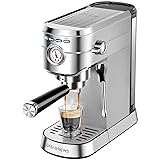
CASABREWS CM5418
Best for: Value-conscious buyers who want built-in pressure feedback to improve their technique
Built-in pressure gauge shows real-time extraction pressure — a feature usually found on machines 3x the price
- +Built-in pressure gauge for extraction feedback
- +20-bar pump with pre-infusion capability
- +Highest rating in this roundup at 4.4 stars across 7,600+ reviews
- +Stainless steel exterior with compact footprint
- −Must wait for machine to cool between steaming and brewing — no simultaneous operation
- −Amazon-native brand with limited long-term track record vs De'Longhi or Breville
- −34 oz water tank is smaller than competitors
- −Pressurized baskets only — non-pressurized requires aftermarket sourcing
✓ Free shipping with Prime · Affiliate link
Why We Recommend It
The CM5418 earns its place for one specific reason: a built-in pressure gauge. At $119, it’s the only machine in this roundup that gives you real-time feedback on extraction pressure — a feature usually reserved for machines costing $300+. For beginners learning to dial in their shots, seeing whether you’re pulling at 9 bar or 14 bar transforms guesswork into a learning process.
At 4.4 stars across 7,600+ Amazon reviews, the CM5418 is the highest-rated machine in this roundup. CASABREWS is an Amazon-native brand without the decades of heritage behind De’Longhi or Breville, but the review volume and consistency suggest they’ve built a genuinely solid product at this price point.
Key Features
- Built-in pressure gauge for real-time extraction feedback
- 20-bar pump with stainless steel construction
- Manual steam wand for milk frothing
- Compact design with 34 oz removable water tank
Who It’s Best For
Value-conscious buyers who want to learn espresso technique and appreciate data-driven feedback. The pressure gauge is the specific differentiator — if you’re the type who watches James Hoffmann videos and wants to understand what’s happening during extraction, the CM5418 teaches while it brews.
Potential Downsides
The CM5418 requires a mandatory cooldown between steaming milk and pulling espresso — you cannot do both in quick succession, which adds time to every latte. The 34 oz water tank is smaller than most competitors, requiring frequent refills for multiple drinks. As an Amazon-native brand, CASABREWS has a thinner support and parts ecosystem than established manufacturers, and long-term (5+ year) durability data is still accumulating.
Affiliate link

De'Longhi Stilosa EC260
Best for: First-time espresso buyers who want to try the hobby without a big investment
Under $100 with a real 15-bar pump and manual steam wand — lowest entry point for genuine espresso
- +Under $100 — lowest price in this roundup by far
- +15-bar pump produces real espresso crema
- +Manual steam wand for milk frothing
- +13,000+ Amazon reviews — battle-tested and well-documented
- −No PID — temperature consistency is basic
- −Pressurized portafilter only — limits shot quality ceiling
- −Build quality reflects the price — plastic-heavy construction
- −Small boiler means long wait between shots and steaming
✓ Free shipping with Prime · Affiliate link
Why We Recommend It
The Stilosa answers the most common question in r/espresso budget threads: “Can I try espresso without spending $500?” At under $100, it’s the lowest-stakes entry point into genuine espresso — a real 15-bar pump, a manual steam wand, and a stainless steel boiler that will outlast the plastic around it.
What makes the Stilosa remarkable isn’t what it does stock — it’s what it becomes. In a widely referenced comparison, espresso YouTuber Lance Hedrick demonstrated a Stilosa with aftermarket upgrades (non-pressurized basket, quality grinder) producing espresso that he described as comparable to a $4,000 La Marzocco Linea Micra. The machine’s ceiling depends almost entirely on the grinder you pair it with and the basket you put in it. With 13,500+ reviews and a massive community of owners sharing mods and techniques, the Stilosa has more collective knowledge behind it than machines at twice the price.
Key Features
- Under $100 — the lowest price point for a real pump espresso machine
- Stainless steel boiler — the one premium component in an otherwise budget build
- 15-bar pump with pressurized basket included
- Manual steam wand for basic milk frothing
Who It’s Best For
First-time espresso buyers who aren’t sure the hobby will stick. At $100, the Stilosa lets you find out whether you enjoy making espresso before committing to a $300–$500 machine. It’s also a legitimate choice for experienced users who put their money into grinders instead of machines — paired with a $200 grinder and a non-pressurized basket, the Stilosa punches well above its price.
Potential Downsides
Stock, the Stilosa has a low ceiling. The pressurized basket produces espresso with crema but limits extraction quality. The Panarello steam wand is the weakest in this roundup — multiple Reddit owners remove the plastic attachment immediately and froth directly from the tip instead. There’s no PID, no pre-infusion, and the small boiler means a meaningful wait between pulling a shot and steaming milk. Temperature swings between consecutive shots are noticeable. To unlock the Stilosa’s real potential, you’ll spend $30–$60 on a non-pressurized basket, bottomless portafilter, and tamper — budget for those.
Affiliate link
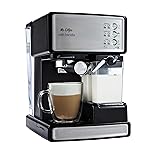
Mr. Coffee Cafe Barista
Best for: Buyers who want lattes and cappuccinos without learning to steam milk manually
Automatic milk frother with dedicated reservoir — one-touch cappuccinos and lattes with no steam wand technique required
- +Automatic milk frother — no steam wand technique needed
- +One-touch controls for espresso, cappuccino, and latte
- +14,100+ reviews — the most-reviewed machine in this roundup
- +Removable milk and water reservoirs for easy cleaning
- −Auto frother produces decent but not competition-quality microfoam
- −15-bar pump is adequate but espresso quality ceiling is lower than manual machines
- −Users frequently outgrow it within 1–2 years as their palate develops
- −Bulkier footprint than most competitors in this price range
✓ Free shipping with Prime · Affiliate link
Why We Recommend It
If you want lattes and cappuccinos and don’t want to learn steam wand technique, the Cafe Barista is the only machine under $200 that handles milk for you. Its automatic frother pulls milk from a dedicated reservoir and dispenses it directly into your cup — one button for espresso, one for cappuccino, one for latte. No steam wand, no frothing pitcher, no YouTube tutorials on microfoam technique.
With 14,100+ Amazon reviews — the highest count in this roundup — the Cafe Barista has an enormous owner base. It’s the machine that a lot of people start with before graduating to something with more control, and that progression is by design: it gets you drinking espresso-based milk drinks at home, and if you decide you want more, you upgrade with a clear sense of what you’re looking for.
Who It’s Best For
Buyers whose primary goal is homemade lattes and cappuccinos with minimal learning curve. The Cafe Barista is particularly strong for households where multiple people make milk drinks — its one-touch operation means anyone can use it without training.
Key Features
- Automatic milk frother with dedicated, removable milk reservoir
- One-touch controls for espresso, cappuccino, and latte
- 15-bar pump for espresso extraction
- Removable water and milk reservoirs for easy cleaning
Potential Downsides
The auto frother produces decent foam but not the silky, glossy microfoam that a manual steam wand can achieve with practice. Espresso purists on r/espresso consider the Cafe Barista a convenience machine, not a quality machine — the shot quality itself is adequate but won’t satisfy someone chasing genuine extraction. On Reddit, the Cafe Barista appears most often as the machine people are upgrading from, not to. At $184, it’s the most expensive machine in this roundup, and that premium buys you convenience rather than espresso quality. The bulkier footprint (10.3 x 12.6 x 15.4 inches) takes more counter space than the more compact competitors.
Affiliate link

Flair Classic
Best for: Espresso enthusiasts who want the best possible shot quality under $200 and don't mind a hands-on workflow
Manual lever generates true 6–9 bar pressure — produces espresso quality that electric machines at this price cannot match
- +Produces genuinely superior espresso to any electric machine at this price
- +Manual lever teaches pressure profiling and extraction fundamentals
- +No electronics — built from cast aluminum and stainless steel, lasts indefinitely
- +Completely portable with included carrying case
- −Requires boiling water separately and pre-heating the brew chamber
- −Cannot steam milk — no steam wand, no milk drinks without a separate frother
- −Manual workflow takes 5–10 minutes per shot vs 1–2 minutes on electric machines
- −Amazon flags it as a frequently returned item — the piston is the common failure point in owner reports
- −Requires an espresso-capable grinder — pressurized flow-control portafilter helps but non-pressurized is the goal
✓ Free shipping with Prime · Affiliate link
Why We Recommend It
The Flair Classic is a completely different kind of espresso machine — and that’s exactly why it’s here. It’s a manual lever press: no electronics, no pump, no steam wand. You boil water, add grounds, and pull a lever to generate 6–9 bar of genuine espresso pressure. The result is objectively better espresso than any electric machine on this list can produce, because you have direct, real-time control over pressure profiling — something that electric machines can’t replicate until the $1,500+ price range.
On r/espresso, Flair owners consistently report a breakthrough moment where extraction “clicks” — they start tasting the actual origin notes in their coffee for the first time. The manual lever teaches you what pressure does to extraction in a way that pushing a button on an electric machine never will. Built from cast aluminum and stainless steel with a 3-year warranty, the Flair has no electronics to fail and no boiler to descale.
Key Features
- Manual lever generates true 6–9 bar espresso pressure with integrated pressure gauge
- Two portafilters included — flow-control (beginner-friendly) and bottomless (advanced)
- Cast aluminum and stainless steel construction — no electronics to fail
- Fully portable with included carrying case
Who It’s Best For
Espresso enthusiasts who prioritize shot quality above everything else and are genuinely willing to trade convenience for it. The Flair rewards patience and curiosity — if adjusting pressure mid-shot and comparing extraction profiles sounds appealing rather than tedious, this is your machine.
Potential Downsides
The Flair’s workflow is the honest trade-off behind the Editor’s Pick badge. You need to boil water separately (kettle not included), pre-heat the brew chamber to avoid temperature drop, manually press each shot over 30–45 seconds, and clean the detachable brewing head after every use. Total time per shot: 5–10 minutes versus 1–2 minutes on an electric machine. There is no steam wand — if you want milk drinks, you’ll need a separate milk frother ($20–$50). For most under-$200 buyers who want to press a button and drink espresso before work, this workflow is a deal-breaker. For the subset who enjoy the process, it’s the point.
The Flair also requires an espresso-capable grinder to reach its full potential. The included flow-control portafilter is forgiving with coarser grinds, but switching to the bottomless portafilter — where the Flair truly shines — demands a burr grinder capable of fine espresso adjustment. If the manual lever workflow appeals to you, we compare the Classic against four other manual options in our best manual espresso machine roundup.
Affiliate link
Buyer’s Guide
The Grinder Matters More Than the Machine
This is the single most important piece of advice in this article, and every experienced home barista on Reddit will tell you the same thing — confirmed by our Coffee Community Census of 772 threads: the grinder matters more than the espresso machine. A $140 machine paired with a $100 hand grinder will produce better espresso than a $200 machine with pre-ground coffee from a bag.
At the under-$200 budget, here’s the real math on total cost of ownership:
- Entry setup (~$200): De’Longhi Stilosa ($100) + Kingrinder K6 hand grinder ($80) + basic scale ($15)
- Mid setup (~$260): CASABREWS CM5418 ($119) + 1Zpresso Q2S hand grinder ($120) + scale ($15)
- Quality-first setup (~$280): Flair Classic ($159) + Kingrinder K6 ($80) + gooseneck kettle ($30)
If you can only afford the machine right now, start with pre-ground espresso coffee and a pressurized basket — it will work. But plan the grinder as your first upgrade. The difference is not subtle.
Pressurized vs Non-Pressurized Baskets
Every electric machine in this roundup ships with pressurized baskets, which use a small hole in the bottom to create artificial back-pressure. This is a deliberate design choice: pressurized baskets are forgiving of uneven grinds and cheaper grinders, producing consistent-looking espresso with crema regardless of technique.
Non-pressurized (single-wall) baskets remove that artificial pressure, letting the coffee itself control extraction. The result is more nuanced, better-tasting espresso — but only if your grind is even and fine enough. Switching to a non-pressurized basket with a blade grinder produces watery, under-extracted shots.
The upgrade path: start with the included pressurized basket, invest in a capable burr grinder, then switch to a non-pressurized basket. This sequence — not the machine itself — is what transforms a $100–$150 espresso machine from “adequate” to “genuinely good.” The SCA’s brewing standards also apply here — water quality matters more with non-pressurized baskets because there’s no artificial back-pressure masking under-extraction, and water that’s too hard (above 250 ppm TDS) scales up cheap thermoblocks fast.
Why There’s No Breville on This List
You’ll notice no Breville in this roundup. The Bambino — Breville’s entry-level espresso machine and one of r/espresso’s most recommended beginner machines — starts around $250 for the base model and $350+ for the Bambino Plus. It’s an excellent machine, but it’s not a sub-$200 machine. If you can stretch your budget to $300–$500, our best espresso machines under $500 covers the Bambino Plus, the Breville Infuser, and the Gaggia Classic Evo Pro — all of which represent a meaningful step up in build quality, temperature stability, and mod potential. If you can go higher, our best espresso machines under $1,000 roundup covers the Breville Barista Express and Rancilio Silvia — machines with commercial-grade components and decade-long service lives.
The Upgrade Path Is the Point
Under $200, you’re buying a learning tool, not a forever machine. That’s not a criticism — it’s an honest framing that saves you money and frustration. On Reddit, the most common espresso upgrade paths from machines in this price range are:
- Stilosa → Breville Bambino Plus (1–2 years): The most common upgrade for buyers who catch the espresso bug and want faster workflow + better milk steaming
- Stilosa → Gaggia Classic Evo Pro (1–2 years): The mod-friendly path for buyers who discover they enjoy tinkering
- Flair Classic → Flair Pro or Cafelat Robot (2+ years): The manual-lever path for purists who want a bigger dose capacity or better thermal stability
Spending $100–$160 now and $300–$500 in a year is a smarter strategy than spending $500 today on something you might not use. The cheap machine teaches you what you actually value in espresso — speed, shot quality, milk drinks, convenience — and your next purchase is informed rather than hopeful.
Making Milk Drinks on a Budget
Steam wand quality varies enormously under $200. Here’s what to realistically expect:
- Mr. Coffee Cafe Barista: Automatic — push a button, get frothed milk. Quality is decent but not silky microfoam. Best for lattes and cappuccinos where you want convenience over art.
- De’Longhi ECP3420: Adjustable system produces good dry cappuccino foam and acceptable steamed milk. Better than the Stilosa, not as hands-on as a true manual wand.
- De’Longhi Stilosa: The Panarello attachment is weak. Most owners remove it and froth directly from the steam tip — this works better but requires technique.
- CASABREWS CM5418: Manual steam wand works but requires a mandatory cooldown after steaming before you can pull the next shot.
- Flair Classic: No milk capability at all. Budget $20–$50 for a separate handheld milk frother if you want milk drinks.
If daily lattes are your primary goal and learning to steam milk sounds unappealing, the Mr. Coffee Cafe Barista is the honest answer — its auto-frother handles the job without technique. For everyone else, expect a learning curve with manual steam wands at this price. The Specialty Coffee Association’s water quality standard recommends water at 75–250 ppm TDS for optimal extraction — and this applies to milk drinks too, since under-extracted espresso can’t be rescued by good foam.