The Breville Barista Express is the best espresso machine under $1,000 for most people — 27,000+ owners agree, its integrated grinder gets you from beans to espresso in under a minute, and PID temperature control keeps shots consistent without any manual fussing. If you’ve outgrown a Bambino Plus or basic machine and want more control without buying a separate grinder, start here.
We researched and compared over 25 machines in the $500–$1,000 range, cross-referencing real owner feedback from r/espresso, Home-Barista forums, and manufacturer specs. This price tier is where home espresso gets genuinely good: PID temperature control becomes standard, build quality steps up from plastic to metal, and the machines are capable enough to grow with you for years. If your budget caps at $500, our under-$500 picks (specifically the Breville Bambino Plus and Gaggia Classic Evo Pro) are the right starting point. This article is for buyers ready to step into more capable territory.
How We Evaluated
We focused on five criteria that matter most to someone spending $500–$1,000 on an espresso machine:
- Shot quality and consistency — PID temperature control, pre-infusion capability, and how repeatable the extraction is shot to shot.
- Build quality and longevity — Brass boilers outlast thermoblocks. Metal frames outlast plastic. We weighted long-term ownership, not just first impressions.
- Ease of use vs. growth ceiling — Some machines are easy day one but limiting by month six. Others demand more upfront but reward you for years. We note which is which.
- Steam performance — Every machine in this range can steam milk. The question is how well, how fast, and whether it supports latte art.
- Total cost of ownership — Machines with integrated grinders save $200–$400 upfront. Machines without grinders offer better espresso long-term but cost more total. We call this out for every pick.
1. Breville Barista Express — Beans to Espresso in Under a Minute

Breville Barista Express
Best for: Home baristas who want an all-in-one machine that delivers solid espresso without a separate grinder
you want one appliance, one workflow, and solid espresso without researching a separate grinder.
you already expect to chase shot quality or upgrade components independently.
Integrated conical burr grinder with dose control — beans to espresso in under a minute
- +27,000+ reviews at 4.5 stars — the most-proven espresso machine on Amazon
- +Integrated burr grinder eliminates the need for a separate grinder
- +PID temperature control for consistent extraction
- +Low-pressure pre-infusion for balanced flavor
- −Integrated grinder is the ceiling — enthusiasts outgrow it within 1-2 years
- −54mm portafilter limits aftermarket accessory options vs 58mm standard
- −Thermocoil heating is slower than ThermoJet models (Barista Pro, Touch)
✓ Free shipping with Prime · Affiliate link
Evidence notes
Community signal: Most proven integrated-grinder machine by owner volume, but the community census shows negative net sentiment because enthusiasts outgrow it.
Main tradeoff: The built-in grinder and 54mm portafilter become the upgrade ceiling.
Evidence note: The built-in-grinder article uses census sentiment, upgrade-path forum stories, and 27,000+ Amazon reviews.
Why We Recommend It
The Breville Barista Express has 27,000+ reviews at 4.5 stars — more verified owners than any other espresso machine on Amazon. That volume of feedback means its strengths and weaknesses are thoroughly documented, and there are no surprises. The integrated conical burr grinder with dose control eliminates the need for a separate grinder, saving $200–$400 upfront and significant counter space.
On r/espresso, the Barista Express is the machine people either start with or upgrade from — and both reactions validate it. Beginners appreciate the all-in-one simplicity. Enthusiasts who outgrow it typically do so after 1–2 years, which means most buyers get excellent value before hitting the grinder’s ceiling.
Key Features
- Integrated conical burr grinder with dose control — beans to portafilter in seconds
- PID temperature control for consistent extraction temperature
- Low-pressure pre-infusion gradually increases pressure for balanced flavor
- Manual steam wand capable of microfoam for latte art
Who It’s Best For
The buyer who wants solid espresso without managing two separate machines. If you’re upgrading from a Keurig, drip maker, or pod machine and want a single purchase that handles grinding and brewing, the Barista Express is the right first serious espresso machine.
Potential Downsides
- The integrated grinder is the ceiling — r/espresso owners consistently report outgrowing it within 12–18 months as their palate develops. The 54mm portafilter also limits aftermarket basket options compared to the industry-standard 58mm.
- Thermocoil heating is slower than the ThermoJet system in the Barista Pro and Touch — expect 30+ seconds to reach extraction temperature vs. 3 seconds.
For the full Breville lineup including the Bambino, Barista Pro, and Touch models, see our best Breville espresso machine guide. If you’re specifically looking for a machine with an integrated grinder, our best espresso machine with built-in grinder roundup covers all six semi-auto options in this category.
Affiliate link
2. Breville Barista Touch — The Easiest Path to Good Espresso
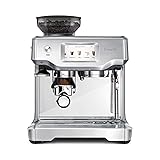
Breville Barista Touch
Best for: Beginners who want touchscreen guidance and pre-programmed drinks without a learning curve
multiple people in the house want saved drink presets and automatic milk texture.
you want manual steam control for latte art or fewer electronics to age.
Touchscreen with pre-programmed recipes and ThermoJet 3-second heat-up
- +Touchscreen with customizable drink presets — lowest friction path to good espresso
- +ThermoJet heats to extraction temperature in 3 seconds
- +Integrated grinder with dose control
- +Automatic steam wand for consistent milk texturing
- −Most expensive all-in-one in this lineup at $800
- −Touchscreen adds complexity that can fail — some owners report screen issues
- −Same 54mm portafilter limitation as the Express
- −Automatic steam wand limits latte art compared to manual wands
✓ Free shipping with Prime · Affiliate link
Evidence notes
Community signal: Owner sentiment is still negative in the census, but less harsh than the Express because milk automation solves a real household problem.
Main tradeoff: Touchscreen convenience adds complexity while keeping the same integrated-grinder ceiling.
Evidence note: The article uses census sentiment and owner comments about learning the grinder limits while keeping the machine for milk automation.
Why We Recommend It
The Barista Touch answers the question that floods r/espresso daily: “What am I doing wrong?” Its touchscreen interface with pre-programmed drink recipes removes the variables that trip up beginners — grind size, dose, extraction time, and milk temperature are all guided. You customize to taste over time, but day one is immediately productive.
The ThermoJet heating system reaches extraction temperature in 3 seconds, which transforms the morning routine. No warm-up wait, no temperature surfing — you walk up, press the screen, and pull a shot.
Key Features
- Color touchscreen with customizable drink presets — espresso, latte, cappuccino, flat white, and more
- ThermoJet 3-second heat-up — ready to brew almost instantly
- Automatic steam wand with adjustable milk texture settings
- Integrated grinder with dose control
Who It’s Best For
First-time espresso buyers who value convenience and consistency over manual control. If you want your morning espresso to work like an appliance rather than a hobby — press a button, get a drink — the Touch delivers that reliably.
Potential Downsides
- At $800, it’s the most expensive all-in-one in this lineup. The Express delivers 90% of the same capability for $250 less.
- The automatic steam wand limits latte art compared to the manual wands on the Pro and Express. If milk art matters to you, the Touch isn’t the right pick.
- Some owners report touchscreen reliability issues after 2–3 years of daily use.
Affiliate link
3. Ninja Luxe Café Premier — Three Machines in One

Ninja Luxe Café Premier
Best for: Buyers who want espresso, drip coffee, and cold brew from a single machine
your household wants espresso, drip, and cold brew from one machine at the lowest price in this lineup.
you only care about espresso quality or want a mature reliability record.
3-in-1 system (espresso + drip + rapid cold brew) with weight-based dosing and hands-free frothing
- +Three machines in one — espresso, drip coffee, and rapid cold brew
- +Weight-based dosing with built-in scale — more precise than time-based grinding
- +Hands-free Dual Froth System steams and whisks simultaneously
- +Barista Assist Technology provides guided grind and brew adjustments
- −Jack-of-all-trades — espresso quality won't match a dedicated espresso machine at the same price
- −Newer product (2024) — long-term reliability unproven
- −Large footprint for a kitchen counter
- −25 grind settings — fewer than the 30 on Breville Pro
✓ Free shipping with Prime · Affiliate link
Evidence notes
Community signal: Polarizing: owners value the 3-in-1 convenience, while espresso-focused threads flag early reliability and grinder-consistency concerns.
Main tradeoff: Newer 2024 product with thinner long-term durability evidence than the Breville machines.
Evidence note: The article cites r/NinjaLuxeCafe owner discussion, one-week failure reports, and the machine's unique 3-in-1 feature set.
Why We Recommend It
The Ninja Luxe Café is the only machine in this lineup that does espresso, drip coffee, and rapid cold brew — three separate brewing methods from a single machine at $511. Its weight-based dosing (built-in scale) is more precise than the time-based grinding on Breville machines, and the hands-free Dual Froth System steams and whisks simultaneously.
A word on positioning: the Ninja is built for multi-function convenience, not espresso purism. If shot quality is your primary criterion, the Breville Barista Express or Rancilio Silvia will produce better espresso. If you want one machine that replaces your drip maker, cold brew pitcher, and espresso setup, the Ninja is genuinely the best value per dollar in this range.
Key Features
- 3-in-1 brewing — espresso (double or quad shot), drip coffee (6–18 oz), and rapid cold brew
- Weight-based dosing with built-in scale for precise, consistent doses
- Barista Assist Technology provides real-time grind and brew adjustment recommendations
- Hands-free Dual Froth System combines steaming and whisking for dairy and plant-based milk
Who It’s Best For
Households where not everyone drinks espresso. If your partner wants drip coffee, you want espresso, and weekend you wants cold brew — the Ninja covers all three without three machines on the counter.
Potential Downsides
- Jack-of-all-trades, master of none. Dedicated espresso machines at this price produce better shots. The trade-off is versatility.
- Released in 2024 — long-term reliability is unproven compared to the Breville Express (10+ years on market) or Rancilio Silvia (20+ years).
- Larger footprint than most single-function machines.
Affiliate link
4. Breville Barista Pro — Fast Heat, Precise Control

Breville Barista Pro
Best for: The all-rounder buyer who wants fast heat-up and precise control without paying for a touchscreen
you want the best daily-driver version of the integrated Breville workflow without touchscreen automation.
the same budget could buy a Bambino Plus and standalone grinder with more upgrade flexibility.
ThermoJet 3-second heat-up with LCD display for precise shot control
- +ThermoJet heats in 3 seconds — fastest warm-up in the Breville lineup
- +LCD display for grind size, shot time, and temperature feedback
- +Integrated grinder with 30 grind settings
- +Instant transition from espresso to steam — no wait between brew and milk
- −Same integrated grinder ceiling as Express — enthusiasts will outgrow it
- −54mm portafilter limits aftermarket basket options
- −Manual steam wand requires practice for latte art
✓ Free shipping with Prime · Affiliate link
Evidence notes
Community signal: Forum upgrade stories frame the Pro as a faster Barista workflow, not a different long-term upgrade path.
Main tradeoff: The premium buys speed and interface, not a fundamentally better grinder.
Evidence note: The article anchors this pick on ThermoJet workflow value and negative-but-less-severe census sentiment than the Express.
Why We Recommend It
The Barista Pro is the Breville that doesn’t make you choose. ThermoJet’s 3-second heat-up means it’s ready for a quick weekday shot. The LCD display and 30 grind settings give you enough precision for weekend dialing-in sessions. The manual steam wand lets you practice real latte art. It covers the widest range of espresso scenarios in the Breville lineup without the Touch’s $800 price or the Express’s slower thermocoil.
The instant transition from espresso to steam — no wait between pulling a shot and frothing milk — is a meaningful quality-of-life upgrade over the Express, especially if you’re making multiple milk drinks each morning.
Key Features
- ThermoJet 3-second heat-up with instant espresso-to-steam transition
- LCD display showing grind size, shot time, and extraction feedback
- 30 grind settings — finer adjustment than the Express’s stepped dial
- Manual steam wand for full control over milk texture
Who It’s Best For
The buyer who wants the fastest Breville experience without paying for a touchscreen. If you value speed (ThermoJet), precision (LCD + 30 grind settings), and milk control (manual wand) in a single machine, the Pro is the sweet spot.
Potential Downsides
- Same integrated grinder ceiling as the Express — the grinder is the limiting factor for espresso quality, and it’s not upgradeable.
- 54mm portafilter limits aftermarket options.
- At $680, it sits close to the Express ($550) with incremental rather than transformative improvements — the ThermoJet and LCD are nice, not necessary.
Affiliate link
5. De’Longhi La Specialista Arte — The Compact Italian Alternative
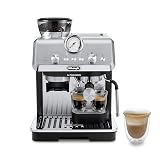
De'Longhi La Specialista Arte
Best for: Latte art learners who want a compact Italian-designed machine with a cool-touch steam wand
you want a compact non-Breville machine with a cool-touch wand for milk practice.
you want the most battle-tested integrated-grinder ecosystem and accessory support.
My Latte Art steam wand stays cool-to-touch after steaming — safer and easier for beginners learning milk texturing
- +My Latte Art wand stays cool-to-touch — genuine differentiator for learning latte art
- +Compact design fits smaller kitchen counters
- +3 infusion temperatures for matching water to bean variety
- +Italian-made conical burr grinder with 8 settings
- −Only 8 grind settings — less precise than Breville's 30 settings
- −4.0-star rating is the lowest in this lineup
- −Only 3 preset recipes (espresso, americano, hot water) vs Ninja's full drink menu
- −No cold brew capability
✓ Free shipping with Prime · Affiliate link
Evidence notes
Community signal: Thinner product-specific forum signal than Breville; the article treats broader Specialista owner reports as directional.
Main tradeoff: Only 8 grind settings, lower Amazon rating, and less established US service discussion than Breville.
Evidence note: Included for compactness and steam-wand differentiation, with the article explicitly noting thin Arte-specific community data.
Why We Recommend It
The La Specialista Arte is the pick for buyers who want something different from the Breville ecosystem. Its My Latte Art steam wand stays cool-to-touch after steaming — a genuine differentiator that makes learning milk texturing less intimidating and safer. The machine’s Italian design language stands apart visually, and at 15 pounds it’s significantly lighter than the 23-pound Brevilles.
De’Longhi’s Active Temperature Control offers 3 infusion temperature settings, letting you match water temperature to bean variety. The compact 34 oz water tank and smaller footprint make this the right pick for kitchens where counter space is at a premium.
Key Features
- My Latte Art steam wand — cool-to-touch housing for safer, more comfortable milk steaming
- Active Temperature Control with 3 infusion temperature settings
- Compact design — smallest footprint and lightest weight in this lineup
- Italian-made conical burr grinder with barista toolkit (tamping guide and mat)
Who It’s Best For
Buyers with limited counter space who want a quality espresso machine that doesn’t dominate the kitchen. Also a strong pick for latte art learners — the cool-touch wand removes the “hot metal next to your hand” anxiety that comes with learning on traditional steam wands. If counter space is your primary constraint, our compact espresso machine roundup covers the slimmest options across all budgets.
Potential Downsides
- Only 8 grind settings — significantly less precision than Breville’s 30. If you’re particular about dialing in, this is a limitation.
- 51mm portafilter is the smallest in this lineup, limiting aftermarket options further than Breville’s 54mm.
- 34 oz water tank needs refilling frequently with daily use.
- 4.0-star Amazon rating is the lowest in this lineup — some owners report build quality issues and inconsistent grinding.
Affiliate link
6. Rancilio Silvia — The Machine You’ll Keep for a Decade

Rancilio Silvia
Best for: Enthusiasts who want commercial-grade build quality and a machine they'll keep for a decade
Commercial-spec 58mm group head and brass boiler from Rancilio's commercial lineup — the same components that run cafe machines
- +58mm commercial portafilter — industry standard, massive accessory ecosystem
- +Iron frame and brass boiler built for 10–20+ year service life
- +The most moddable machine in this range (PID kits, Gaggiuino, 3D-printed accessories)
- +20+ year production run — proven platform with known failure points and easy parts sourcing
- −No PID temperature control — requires temperature surfing for best results (or a $50-$100 PID kit)
- −No integrated grinder — budget an additional $200–$400 for a standalone grinder
- −Single boiler means switching between brew and steam takes 30-60 seconds
- −Compact cup clearance limits taller cups and mugs
✓ Free shipping with Prime · Affiliate link
Why We Recommend It
The Rancilio Silvia is the only machine in this lineup built with commercial-grade components. Its 58mm group head is the same size used in cafe espresso machines — which means every commercial tamper, basket, and portafilter accessory fits. The iron frame and brass boiler are the kind of hardware that runs for 10–20+ years with basic maintenance. On r/espresso, owners report running modded Silvias for 4, 7, even 10+ years of daily use.
The Silvia’s real value proposition isn’t what it does out of the box — it’s what it becomes. A $50 PID kit adds temperature control. A $15 OPV spring swap optimizes pressure. The Gaggiuino project transforms it into a flow-profiling machine with capabilities approaching $2,000+ setups. No other machine under $1,000 offers this upgrade path.
This is the prosumer ceiling of the under-$1,000 range. If you want to buy once and grow into your machine for years, the Silvia rewards that commitment.
Key Features
- 58mm commercial portafilter — industry standard with the largest accessory ecosystem
- Iron frame and brass boiler — built for decades of daily service
- Commercial-grade group head from Rancilio’s professional lineup
- Three-way solenoid valve for clean puck removal and easy backflushing
- Articulating steam wand with professional steaming knob for precise milk control
Who It’s Best For
Enthusiasts who see espresso as a long-term skill, not just a morning routine. The Silvia rewards investment: investment in a good grinder ($200–$400 separately), investment in learning technique, and investment in mods over time. If you enjoy the process of improving your setup, no machine at this price offers more ceiling.
Potential Downsides
- No PID temperature control out of the box — the Silvia requires temperature surfing (flushing water to stabilize brew temperature) for best results. Most serious owners add a PID kit within the first few months.
- No integrated grinder — budget an additional $200–$400 for a standalone espresso grinder. The r/espresso consensus is that this is actually an advantage (better grinder = better espresso), but it increases total cost.
- Single boiler workflow — switching from brew to steam temperature takes 30–60 seconds. Fine for 1–2 drinks; tedious for a household making 3+ drinks each morning.
- 571 Amazon reviews is lower than the rest of this lineup — the Silvia is primarily sold through specialty dealers (Whole Latte Love, Clive Coffee). Its reputation is built on 20+ years of community trust, not Amazon volume.
Affiliate link
Buyer’s Guide
Integrated Grinder vs. Separate Machine + Grinder
The biggest decision in this price range isn’t which machine — it’s whether you want your grinder built in.
Four machines in this lineup (Breville Barista Express, Barista Pro, Barista Touch, and Ninja Luxe Café) include integrated grinders. The De’Longhi La Specialista Arte also includes one. The Rancilio Silvia does not — it requires a separate grinder ($200–$400).
The trade-off is straightforward. Integrated grinders save money upfront and counter space. But every integrated grinder in this lineup is a conical burr with limited adjustment range (8–30 settings depending on model). A dedicated grinder like the Eureka Mignon Zero, DF64, or Niche Zero offers finer adjustment, more consistency, and — crucially — upgradeability. When you outgrow the machine’s grinder, you replace a $200–$400 component rather than the entire $550–$800 machine.
If you’re buying your first serious espresso setup, an all-in-one machine is the pragmatic choice. If you already own a capable grinder or plan to invest in espresso long-term, the Rancilio Silvia with a standalone grinder is the configuration that r/espresso consistently recommends.
Why the Grinder Matters More Than the Machine
The single most repeated piece of advice on r/espresso: invest in the grinder. A $300 grinder paired with a $500 machine will consistently outperform a $700 machine with a $100 grinder. The grinder determines the consistency of your grind particles, which directly controls extraction quality. The machine’s job is to push water through those grounds at the right temperature and pressure — but if the grounds are uneven, no amount of PID precision or pre-infusion will fix the shot.
This matters for this lineup because the integrated grinders in the Breville and Ninja machines are good but not great. They’ll produce solid espresso for most buyers, but they’re the component you’ll hit the ceiling on first. When threads on r/espresso ask “why do my shots taste flat?”, the answer is almost always grinder-related, not machine-related.
Single Boiler Reality: What to Expect with Milk Drinks
Every machine under $1,000 in this lineup uses a single boiler (or thermoblock). This means you cannot brew espresso and steam milk simultaneously — you pull the shot first, then wait for the boiler to reach steam temperature (15–60 seconds depending on the machine), then steam your milk.
For a single morning latte, this is a non-issue. For two or three milk drinks, the workflow is manageable but noticeable. For a household of four making cappuccinos, you’ll feel the limitation.
ThermoJet machines (Breville Barista Pro and Touch) transition from brew to steam almost instantly, significantly reducing wait time. Thermocoil machines (Barista Express, Ninja) take longer. The Rancilio Silvia’s brass boiler holds more heat but transitions the slowest without a PID mod. True dual boiler machines that eliminate this wait entirely start at $1,500+ (Breville Dual Boiler) or $2,000+ (Rancilio Silvia Pro X).
What PID Temperature Control Actually Does
PID (Proportional-Integral-Derivative) is a control algorithm that maintains precise water temperature during extraction. Without PID, boiler temperature swings between shots — the first shot might brew at 200°F, the second at 195°F, the third at 205°F. These fluctuations produce inconsistent extraction: one shot tastes perfect, the next is sour, the next is bitter.
Every Breville machine in this lineup includes PID. The Ninja includes temperature management through its Barista Assist system. The De’Longhi uses Active Temperature Control. The Rancilio Silvia is the exception — it ships without PID, relying on a bimetallic thermostat that’s less precise. Most Silvia owners add an aftermarket PID kit ($50–$100) within the first few months.
The Specialty Coffee Association’s coffee standards recommend brewing water between 90.5–96°C (195–205°F). PID control keeps you in this range consistently; without it, you’re temperature surfing — manually flushing water to approximate the right temperature before each shot.
The Upgrade Path: When You’ve Outgrown Entry-Level
If you’re reading this, you’ve likely already answered the question. The jump from a $100–$300 machine to this tier is the biggest quality-of-life improvement in home espresso. Temperature stability improves dramatically. Steam power steps up. Build quality goes from “will this last 2 years?” to “this will last 5–10 years.”
On r/espresso, the upgrade path from entry-level to this tier is the most common discussion topic. Breville Bambino Plus owners frequently report wanting more temperature control. Basic De’Longhi owners want better steam. Keurig converts want real espresso. Every machine in this lineup satisfies those needs — the question is which features matter most to you.
If you’re coming from a Bambino Plus or similar entry-level machine and your budget caps at $500, our under-$500 picks — specifically the Gaggia Classic Evo Pro and Breville Bambino Plus — deliver excellent results at that tier. If you’re coming from under $200, our under-$200 picks get you pulling real espresso without the learning curve.
A Note on Machines Not Available on Amazon
The r/espresso community’s favorites in this price range include the Profitec Go ($900) and Lelit Victoria ($700) — both excellent machines with PID, brass boilers, and dedicated enthusiast followings. They’re not in this lineup because they’re not sold on Amazon. If you’re willing to buy from specialty retailers like Whole Latte Love or Clive Coffee, both are worth considering. The Profitec Go in particular is the default recommendation on r/espresso for the $800–$900 tier, with its PID, 58mm portafilter, and build quality that matches machines at twice the price.