If you want a semi-automatic machine that lets you control every variable — grind, dose, tamp, extraction time — read our best espresso machine roundup instead. Every machine on that list will produce better espresso than every machine on this one. That is not a caveat buried in the buyer’s guide. That is the honest starting point for a super-automatic roundup. And if you searched “espresso machine with built-in grinder” and landed here, note the distinction: super-automatics are push-button, no portafilter. Semi-automatics with integrated grinders — the Barista Express, Ninja Luxe Cafe, La Specialista Arte — are a different category. Our best espresso machine with built-in grinder roundup covers those.
Super-automatic espresso machines exist for people who already know that tradeoff and have decided: they want one-button café drinks, not a barista hobby. On r/superautomatic, a Lelit Bianca owner who bought a Jura for their parents described the value proposition perfectly: “90% as good for 10% of the effort.” On r/espresso, an office with both a Jura and a semi-automatic ECM found that colleagues could taste the difference — but when they were busy, they still walked to the Jura. If you are the person at the Jura, this roundup is for you. If you are the person at the ECM, you already have better options under $500.
We researched over 20 super-automatic machines, analyzed 45+ Reddit threads across r/espresso, r/Coffee, r/superautomatic, and r/jura, and compared these six on espresso quality, milk system design, daily maintenance, and long-term reliability. The category runs from $400 to $4,000 — we focused on the $540–$1,700 range where the strongest options land.
How we evaluated
We focused on five criteria specific to the super-automatic category — different from how we evaluate semi-automatics, because different things matter when the machine handles the workflow:
- Espresso quality within the super-auto ceiling — All super-automatics use integrated burr grinders that cannot match a dedicated grinder, fixed pressure profiles that cannot replicate pre-infusion variance, and thermoblocks or small boilers with less temperature stability than commercial group heads. We evaluated which machines produce the best results within those constraints — not against semi-automatics.
- Milk system design and daily cleanup — The milk system is the defining differentiator between super-automatics. We prioritized systems that are genuinely easy to clean daily (Philips LatteGo: 2 parts, no tubes, 15-second rinse) over systems with more features but more maintenance friction.
- Grinder usability — Super-auto grinders are set-and-forget compared to standalone grinders, but new owners consistently struggle with dialing in. We evaluated how intuitive each machine’s grind adjustment is and how forgiving it is with different bean types.
- Reliability and maintenance burden — Super-automatics have more moving parts than any other coffee machine category. We checked owner reports for brew group failures, descaling frequency, and the dreaded error codes that send machines to service.
- Total cost of ownership — The machine price is just the start. Descaling tablets, milk system cleaners, water filters, and potential service visits add up. Jura’s recommended $375–$400 biannual servicing, for example, dramatically changes the long-term math.
1. De’Longhi Magnifica Evo — The One Most People Buy

De'Longhi Magnifica Evo with LatteCrema System
Best for: Most people who want one-button espresso, lattes, and cappuccinos without learning barista skills
7 one-touch recipes with De'Longhi's LatteCrema automatic milk system that textures dairy and plant-based alternatives
- +Best-selling super-automatic in the US — more owners means more troubleshooting resources and replacement parts availability
- +LatteCrema milk system produces consistent microfoam for lattes and cappuccinos with one button press
- +Removable brew group allows manual cleaning — a significant maintenance advantage over sealed-unit competitors
- +13 grind settings with conical burr grinder and Over Ice recipe for iced coffee
- −3.9 stars across 1,637 reviews — lower than semi-automatics at this price, reflecting the super-auto quality ceiling
- −Water reservoir is small (60 oz) and needs refilling daily for multi-cup households
- −Espresso shots lack the crema depth and body of a dedicated semi-automatic at the same price point
- −LatteCrema carafe has multiple parts that need daily disassembly and cleaning despite the auto-clean cycle
✓ Free shipping with Prime · Affiliate link
Why we recommend it
The Magnifica Evo is the best-selling super-automatic espresso machine in the United States, and the reason is simple: it does everything a super-auto should do for $600. Seven one-touch recipes, De’Longhi’s LatteCrema automatic milk system, a 13-setting conical burr grinder, and an Over Ice function for iced coffee. On r/superautomatic, a buyer who found the Magnifica Evo on sale at Best Buy chose it over the Breville Barista Express — comparable price, zero learning curve. One owner reported going on four years with “no drama.”
The Magnifica Evo’s strongest advantage over competitors is its removable brew group. Philips machines have sealed brew groups that rely on auto-rinse cycles. De’Longhi lets you pull the brew group out and wash it under the tap. After six months of daily use, that difference matters. The De’Longhi community also consistently recommends the Magnifica line across every price point: “Any De’Longhi is probably your best bet. They all share the same brew group.”
Key features
- LatteCrema automatic milk system textures dairy and plant-based milk into consistent microfoam with one button press
- Removable brew group allows manual cleaning — no reliance on auto-rinse cycles for hygiene
- 13-setting conical burr grinder with a community-recommended sweet spot around 3.5 for medium roasts
- Over Ice recipe adjusts dose and brew strength for espresso poured directly over ice
Who it’s best for
People who want the most-proven super-automatic at the lowest price that still includes automatic milk frothing. If you are upgrading from a Keurig, Nespresso, or basic drip machine and want lattes and cappuccinos without learning barista skills, start here.
Potential downsides
- 3.9 stars across 1,637 reviews — lower than semi-automatics at this price, reflecting the super-auto category’s structural Amazon rating pattern (most rate 3.7–3.9)
- Noise is a specific complaint — one owner’s spouse called it “so noisy.” The Philips 5500’s SilentBrew is 40% quieter if early-morning noise matters
- Espresso quality sits firmly below what a $400 Breville Bambino Plus paired with a $150 Baratza Encore can produce — you are paying for convenience, not shot quality
- LatteCrema carafe requires daily disassembly and cleaning despite the “auto-clean” branding — skip a day and you risk mold growth in the milk lines
Affiliate link
2. Philips 3200 Series LatteGo — The Easiest Milk System to Clean

Philips 3200 Series LatteGo
Best for: Buyers who want the easiest possible cleanup — the LatteGo milk system rinses clean in 15 seconds with no tubes to disassemble
2-part LatteGo milk system with no internal tubes — the fastest milk-system cleanup of any super-automatic
- +LatteGo milk system has only 2 parts and no internal tubes — rinses clean in 15 seconds or goes straight in the dishwasher
- +100% ceramic grinder resists wear longer than steel burrs and won't overheat beans during grinding
- +AquaClean filter means no descaling for up to 5,000 cups when replaced on schedule
- +6,149 reviews at 4.0 stars — the most-reviewed super-automatic on Amazon with a rating at or above 4.0
- −Only 5 drink presets — fewer options than comparably priced De'Longhi or Gaggia machines
- −Brew group is not removable — cleaning relies on the automatic rinse cycle rather than manual disassembly
- −Milk temperature runs cooler than competitors — multiple owners report drinks are not hot enough even at max settings
- −Limited customization compared to the Philips 5500 — no user profiles, no strength memory per drink
✓ Free shipping with Prime · Affiliate link
Why we recommend it
The Philips 3200 LatteGo has 6,149 reviews at 4.0 stars — more reviews than any other super-automatic on Amazon with a rating at or above 4.0. That mass validation is not an accident. The LatteGo milk system has only two parts, no internal tubes, and rinses clean in 15 seconds. Every other milk system on this list requires more disassembly, more parts, or more time. If you make milk drinks daily and the thought of cleaning a milk carafe every night makes you tired, the LatteGo solves it.
Philips uses a 100% ceramic grinder instead of steel burrs. Ceramic resists wear longer, stays sharper over years of daily use, and does not overheat beans during grinding. A Philips 4300 owner reported 16,000 cycles on their machine “and it’s great.” The tradeoff: fewer grind settings (12 vs De’Longhi’s 13) and a non-removable brew group — you cannot manually clean the brew unit, which the community calls “a stinker to clean.”
Key features
- 2-part LatteGo milk system with no internal tubes — rinses clean in 15 seconds or goes in the dishwasher
- 100% ceramic grinder with 12 settings — resists wear longer than steel burrs
- AquaClean filter eliminates descaling for up to 5,000 cups when replaced on schedule
- 4.0 stars across 6,149 reviews — the most-validated super-automatic on Amazon
Who it’s best for
Buyers who will make milk drinks daily and want the absolute minimum cleanup friction. If the De’Longhi LatteCrema carafe sounds like too much work, the LatteGo is the answer.
Potential downsides
- Only 5 drink presets — the fewest options on this list
- Brew group is sealed and non-removable — cleaning depends entirely on the machine’s auto-rinse cycle, and coffee oil buildup becomes a problem over time
- Multiple owners report milk drinks are not hot enough, even at the maximum temperature setting — a known LatteGo limitation
- No user profiles — everyone shares the same strength and volume settings
Affiliate link
3. Philips 5500 Series LatteGo — The Quiet One for Shared Households

Philips 5500 Series LatteGo
Best for: Multi-person households that want quiet morning brewing, saved drink profiles for each family member, and the most drink options under $1,000
20 hot and iced coffee presets with SilentBrew technology (40% quieter, Quiet Mark certified) and 4 saved user profiles
- +SilentBrew technology is 40% quieter than standard super-automatics — Quiet Mark certified for early-morning brewing without waking the house
- +20 drink presets including iced coffee variations — the most options of any machine under $1,000 in this roundup
- +4 user profiles save strength, volume, and milk preferences per person — best for shared households
- +QuickStart technology is ready to brew in 3 seconds — no warm-up wait
- −Only 261 reviews — newer listing without the long-term reliability data of the Philips 3200 (6,149 reviews)
- −$350 more than the Philips 3200 LatteGo — the premium buys SilentBrew, more presets, and user profiles, not better espresso
- −Same non-removable brew group as all Philips machines — you cannot manually clean it, relying on auto-rinse cycles
- −The 20 presets include variations (iced espresso, iced americano, iced coffee) that are essentially the same brew over ice — actual unique recipes number closer to 12
✓ Free shipping with Prime · Affiliate link
Why we recommend it
The Philips 5500 is the only super-automatic on this list with SilentBrew technology — Quiet Mark certified at 40% quieter than standard machines. If you brew at 6 AM and someone is sleeping 20 feet away, this is the machine that does not wake them. The De’Longhi Magnifica Evo is noticeably loud by comparison — one owner’s spouse “hates” the noise. If early-morning stealth matters, the $350 premium over the Philips 3200 buys genuine peace.
The 4 user profiles save strength, volume, and milk preferences per person. In a household of 3–4 coffee drinkers with different preferences, each person gets their drink with one touch rather than adjusting settings every morning. The 20 presets include hot and iced coffee variations — though realistically, the “20” includes iced versions of existing recipes, so unique recipes number closer to 12.
Key features
- SilentBrew technology — 40% quieter than standard super-automatics, Quiet Mark certified
- 4 user profiles save individual strength, volume, and milk preferences
- QuickStart — ready to brew in 3 seconds, no warm-up wait
- LatteGo 3-part milk system — same tube-free, dishwasher-safe design as the Philips 3200
Who it’s best for
Multi-person households that want quiet morning brewing and personalized drink settings without anyone touching the machine’s configuration. The 4 user profiles and SilentBrew combination is unique in this price range.
Potential downsides
- Only 261 reviews — newer listing without the long-term reliability data of the Philips 3200 (6,149 reviews)
- $350 more than the Philips 3200 LatteGo — you pay for SilentBrew, more presets, and user profiles, not better espresso
- Same non-removable brew group as all Philips machines — you rely on auto-rinse cycles for cleaning
- The “20 presets” marketing counts iced variations as separate recipes — genuinely unique options number closer to 12
Affiliate link
4. Gaggia Cadorna Prestige — Italian Heritage in a Super-Automatic

Gaggia Cadorna Prestige
Best for: Buyers who want Italian espresso heritage and one-touch milk drinks in a super-automatic — the brand that invented the modern espresso machine
14 pre-programmed beverages with integrated milk carafe, 4 user profiles, and full-color TFT display from the company that patented the modern espresso machine
- +14 beverages including flat white, cortado, and cafe au lait — the most Italian-style drink variety in this roundup
- +Gaggia's heritage: the company patented the lever espresso machine in 1938, and the Cadorna inherits decades of brew group engineering
- +Integrated milk carafe with automatic rinse cycle reduces cleanup friction for milk-heavy households
- +4 user profiles with per-drink customization of strength, volume, temperature, and milk ratio
- −Multiple owners report Error Code 14 (brew unit failure) within the first year — a known reliability concern in Amazon reviews
- −3.9 stars across 199 reviews — the error-code complaints pull the rating below 4.0
- −At $1,000, you pay a premium for Gaggia's brand and drink variety over the De'Longhi Evo ($600) with similar core brew hardware
- −Gaggia's US warranty and parts support is less established than De'Longhi's or Philips's US service networks
✓ Free shipping with Prime · Affiliate link
Why we recommend it
Gaggia patented the lever espresso machine in 1938. The Cadorna Prestige carries that Italian heritage into the super-automatic format with 14 pre-programmed beverages — the widest drink menu on this list, including flat white, cortado, and café au lait alongside the standard espresso and cappuccino. One owner logged 2,500 drinks in 1.5 years — 4.5 drinks a day for two adults — and praised the interface as “the easiest ever, everything is touch and intuitive.”
The catch is reliability. The Cadorna has a documented failure pattern that you should know about before buying. We gave it the Editor’s Pick badge for its drink variety and heritage, not for reliability — if you value uptime over beverage breadth, the Philips 5500 or De’Longhi Evo are safer choices.
Key features
- 14 pre-programmed beverages — the most Italian-style drink variety on this list, including flat white, cortado, café au lait, and cappuccino XL
- Gaggia heritage — the company that patented the modern espresso machine, with 85+ years of brew group engineering
- Integrated milk carafe with automatic rinse cycle after each milk drink
- 4 user profiles with per-drink customization of strength, volume, temperature, and milk ratio
Who it’s best for
Buyers who want the widest drink variety from a brand with genuine espresso heritage. If you drink cortados, flat whites, and café au lait — not just espresso and cappuccino — the Cadorna’s 14-beverage menu covers more ground than any competitor under $1,200.
Potential downsides
- Multiple owners report Error Code 14 (brew unit failure) within the first year — a documented reliability concern in Amazon reviews that should give pause
- 3.9 stars across 199 reviews — the error-code complaints pull the rating below 4.0
- At $1,000, you pay a premium for Gaggia’s brand and drink variety over the De’Longhi Evo ($600) that shares similar core brew hardware
- Gaggia’s US warranty and parts support network is less established than De’Longhi’s or Philips’s — getting service may require more effort
Affiliate link
5. Jura E4 — Swiss Precision for Espresso Purists
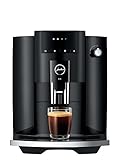
Jura E4 Piano Black
Best for: Buyers who want the best possible super-automatic espresso and are willing to pay for Swiss engineering — the entry point to Jura's ecosystem
Jura's Pulse Extraction Process (P.E.P.) optimizes extraction time for short specialty coffees, with an eighth-generation brew unit and Professional Aroma Grinder
- +Highest Amazon rating (4.2 stars) of any super-automatic with 100+ reviews in this roundup — Jura's quality reputation is validated by owners
- +Pulse Extraction Process (P.E.P.) pulses water through the grounds for short specialties like ristretto and espresso — a genuine extraction advantage over continuous-flow competitors
- +Professional Aroma Grinder preserves 12.2% more aroma than conventional grinders per Jura's testing
- +Single-serve design uses only the beans needed per cup — no waste, no stale grounds sitting in a brew group
- −At $1,394, the E4 costs more than twice the De'Longhi Magnifica Evo — you pay for Jura's build quality and extraction technology, not for more features
- −Only 5 drink specialties (espresso, coffee, ristretto, cafe barista, lungo barista) — no one-touch milk drinks without a separate Jura milk accessory ($80+)
- −Jura sells primarily through authorized dealers — Amazon stock fluctuates and warranty claims may require going through Jura directly
- −150 reviews on Amazon — Jura's authorized-dealer model means less Amazon review data than mass-market competitors
✓ Free shipping with Prime · Affiliate link
Why we recommend it
The Jura E4 has the highest Amazon rating of any super-automatic with 100+ reviews on this list: 4.2 stars. That rating reflects something genuine about Jura’s approach — the Pulse Extraction Process (P.E.P.) pulses water through the grounds during short specialty drinks like ristretto and espresso, creating an extraction pattern closer to what a semi-automatic achieves with pre-infusion. Even in community head-to-head comparisons, Jura espresso consistently rates at the top of the super-auto category.
Jura machines are built for longevity. On r/superautomatic, a Z5 owner reported 15 years of daily use; a J8 owner reported 14 years on their first unit before upgrading; an Impressa F7 owner reported almost 25 years. No other brand in this roundup has that track record. The build quality commands a price premium — $1,394 — but the per-decade cost amortizes if the machine lasts.
Key features
- Pulse Extraction Process (P.E.P.) — pulses water for short specialties, creating extraction variance that fixed-pressure competitors cannot replicate
- Professional Aroma Grinder designed for decade-plus service life
- Eighth-generation brew unit with 3D brewing technology
- Single-serve design grinds only the beans needed per cup — no waste, no stale grounds in the brew group
Who it’s best for
Buyers who want the best possible super-automatic espresso and are willing to pay for Swiss engineering and a machine built to last 10–15+ years. The E4 is the entry point to Jura’s ecosystem — if espresso quality matters more to you than one-touch milk drinks, this is the machine. It’s also among the most compact super-automatics available — for more on compact machines across all types, see our compact espresso machine roundup.
Potential downsides
- At $1,394, the E4 costs more than twice the De’Longhi Magnifica Evo — and Jura’s US pricing is widely considered inflated (the Jura E8 costs $3,100 in the US vs €888 in Germany; the community consensus is blunt: “Jura is overpriced in the US”)
- Jura recommends biannual servicing at $375–$400 per visit — “it’s a coffee machine, not a car,” as one frustrated owner put it. This significantly increases total cost of ownership
- Only 5 drink specialties and no built-in milk system — making lattes requires a separate Jura Cool Control ($80+) or a standalone frother
- If you are spending $1,394 on coffee equipment, a $550 Breville Barista Express plus a dedicated grinder will produce better espresso — the Jura wins on convenience and longevity, not shot quality
Affiliate link
6. KitchenAid KF8 — The Premium Disruptor

KitchenAid KF8 Fully Automatic Espresso Machine
Best for: Buyers who want Jura-level espresso quality and build at roughly half the price — the premium disruptor the community is rallying behind
Manufactured in the same factory as Jura and Miele with metal-clad construction, 40+ drink recipes, color touchscreen, and a milk system that forces a rinse after every drink
- +Built in the same factory as Jura and Miele — metal-clad construction with the same manufacturing quality at roughly half the Jura price
- +Espresso quality rated 9/10 vs Jura's 10/10 by community reviewers who tested both side-by-side — the smallest quality gap at the largest price gap in the category
- +Milk system forces a rinse after every drink — sounds annoying, but owners praise it as the best long-term hygiene design of any super-auto
- +Color touchscreen with 40+ drink recipes — the most intuitive premium interface, making the Jura E8's button-based display feel dated
- −At 147 reviews, the KF8 is less than 2 years old with no long-term durability data — Jura's 15-25 year track record is unmatched
- −MSRP $1,695 with no Buy Box price on Amazon — actual purchase often requires going through KitchenAid.com or authorized retailers
- −KitchenAid's coffee machine support infrastructure is unproven — unclear whether they will support the KF8 for 7+ years with parts and service
- −No wifi connectivity — the Jura E8 and De'Longhi Rivelia both offer app control, which the KF8 lacks
✓ Free shipping with Prime · Affiliate link
Why we recommend it
The KitchenAid KF8 is the most talked-about super-automatic on r/superautomatic in 2025–2026, and for good reason: it is manufactured in the same factory as Jura and Miele, uses metal-clad construction, and delivers espresso quality that community reviewers rate at 9 out of 10 compared to Jura’s 10 — at roughly half Jura’s US price. One head-to-head reviewer put it bluntly: “When you dial them in and set the flow rate on the KF8 to max you will find them near identical in espresso quality. For what Jura charges for their machines this is highly insulting.”
The KF8’s milk system takes a different approach to hygiene: it forces a rinse after every drink. This sounds annoying, but owners praise it as the best long-term milk-system design of any super-auto — it prevents the buildup that plagues Jura’s thin milk hoses and De’Longhi’s LatteCrema carafe when cleaning is skipped. The color touchscreen with 40+ drink recipes makes the Jura E8’s button-based display feel dated.
Key features
- Same factory as Jura and Miele — metal-clad construction with manufacturing pedigree at roughly half Jura’s US price
- 40+ drink recipes with a seamless color touchscreen — the most intuitive premium interface in the category
- Forced milk-system rinse after every drink prevents the buildup that causes sputtering and mold in competitors
- Removable bean hopper with twist-and-lift design for easy bean switching
Who it’s best for
Buyers who want Jura-level build quality and near-Jura espresso at a dramatically lower price. The KF8 fills the gap between the $600 De’Longhi tier and the $2,800+ Jura E8 tier — a premium machine that does not feel like a luxury tax. Also the right choice for anyone frustrated by Jura’s US pricing or mandatory servicing fees.
Potential downsides
- Only 147 reviews — the KF8 is less than 2 years old with no long-term durability data. Jura’s 15–25 year track record is unmatched and may never be matched
- MSRP $1,695 with no consistent Buy Box on Amazon — you may need to purchase through KitchenAid.com or authorized retailers to get the best price (KitchenAid Insider Pass has offered it at $1,200)
- KitchenAid’s coffee machine support infrastructure is unproven — unclear whether they will support the KF8 with parts and service for 7+ years. One community member warned: “It is not certain that KitchenAid will support the KF8 for more than 7 years, so that makes their unit disposable”
- No wifi or app connectivity — the Jura J.O.E. app and De’Longhi Coffee Link offer remote control that the KF8 lacks
Affiliate link
Buyer’s guide
Who should NOT buy a super-automatic
If you enjoy the process of making espresso — grinding, tamping, pulling shots, steaming milk — a super-automatic will frustrate you. The integrated grinder cannot be upgraded. The pressure profile is fixed. The brew temperature stability is less precise than a dedicated boiler. A 5-year Philips 3200 owner on r/espresso described it bluntly: the machine “constantly left me disappointed.” They switched to a $100 machine with a $400 grinder and reported the coffee was “100x better.”
If shot quality is your priority, the better investment is a semi-automatic under $500 paired with a dedicated burr grinder. A $400 Breville Bambino Plus with a $150 Baratza Encore will outpull any super-automatic on this list. The semi-auto under-$1,000 bracket — machines like the Breville Barista Touch or Specialista Arte — will outpull them more comfortably. Super-automatics win on convenience, not on espresso.
The convenience-vs-quality tradeoff, honestly
The Specialty Coffee Association’s brewing standards define espresso by extraction yield, brew temperature, and pressure — variables that semi-automatic machines let you control and super-automatics handle automatically with less precision. The practical result: super-automatic espresso is consistently acceptable but rarely exceptional.
On r/superautomatic, the community frames this as “90% as good for 10% of the effort.” On r/espresso, the framing is harsher — a Magnifica owner who upgraded to a Lelit Bianca reported “the taste is absolutely next level.” Both framings are honest. The right one for you depends on whether you view making espresso as a task to automate or a craft to enjoy.
An office comparison on r/espresso captured the dynamic perfectly: when people had time, they chose the semi-automatic ECM. When they were busy, they walked to the Jura. Super-automatics are the machine you use when coffee is fuel, not a hobby.
Bean selection matters more than machine selection
Forum consensus across r/superautomatic is clear: the right beans in a $600 machine produce better coffee than the wrong beans in a $3,000 machine. Medium to medium-dark roasts work best in most super-automatics. Very oily dark roasts gum up the grinder over time. Very light or very fresh beans (within 1–5 days of roasting) need coarser grind settings or they choke the machine.
The Nespresso-to-super-auto upgrade path is the most common one on r/superautomatic. Owners consistently report a big quality improvement, but the learning curve is bean selection and grind dialing, not the machine itself. One new De’Longhi owner described it: “it is really really good, once you find the right adjustment.” Finding that adjustment takes a week of experimentation.
Milk system types: LatteGo vs LatteCrema vs forced-rinse
The milk system is the single most important daily-use differentiator between super-automatics. Four designs appear in this roundup:
Philips LatteGo (Philips 3200, 5500): Two or three parts, no internal tubes. Rinses clean in 15 seconds or goes in the dishwasher. The fastest cleanup of any super-auto milk system. Tradeoff: milk temperature runs cooler than competitors — multiple owners report drinks are not hot enough even at maximum settings.
De’Longhi LatteCrema (Magnifica Evo): Integrated carafe with internal mixing mechanism. Produces consistent microfoam. More parts to disassemble than LatteGo. The carafe stores in the fridge between uses, keeping milk fresh. Tradeoff: skip a day of cleaning and you risk mold growth in the carafe — a De’Longhi Dinamica Plus owner described finding mold as “tragic.”
KitchenAid forced-rinse (KF8): The KF8 forces a rinse after every milk drink. Owners initially find this annoying but universally praise it over time — it prevents the buildup that causes sputtering and hygiene issues in competitors. The included milk container handles dairy and plant-based milk.
Gaggia integrated carafe (Cadorna Prestige): Similar concept to LatteCrema — integrated carafe with automatic rinse after each drink. 14 drink presets provide the most milk-drink variety. Tradeoff: documented reliability concerns with Error Code 14 (brew unit failure).
Jura external milk accessory (E4, sold separately): The E4 ships without a milk system. You add Jura’s Cool Control or a basic milk tube for $80+, or use a standalone frother. Jura’s thin milk hose is vulnerable to clogging — a Z10 owner reported sputtering “within the first week,” a known issue across the Jura line.
Grinder settings: why your first espresso will taste wrong
Nearly every “just got my first super-auto” post on r/superautomatic describes the same thing: watery, disappointing espresso. The reason is consistent — the default grinder setting (usually 5) is too coarse for most beans.
The community fix is straightforward: lower the grind setting to 3–3.5, set brew strength to maximum, and reduce water volume. The consensus sweet spot for medium-dark roasts is 3–4 on most machines. Lighter roasts need coarser settings (5–6) to avoid choking the machine. Philips user manuals explicitly warn against adjusting grind fineness in the first month — the machine needs a break-in period.
Two important rules: adjust the grinder only while it is running (the burrs need to be moving to change position safely), and change one setting at a time. A De’Longhi Rivelia owner recommended disabling Bean Adapt entirely: “it over-complicates the entire process without bringing much benefit. 3.5 has proven perfect for both our standard and decaf beans.”
Maintenance: what super-auto ownership actually looks like
Super-automatic espresso machines have more moving parts than any other coffee equipment category. Daily, weekly, and monthly maintenance is not optional — it directly affects both drink quality and machine lifespan.
Daily: Empty the dreg drawer and drip tray. Clean the milk system (LatteGo: 15-second rinse; LatteCrema: disassemble carafe; KF8: forced rinse after each drink; Jura: run milk-system clean cycle). Refill water and beans.
Weekly: Remove and rinse the brew group (De’Longhi, Gaggia — removable brew groups). Run the machine’s cleaning cycle with manufacturer-recommended cleaning tablets. Wipe the drip tray area.
Monthly: Descale when prompted (or every 1–2 months with hard water). Using filtered water extends machine lifespan by reducing mineral buildup — the SCA certifies home drip machines but has no equivalent certification for super-automatics, partly because the internal plumbing is harder to keep scale-free. Replace the AquaClean filter (Philips) or CLARIS filter (Jura). Inspect brew group seals for wear.
Skipping maintenance is the #1 cause of early failure. A Jura Z5 owner reported 15 years of daily use — but “regular maintenance is key. Treat it right and it’s the last machine you’ll own.” A cleaned-up Gaggia Baby with fully occluded tubes from skipped descaling was a cautionary tale on r/Coffee: the owner had to fully disassemble the machine to clear the buildup.
How long do these machines last?
Lifespan varies dramatically by brand, based on owner reports across r/superautomatic, r/espresso, and r/jura:
- De’Longhi: 5–10 years with regular maintenance. Multiple Magnifica S owners report 6–10 years of service. Removable brew group helps — you can clean what matters most.
- Philips: 3–5+ years. The non-removable brew group limits deep cleaning, and coffee oil buildup becomes a problem over time. A Philips 4300 owner at 16,000 cycles reported the machine “is great” — but that is the exception, not the norm.
- Jura: 10–25 years with servicing. The strongest longevity data of any brand — Z5 at 15 years, J8 at 14 years, Impressa F7 at nearly 25 years. The catch: Jura recommends $375–$400 servicing every two years.
- KitchenAid: Unknown. The KF8 is less than 2 years old. Built in the same factory as Jura, but long-term support commitment is unproven.
- Gaggia: Variable. Heritage brand but Error Code 14 suggests brew group durability issues at the 1–2 year mark for some units.
For comparison, semi-automatic boiler machines like the Gaggia Classic Evo Pro or Rancilio Silvia routinely last 15–20+ years. The difference is complexity — super-automatics have more electronic components, more seals, more points of potential failure.