If your espresso machine has a steam wand, you probably do not need a standalone milk frother. Your steam wand — even a basic one on a Gaggia or Bambino — produces better microfoam than any standalone device under $200. That is the honest starting point for this article, and we will not pretend otherwise.
But most people searching “best milk frother” do not have a steam wand. They have a Nespresso machine, or a pour-over dripper, or a drip coffee maker, and they want to add a latte or cappuccino to their morning without buying a full espresso machine. For those people — the actual audience for this product category — the question is not “which frother is best?” It is: “do I need a $15 handheld wand or a $60+ automatic jug?” Those are two fundamentally different products that solve two different problems.
Handheld frothers ($15–$50) heat nothing. You warm milk separately, stick the wand in, and get foam in 15–30 seconds. Most produce airy, dry froth — fine for a cappuccino, unsuitable for latte art. The exception is the Subminimal NanoFoamer, which uses a patented impeller to create genuine microfoam from pre-heated milk.
Automatic jug frothers ($34–$200) heat and froth in one step. Push a button, walk away. The better ones offer temperature control and cold foam modes. The Breville Milk Cafe at the top end produces café-level results; the Secura at the budget end gets the job done without fuss.
We researched 6 milk frothers across both categories and the full $15–$200 price range. Two — the Aeroccino and the NanoFoamer — have genuine community followings among coffee enthusiasts. Three — the Zulay, Secura, and DREO — are Amazon marketplace picks with strong review data but no enthusiast-community discussion. The Breville Milk Cafe has a long track record and positive reception from both buyers and reviewers. We include all six because each serves a distinct use case.
How we evaluated
- Foam quality — The single most important differentiator. James Hoffmann has explained that milk texture depends on how air is incorporated: whisk-style frothers agitate large bubbles (macrofoam), while impeller and steam-based systems shear milk proteins into tiny, uniform bubbles (microfoam). We note which type each frother produces.
- Temperature control — Milk tastes sweetest between 55–65°C (131–149°F). Above 70°C (158°F), proteins break down, foam collapses, and a burnt taste develops. Most budget frothers overshoot. We note which ones give you control and which ones decide for you.
- Capacity and batch flexibility — A 4 oz frother makes one drink. A household of two making morning lattes needs to froth twice. We note practical capacity — how many drinks each frother handles per batch.
- Ease of use and cleanup — Magnetic whisks detach easily. Fixed whisks require creative rinsing. Non-stick interiors wipe clean. Stainless steel interiors need soaking. We note the real-world cleanup experience.
- Value per froth — A $15 handheld that produces decent foam daily for two years is a better investment than a $100 automatic that sits on the counter unused. We match each frother to the use case it actually serves.
1. Zulay Kitchen Powerful Milk Frother Wand (Z1 Motor) — The One Everyone Starts With

Zulay Kitchen Powerful Milk Frother Wand (Z1 Motor)
Best for: Anyone who wants a basic frother that works for lattes, matcha, and protein shakes without spending more than $15
Z1 motor with Duracell batteries included, metal storage stand, lifetime guarantee from Zulay
- +214,000+ reviews at 4.4 stars — the most-reviewed milk frother on Amazon by a wide margin
- +Batteries included and ready to use out of the box — no charging, no setup
- +Metal stand keeps the frother upright on the counter next to your espresso machine
- +Works on all milk types including oat, almond, soy, and half-and-half
- −Produces dry, airy froth — not the glossy microfoam needed for latte art
- −Battery-powered with no rechargeable option — you will replace AA batteries every few months with daily use
- −The whisk attachment is not removable for deep cleaning without tools
- −No temperature control — you heat the milk separately, then froth
✓ Free shipping with Prime · Affiliate link
Why we recommend it
The Zulay is not the best frother on this list. It is the most purchased — 214,000+ reviews at 4.4 stars, the most-reviewed milk frother on Amazon by an enormous margin. The reason is simple: it costs $15, it works out of the box with batteries included, and it turns warm milk into foam in 20 seconds. For most people who want to add foam to their morning coffee without investing in a countertop appliance, this is the right answer. It comes with a metal stand that sits on the counter, batteries are pre-installed, and the lifetime guarantee from Zulay means you can stop thinking about it after buying.
The editorial honesty here: the Zulay has zero presence on r/Coffee, r/espresso, or any coffee enthusiast forum. Nobody on Reddit recommends it by name. But 214,000 people rated it 4.4 stars, and for a $15 handheld wand that froths milk, the enthusiast community is not the target audience. Amazon found this one. Reddit has not weighed in.
Key features
- Z1 motor with Duracell batteries included: Ready to use immediately — no charging, no setup, no USB cable
- Metal storage stand: Keeps the frother upright on the counter next to your coffee setup
- Works on all milk types: Whole, skim, oat, almond, soy, half-and-half — and non-milk applications like matcha and protein shakes
- Single-speed operation: One button. No modes to learn.
Who it’s best for
Anyone who wants to add foam to their morning coffee for under $15 and does not care about latte art, temperature control, or microfoam. Also strong for matcha whisking and protein shake mixing.
Potential downsides
- Produces dry, airy froth — not the glossy microfoam needed for latte art or proper flat whites
- Battery-powered with no rechargeable option — you will replace AA batteries every few months with daily use
- The whisk attachment is not easily removable for deep cleaning
- No temperature control — you heat the milk separately, then froth. If you overheat the milk, the frother cannot fix that
Affiliate link
2. Subminimal NanoFoamer Lithium — The Only Handheld That Produces Real Microfoam

Subminimal NanoFoamer Lithium
Best for: Home baristas who want to practice latte art without an espresso machine steam wand
Patented NanoScreen technology creates genuine microfoam from heated milk in 30 seconds — the only handheld that produces pour-quality texture
- +Patented NanoScreen produces real microfoam — glossy, pourable, latte-art-capable texture that standard whisk frothers cannot match
- +USB-C rechargeable lithium-ion battery with charge indicator — no disposable batteries
- +IP4 waterproof rating means you can rinse it under running water after each use
- +Dual-speed digital switch gives control over foam density
- −At $50, costs 3× more than a basic handheld frother for a texture difference most casual drinkers will not notice
- −Requires pre-heated milk — the NanoFoamer textures milk but does not heat it
- −NanoScreens wear out and need periodic replacement (sold separately)
- −4.2-star rating reflects a learning curve — achieving good microfoam requires technique, not just pressing a button
✓ Free shipping with Prime · Affiliate link
Why we recommend it
The NanoFoamer Lithium is the only handheld frother that the specialty coffee community takes seriously. Subminimal is a brand that r/espresso users actually discuss — their dosing cup and scale get genuine “I love this thing” posts. The NanoFoamer earns its reputation with a patented NanoScreen that works differently from every other handheld: instead of whisking air into milk (macrofoam), the impeller and screen shear milk proteins into tiny, uniform bubbles (microfoam). The result is glossy, pourable foam that you can actually attempt latte art with — something no $15 whisk frother can do.
The catch: the NanoFoamer does not heat milk. You need to heat milk separately to 55–65°C, then use the NanoFoamer to texture it. This adds a step that automatic frothers eliminate. And at $50, it costs 3× what a Zulay does for a texture difference that most casual drinkers will not notice. This is a tool for people who specifically want latte art capability without buying an espresso machine with a steam wand.
Key features
- Patented NanoScreen technology: Creates genuine microfoam — glossy, pourable, latte-art-capable texture in 30 seconds
- USB-C rechargeable lithium-ion battery: No disposable batteries — charge indicator shows remaining power
- IP4 waterproof: Rinse under running water after each use without worry
- Dual-speed digital switch: Low speed for gentle texturing, high speed for thicker foam
Who it’s best for
Home baristas who want to practice latte art without buying an espresso machine. Pour-over and AeroPress enthusiasts who want café-quality milk drinks. Anyone who has tried a Zulay-style frother and was disappointed by the foam texture.
Potential downsides
- At $50, costs 3× more than a basic handheld — the texture difference matters only if you care about microfoam specifically
- Requires pre-heated milk — the NanoFoamer textures milk but does not heat it, adding a step to your workflow
- NanoScreens are consumable — they wear out with use and need periodic replacement (sold separately)
- 4.2-star rating reflects a learning curve — achieving good microfoam requires technique (angle, depth, speed), not just pressing a button
Affiliate link
3. Secura Electric Milk Frother and Steamer (8.4 oz) — The Entry Point for Automatic Frothing

Secura Electric Milk Frother and Steamer (8.4 oz)
Best for: Daily latte or cappuccino drinkers who want a simple, automatic frother at the lowest automatic price point
3-in-1 operation — hot foam, cold foam, or warm milk — with one-touch control and auto shut-off in a stainless steel body
- +3-in-1 functionality covers hot foam, cold foam, and plain heated milk — handles every standard milk drink
- +Stainless steel exterior with non-stick interior coating makes cleanup genuinely easy
- +At $34, the least expensive automatic frother in our lineup — strong value for daily use
- +Auto shut-off prevents overheating or over-frothing
- −4.2 oz maximum froth capacity is enough for one drink — households making multiple drinks back-to-back will wait between batches
- −Produces decent foam but not the fine microfoam needed for latte art
- −The non-stick coating can wear over time with frequent use and aggressive cleaning
- −No temperature control — the machine decides how hot the milk gets
✓ Free shipping with Prime · Affiliate link
Why we recommend it
The Secura is the least expensive automatic milk frother worth buying. At $34, it does what the Zulay cannot: heat and froth milk in one step with no effort. Press the button once for hot foam. Hold for three seconds for cold foam. That is it. The stainless steel body with non-stick interior cleans up faster than any pitcher-style frother, and the auto shut-off means you can press the button and walk away. For anyone who makes a latte or cappuccino every morning and wants the simplest possible workflow, the Secura delivers.
The Secura has no presence on Reddit or coffee enthusiast forums. It is an Amazon marketplace product with 11,400+ reviews at 4.2 stars — a solid mass-market appliance that does its job reliably without inspiring passion. We include it because reliable and affordable is a legitimate recommendation when the competition at this price point is thin. If cold foam is a regular part of your routine — iced lattes, cold foam cappuccinos — step up to the Aeroccino 3 instead; the Secura’s cold-foam mode works but the Aeroccino is purpose-built for it.
Key features
- 3-in-1 operation: Hot foam, cold foam, or plain heated milk — covers every standard milk drink
- Stainless steel body with non-stick interior: Looks clean on the counter and wipes clean inside
- One-touch with auto shut-off: No temperature settings to learn, no timing to watch
- Included cleaning brush: Gets into the whisk housing where residue accumulates
Who it’s best for
Daily latte or cappuccino drinkers who want push-button convenience at the lowest automatic price point. Strong for single-person households who make one milk drink per morning.
Potential downsides
- 4.2 oz maximum froth capacity is enough for one drink — households making multiple drinks will wait between batches
- Produces decent foam but not the fine microfoam needed for latte art
- The non-stick coating can wear over time with daily use and aggressive scrubbing
- No temperature control — the machine decides how hot the milk gets, and you cannot adjust it
Affiliate link
4. Nespresso Aeroccino 3 — The Most Trusted Name in Standalone Frothing
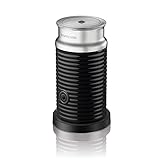
Nespresso Aeroccino 3 Milk Frother
Best for: Nespresso owners who want a matching standalone frother, and anyone who makes iced lattes or cold foam drinks regularly
Dedicated cold froth mode via 2-second button press — the simplest cold foam workflow of any frother in this lineup
- +One-touch operation with dedicated hot and cold modes — press once for hot foam, hold 2 seconds for cold
- +Non-stick interior surface means milk residue wipes clean without soaking
- +Compact footprint fits on a counter next to a Nespresso machine without crowding
- +Heats milk to 160–170°F — hotter than most automatic frothers
- −4.1 oz maximum froth capacity is the smallest in our automatic lineup — one drink at a time
- −No temperature control — the Aeroccino decides the temperature, and 160–170°F is hotter than the 140–150°F range preferred for latte art microfoam
- −At $64 for a basic single-function frother, the Secura offers similar performance at nearly half the price
- −The magnetic whisk attachment can detach during cleaning if you are not careful
✓ Free shipping with Prime · Affiliate link
Why we recommend it
The Aeroccino 3 is the most-discussed standalone frother in the Nespresso community — and for cold foam specifically, nothing in this lineup matches its simplicity. A single 2-second button press produces cold frothed milk for iced lattes, cold foam cappuccinos, and the growing catalog of iced-coffee-with-cold-foam drinks that dominate social media coffee culture. The non-stick interior means milk residue wipes away without soaking, and the compact footprint sits next to a Nespresso machine without crowding the counter.
On r/nespresso, the Aeroccino appears in breakfast-photo posts, recipe threads, and “glad I make this instead of paying $7 at Starbucks” satisfaction threads. On r/espresso, it is largely ignored — espresso enthusiasts with steam wands do not need it, and the foam it produces is functional but unremarkable. That context matters: the Aeroccino is excellent at what it does, and what it does is produce consistent, good-enough foam for everyday milk drinks. It does not produce microfoam for latte art. If that is what you need, look at the NanoFoamer or DREO instead.
Key features
- Dedicated cold froth mode: Hold the button for 2 seconds — the only frother in this lineup with a purpose-built cold foam workflow
- Non-stick interior: Wipes clean without soaking — the easiest cleanup of any automatic frother here
- Compact footprint: Small enough to sit beside a Nespresso machine on a crowded counter
- Heats to 160–170°F: Hotter than most automatic frothers — good for hot chocolate, possibly too hot for optimal latte art foam
Who it’s best for
Nespresso owners who want a matching standalone frother. Anyone who makes iced lattes or cold foam drinks regularly. People who value simplicity and brand consistency over temperature control or foam customization.
Potential downsides
- 4.1 oz maximum froth capacity is the smallest in our automatic lineup — one drink at a time, no exceptions
- At $64 for a basic single-function frother, the Secura offers similar hot-foam performance at nearly half the price
- No temperature control — 160–170°F is hotter than the 131–149°F sweet spot for latte art microfoam, and you cannot adjust it
- The magnetic whisk attachment can detach during cleaning if you are not careful — check that it is seated before each use
Affiliate link
5. DREO BaristaMaker Milk Frother (Upgraded) — The Most Versatile Automatic Under $150
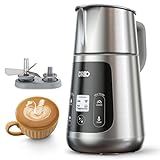
DREO BaristaMaker Milk Frother (Upgraded)
Best for: Serious home baristas who want automatic latte-art-quality microfoam without manual technique
Multi-stage frothing with impeller tip and micro-mesh creates 0.5mm microfoam — 50% finer than standard automatic frothers — with 6 heat levels and 30+ drink presets
- +Produces genuine latte-art-quality microfoam automatically — the impeller and micro-mesh system creates 0.5mm bubbles
- +6 precise heat levels up to 149°F give temperature control that cheaper frothers lack
- +27 oz jug capacity is the largest of any non-Breville frother — enough for 2–3 drinks per batch
- +LED display and 30+ drink presets make it the most feature-rich frother under $150
- −At 546 reviews, this is a newer product without the long-term reliability data of the Aeroccino (9,500+) or Secura (11,400+)
- −The 30+ drink presets are mostly variations on the same 3 foam densities — marketing overstates the versatility
- −DREO is primarily a home appliance brand (fans, air purifiers) — not a coffee-focused company like Breville or Nespresso
- −At $100, it sits in a pricing gap between budget automatics ($34) and the premium Breville ($200) — you need to want microfoam specifically to justify the step up
✓ Free shipping with Prime · Affiliate link
Why we recommend it
The DREO BaristaMaker is the first automatic frother under $200 that genuinely targets the latte art audience. Its impeller tip and micro-mesh system produce 0.5mm microfoam — 50% finer than standard automatic frothers, per DREO’s specs. Six heat levels up to 149°F give temperature control that the Aeroccino and Secura lack entirely. The 27 oz jug is the largest non-Breville frother in our lineup, handling 2–3 drinks per batch. And the LED display with 30+ preset modes makes it the most feature-rich frother under $150.
The transparency: DREO is primarily a home appliance company known for fans and air purifiers, not coffee equipment. The BaristaMaker has 546 Amazon reviews — a fraction of the Aeroccino’s 9,500+ or the Zulay’s 214,000+. But it has earned editorial reviews from Barista Magazine, The Kitchn, and TechRadar, all positive. It passed our three-criterion editorial exception evaluation for sub-1,000-review products: established manufacturer, specialty distribution (editorial coverage from coffee publications), and consistent review sentiment. If you want induction heating and a fully variable temperature dial — the most controlled milk experience available without a steam wand — step up to the Breville Milk Cafe instead; the DREO covers most of the ground at half the price, but the Breville is the ceiling.
Key features
- Impeller + micro-mesh microfoam system: Produces 0.5mm bubbles — finer than standard whisk-based frothers — for pourable, latte-art-capable foam
- 6 precise heat levels up to 149°F: Temperature control that budget frothers lack — lets you stay in the 131–149°F sweet spot
- 27 oz jug capacity: Enough for 2–3 milk drinks per batch — solves the one-drink-at-a-time limitation of the Aeroccino and Secura
- Dishwasher safe: Toss the jug in the dishwasher — the most convenient cleanup option in the lineup
Who it’s best for
Serious home baristas who want automatic, hands-free microfoam without the $200 Breville price tag. Households that make multiple milk drinks daily and need batch capacity. Anyone who has outgrown the Aeroccino’s basic foam and wants temperature control.
Potential downsides
- At 546 reviews, this is a newer product without the long-term reliability data of the Aeroccino (9,500+) or the Secura (11,400+)
- The 30+ drink presets are mostly variations on 3 foam densities (thin, medium, thick) at different temperatures — the preset count overstates the real versatility
- DREO is a home appliance brand (fans, air purifiers), not a coffee-focused company like Breville or Nespresso — the coffee-specific track record is shorter
- At $100, it sits between budget automatics ($34) and the premium Breville ($200) — you need to specifically want microfoam and temperature control to justify the step up from a Secura
Affiliate link
6. Breville Milk Café BMF600XL — The One That Does Everything

Breville Milk Café BMF600XL
Best for: Households that froth multiple times daily and want the most control over temperature and texture
Induction heating with variable temperature dial and interchangeable frothing discs — the only frother in this lineup that lets you dial in exact temperature
- +Induction heating distributes heat evenly without hot spots — produces consistently smooth results
- +Variable temperature dial gives control that no other frother in this lineup offers
- +Interchangeable frothing discs let you switch between latte foam, cappuccino foam, and hot chocolate
- +Measuring cap built into the lid has markings for hot chocolate powder and chai — a genuinely useful detail
- −At $200, it costs more than many entry-level espresso machines — you need to froth daily to justify the price
- −The jug is large and the base is wide — it takes more counter space than the Aeroccino or Secura
- −Induction heating means you cannot use any other container — only the included stainless steel jug works
- −The frothing disc mechanism can be fiddly to attach and detach, especially when wet
✓ Free shipping with Prime · Affiliate link
Why we recommend it
The Breville Milk Cafe is the only frother in this lineup with induction heating and a variable temperature dial. Induction heating distributes heat evenly across the jug — no hot spots, no scorched milk at the bottom. The temperature dial lets you choose exactly how hot you want the milk, from lukewarm (for children’s hot chocolate) to fully hot (for adults who want their latte steaming). Interchangeable frothing discs let you switch between latte foam and cappuccino foam. And the 24 oz capacity handles 3+ drinks per batch — the most of any frother here.
At $200, the Milk Cafe costs more than many entry-level espresso machines. That is the honest framing: if you are spending $200 on milk frothing, you should consider whether a Breville Bambino Plus ($300, with a steam wand) is the smarter investment. But if you already have a coffee setup you love — a Nespresso, a pour-over, a drip machine — and you want the best possible standalone frothing experience without changing your core brewing method, the Milk Cafe is the answer.
Key features
- Induction heating with variable temperature dial: Even heat distribution with exact temperature control — the only frother in this lineup with both
- Interchangeable frothing discs: Latte disc for fine foam, cappuccino disc for thicker foam — switch based on the drink
- Measuring cap with hot chocolate and chai markings: A genuinely useful detail for non-coffee milk drinks
- 24 oz capacity: Largest in our lineup — 3+ drinks per batch for households
Who it’s best for
Households that froth multiple times daily and want the most control over temperature and texture. People who make a variety of milk drinks — lattes, cappuccinos, hot chocolate, chai — and want one machine that handles all of them. Anyone willing to invest $200 in the standalone frothing experience rather than upgrading to an espresso machine.
Potential downsides
- At $200, costs more than many entry-level espresso machines — you need to froth daily to justify the investment
- Large footprint: the jug and base take more counter space than the compact Aeroccino or Secura
- Induction heating means you cannot use any other container — only the included stainless steel jug works with the base
- The frothing disc mechanism can be fiddly to attach and detach, especially when the disc is wet and the magnet does not grip cleanly
Affiliate link
Buyer’s guide
Do you actually need a standalone frother?
If your espresso machine has a steam wand — even a basic one on a Gaggia Classic or Breville Bambino — your steam wand produces better microfoam than any standalone frother under $200. Steam creates microfoam by forcing pressurized water vapor through milk at precisely the right angle and depth. No countertop frother replicates this. The founders of SteamUp, a standalone steamer startup from Delft University of Technology, described on r/espresso spending two years testing heating concepts and concluding that only a boiler-based system produces truly consistent microfoam.
Standalone frothers are for people whose coffee setup does not include steam: Nespresso owners, drip coffee maker users, pour-over enthusiasts, AeroPress and french press brewers. If that is you, read on. (One exception worth knowing about: the Bellman CX-25S is a stovetop steamer that produces real steam without an espresso machine. It takes 10 minutes to heat, requires a stove, and has a learning curve — but it produces genuine microfoam. If that sounds appealing, search r/espresso for Bellman threads before buying any of the frothers below.)
Handheld vs automatic: the real difference
This is not just a form-factor question — it is a foam-quality question.
Handheld frothers ($15–$50) use a spinning whisk to agitate air into milk. The result is macrofoam: large, uneven bubbles that sit on top of the drink, look impressive for 30 seconds, and collapse. Good for cappuccinos, hot chocolate, matcha. Unsuitable for latte art. One exception: the NanoFoamer uses a patented impeller instead of a whisk, producing genuine microfoam — but it requires pre-heated milk and technique.
Automatic jug frothers ($34–$200) heat and froth simultaneously. Most use a magnetic whisk, producing foam similar to handhelds but with the convenience of one-button operation. The better ones (DREO BaristaMaker, Breville Milk Cafe) use impeller or disc systems that create finer foam approaching microfoam quality.
If you froth occasionally and do not care about foam texture, get a handheld. If you froth daily and want consistency without thinking about it, get an automatic.
The temperature sweet spot
Milk tastes sweetest between 55–65°C (131–149°F). At this temperature, lactose becomes more perceptible and the natural sweetness of milk is most pronounced. This range is widely cited in barista training curricula, including the SCA’s coffee standards framework, and produces the most stable foam for pouring.
Above 70°C (158°F), milk proteins denature. The foam collapses, the texture goes from glossy to flat, and a distinctly burnt or sulphurous taste develops. There is no recovering overheated milk — you start over.
Most budget frothers (Zulay, Secura, Aeroccino) either do not heat at all or heat to a fixed temperature you cannot control. The Aeroccino heats to 160–170°F — functional but hotter than optimal. The DREO offers 6 heat levels up to 149°F, and the Breville has a fully variable temperature dial. If temperature control matters to you, it narrows the field.
Non-dairy milk frothing
Not all milks froth equally. The ability to froth depends on protein and fat content — proteins stabilize foam structure, fats add body.
Froths well: whole milk (best), oat milk barista editions (Oatly Barista, Califia Barista Blend), soy milk. Froths poorly: almond milk (too low in protein), coconut milk (separates), rice milk (too thin).
If you use non-dairy milk, look for “barista blend” or “barista edition” versions — they are formulated with added fats and proteins specifically for frothing. Regular oat milk produces thin, unstable foam compared to its barista counterpart. This applies regardless of which frother you use.
How long do frothers last?
Handheld frothers (Zulay, NanoFoamer) are mechanically simple — a motor spinning a whisk or impeller. They last 2–4 years with daily use before the motor weakens. The NanoFoamer’s consumable NanoScreens are the exception: they wear out with regular use and need periodic replacement (sold separately on Subminimal’s site). Budget for 1–2 replacement screens per year if you froth daily.
Automatic jug frothers last longer mechanically but their non-stick interior coatings degrade over time. The Secura and Aeroccino coatings can start to show wear after 12–18 months of daily use and aggressive cleaning. Hand-washing extends the life; dishwasher detergent accelerates coating breakdown. The Breville Milk Cafe and DREO BaristaMaker have stainless steel components that are more durable, but their magnetic whisk attachments and impeller tips may need eventual replacement. None of these products publish expected lifespans, so set expectations accordingly.
Microfoam vs macrofoam: setting expectations
The word “frother” covers two fundamentally different foam types:
Macrofoam — large, visible bubbles. Sits on top of the drink. Looks like the top of a cappuccino. Collapses within a minute. Produced by whisk-style frothers (Zulay, most handhelds, basic automatic frothers).
Microfoam — tiny, uniform bubbles you cannot see individually. Creates a glossy, paint-like texture. Integrates into the drink. Stays stable for minutes. This is what baristas pour latte art with. Produced by steam wands, impeller-based systems (NanoFoamer, DREO BaristaMaker), and induction-heated disc systems (Breville Milk Cafe).
If you want microfoam from a standalone device, your options are the NanoFoamer ($50, handheld, requires pre-heated milk), the DREO BaristaMaker ($100, automatic), or the Breville Milk Cafe ($200, automatic). Everything else produces macrofoam — which is fine for most drinks, but not for latte art.