The french press is the fastest route from “coffee is just caffeine” to “wait, this actually tastes different.” On r/Coffee, the most upvoted beginner discovery post — 1,300+ upvotes — is someone describing their first properly-brewed french press cup. A coarse grind, four-minute steep, and decent beans produce a full-bodied cup that drip machines and pod brewers cannot match. No paper filter, no electricity, no learning curve beyond a timer.
The catch: three of our six picks are from just two brands — Bodum and Secura — because the french press market is structurally concentrated. Bodum invented the modern press pot design and still makes the version everyone else copies. Secura dominates the stainless steel segment. We acknowledge the concentration rather than pretending the field is wider than it is, and we selected picks that cover the genuine buying axes: glass vs. stainless, budget vs. premium, home vs. travel.
If you want something stronger and more concentrated than a french press but do not want the complexity of an espresso machine, a moka pot is the natural next step — stovetop brewing that produces an intense, full-bodied cup with a different character from immersion methods. For a chilled version of french press’s full body, a cold brew maker uses the same immersion principle — coarse grind steeped in cold water overnight — with built-in filtration that skips the plunger cleanup.
One health note before we start: french press coffee is unfiltered. Unlike pour-over or drip methods, the metal mesh does not remove cafestol — a compound that raises LDL cholesterol when consumed regularly. If you drink 3+ cups daily, this is worth knowing. We discuss it in the buyer’s guide below.
How we evaluated
- Brew quality and filter design — A french press’s job is immersion brewing: steep grounds in hot water, press a filter to separate them. The NCA recommends a 1:10 to 1:16 coffee-to-water ratio, ~93°C water, and approximately 4 minutes of contact time. We evaluated how each press’s filter affects the cup — finer mesh means less sediment but also less body. There is a genuine trade-off, not a universal “finer is better.”
- Materials and durability — Glass breaks. Forum users describe this as “when, not if.” Stainless steel does not. We evaluated whether the material choice is justified by the press’s intended use case (countertop vs. travel vs. buy-it-for-life).
- Heat retention — An uninsulated glass carafe loses brewing temperature within minutes. Double-wall stainless holds it for 30–60 minutes. Vacuum insulation (Stanley) holds it for hours. We note the practical impact: if you pour immediately, insulation does not matter; if you linger, it does.
- Cleanup — The #1 complaint in forum discussions. French press cleanup involves disassembling the plunger, scooping wet grounds, and scrubbing the mesh. We note which designs make this easier and which make it worse.
- Value per dollar — A $16 french press brews the same coffee as a $140 one. The premium buys durability, insulation, and filter quality — not better flavor. We evaluated whether each product’s premium is justified.
1. Bodum Chambord 34oz — The Design Everyone Copies

Bodum Chambord 34oz
Best for: Anyone who wants the quintessential french press experience — the Chambord is the design every other press copies
Borosilicate glass carafe, three-part stainless steel mesh plunger, chrome-plated steel frame
- +28,000+ reviews and decades of production — this is the french press other presses benchmark against
- +Three-part stainless steel mesh plunger produces a clean cup with minimal sediment for a metal filter
- +Borosilicate glass carafe lets you watch the bloom and steep — useful for timing and visually satisfying
- +Replacement carafes and filters are widely available and inexpensive
- −Glass carafe breaks if dropped or exposed to sudden temperature changes — forum users call this a matter of when, not if
- −Bodum's customer service is consistently rated among the worst in coffee — warranty claims often take months
- −No insulation — coffee cools quickly in the glass carafe, so decant immediately after brewing
- −Standard mesh filter allows more oils and fine sediment through than ESPRO's double micro-filter
✓ Free shipping with Prime · Affiliate link
Why we recommend it
The Bodum Chambord is the french press. Not the best — the original. Bodum has manufactured this design since 1974, and every press on this page is, at some level, a response to it. The three-part stainless steel mesh plunger, the borosilicate glass carafe, the chrome frame — this is the template the category is built on. With 28,000+ Amazon reviews, the owner data is deeper than any other press available.
The Chambord earns Best Overall not because it outperforms every alternative on every dimension — the Secura has better insulation, the ESPRO has a better filter, the Frieling is more durable — but because it is the best execution of what a french press is supposed to be. The glass lets you watch the bloom. The mesh filter delivers the full-bodied, oily cup that immersion brewing is known for. The technique James Hoffmann popularized — coarse grind, 4-minute steep, gentle skim, slow pour — was developed and filmed with a Bodum press.
Key features
- Borosilicate glass carafe: Heat-resistant glass lets you see the brew — the visual feedback is genuinely useful for timing and satisfying to watch
- Three-part stainless steel plunger: Mesh-plate-mesh sandwich that screws apart for cleaning — the standard other presses are measured against
- Chrome-plated steel frame: Protects the glass and provides structure. Replacement carafes are widely available when the inevitable breakage occurs
- 50+ year design lineage: The Chambord has been in continuous production since 1974. Replacement parts, technique guides, and community knowledge are unmatched
Who it’s best for
Anyone buying their first quality french press, and experienced press users who value the classic glass-and-chrome design. If you already own a burr grinder and a kitchen scale, the Chambord is all you need to brew excellent immersion coffee at home.
Potential downsides
- The glass carafe will break eventually. Thermal shock (cold rinse after hot brew), drops, or bumps will crack it — forum users treat this as inevitable, not a defect
- Bodum’s customer service is consistently among the worst in coffee. Multiple r/Coffee threads document months-long waits for warranty claims, ghosted tickets, and multi-attempt replacements. The product is excellent; the company behind it is not
- No insulation — coffee begins cooling the moment you pour hot water into the glass. Decant into a thermal carafe or mug immediately after brewing
- Standard mesh allows more fine sediment and oils through than the ESPRO’s double micro-filter. If sediment bothers you, the P3 is the better choice
Affiliate link
2. Secura French Press 34oz — Stainless Steel That Costs Less Than Glass

Secura French Press 34oz
Best for: Buyers who want stainless steel durability and double-wall insulation at a price lower than most glass presses
18/10 stainless steel double-wall construction keeps coffee hot and eliminates glass breakage risk
- +Double-wall stainless steel construction — no glass to break, holds temperature far longer than single-wall glass
- +35,000+ reviews with a 4.7-star average — the highest-rated french press in our lineup
- +At ~$26, costs less than many glass presses while solving glass's biggest problem (breakage)
- +Three-layer stainless steel filter reduces sediment compared to standard single-mesh designs
- −Opaque body — you cannot see the brew, so you are timing the steep rather than watching it
- −Stainless steel can retain coffee oils between brews if not cleaned thoroughly
- −Cool-touch handle design is functional but not as refined as the Chambord or Frieling
- −Some owners report a slight metallic taste during the first few uses — seasoning with a few brew-and-dump cycles resolves it
✓ Free shipping with Prime · Affiliate link
Why we recommend it
The Secura solves the two biggest french press complaints — glass breakage and heat loss — for less money than the glass press it replaces. At ~$26, the 18/10 stainless steel double-wall Secura costs less than a Bodum Chambord while being shatterproof and holding temperature noticeably longer. The 4.7-star average across 35,000+ reviews is the highest rating in our lineup.
The double-wall construction is not vacuum insulation — it will not keep coffee hot for hours like the Stanley — but it provides meaningful heat retention compared to bare glass. In practice, your coffee stays at drinkable temperature for 20–30 minutes without a thermal carafe. For most people who pour and drink within that window, that is enough.
Key features
- 18/10 stainless steel, double-wall: No glass to break and better heat retention than any single-wall glass press
- Three-layer stainless steel filter: Three filter screens stacked together reduce sediment compared to standard single-mesh designs
- 35,000+ reviews at 4.7 stars: The most-reviewed and highest-rated french press in our lineup — extensive owner data
- Under $26: Costs less than most glass presses while solving glass’s primary failure mode
Who it’s best for
Value-focused buyers who want a daily-driver french press that will not break, will not lose heat immediately, and will not cost more than two bags of decent beans. If you have dropped a glass carafe before and sworn never again, the Secura is the obvious answer.
Potential downsides
- Opaque body — you cannot see the brew, so you are timing your steep rather than watching it. If visual feedback matters to your process, glass is better
- Stainless steel can retain coffee oils between brews if not cleaned thoroughly. A periodic deep clean with baking soda prevents stale flavor buildup
- The handle and frame are functional but lack the design refinement of the Chambord or Frieling — this is a utilitarian press, not a showpiece
- Some owners report a slight metallic taste during the first few uses. A few brew-and-dump seasoning cycles eliminates it
Affiliate link
3. ESPRO P3 32oz — The Cleanest Cup From a French Press

ESPRO P3 French Press 32oz
Best for: Drinkers who dislike french press sediment — the double micro-filter produces a noticeably cleaner cup
Patented double micro-filter reduces sediment by up to 90% compared to standard mesh filters and stops extraction when plunged
- +Double micro-filter is the ESPRO differentiator — produces a dramatically cleaner cup than any standard mesh press
- +Filter design stops extraction when plunged, so coffee does not over-extract if you leave it in the carafe
- +BPA-free Tritan plastic carafe is shatterproof — solves the glass breakage problem without going full stainless
- +Locking lid prevents accidental plunges and spills during transport
- −Tritan plastic body does not retain heat as well as double-wall stainless or even thick glass
- −Double micro-filter is harder to clean than a standard mesh — grounds get trapped between the two filter layers
- −At 32oz versus the standard 34oz, slightly smaller capacity than most competitors
- −Some reviewers note the plunger requires more force than a standard press due to the finer filter mesh
✓ Free shipping with Prime · Affiliate link
Why we recommend it
The ESPRO P3 exists because some people love french press body but hate french press sediment. Its patented double micro-filter — two layers of fine stainless steel mesh — reduces sediment dramatically compared to any standard single-mesh press. The filter also stops extraction when plunged, which means coffee does not continue to over-steep if you leave it in the carafe. No other press in our lineup does this.
The Tritan plastic body is a deliberate material choice: it is shatterproof (solves the glass problem) without the opacity of stainless steel. You can see your brew without risking a broken carafe. The trade-off is heat retention — Tritan is a worse insulator than glass or double-wall stainless, so the P3 cools faster than both.
Key features
- Double micro-filter: Two layers of fine stainless steel mesh — the defining ESPRO feature. Produces a visibly cleaner cup than any standard mesh press
- Extraction stops at plunge: The tight filter seal prevents grounds from continuing to steep after pressing — no over-extraction if you leave coffee in the carafe
- Shatterproof Tritan body: BPA-free plastic that lets you see the brew without the fragility of glass
- Locking lid: Prevents accidental plunges during transport — a practical detail for carrying between rooms or to an office
Who it’s best for
Drinkers who like the body and ritual of french press but dislike the silt at the bottom of the cup. If you have tried a standard press and been put off by sediment, the P3 is the press that addresses your specific complaint. Also a strong choice for anyone who leaves coffee in the press while they work — the extraction-stopping filter prevents bitterness.
Potential downsides
- The double micro-filter is harder to clean than a standard mesh. Grounds get trapped between the two filter layers, requiring more thorough disassembly and scrubbing
- Tritan plastic does not retain heat as well as double-wall stainless or even thick glass — pour promptly or use a thermal mug
- At 32oz, slightly smaller than the standard 34oz — negligible for most users but worth noting if capacity is tight
- Some owners report the plunger requires more force than a standard press due to the finer filter mesh. Not difficult, but noticeably different
Affiliate link
4. Frieling Double Wall French Press 36oz — Buy It Once
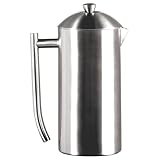
Frieling Double Wall French Press 36oz
Best for: Buyers who want a buy-it-for-life french press — 304 stainless steel, double-wall insulation, built to outlast any glass press
18/10 304 stainless steel construction with double-wall insulation keeps coffee hot for 60+ minutes
- +304 stainless steel body is virtually indestructible — this is the press you hand down, not replace
- +Double-wall insulation maintains brewing temperature noticeably longer than glass or single-wall stainless
- +Mirror-finish exterior and clean lines — the most refined-looking press in the lineup
- +Made in Germany with a build quality that justifies the premium over Secura's double-wall stainless
- −At $140, costs 3–5x more than presses that brew identical coffee — the premium is for materials and longevity, not flavor
- −Opaque stainless body means no visual feedback on brew color or plunger depth
- −Heavy at 2+ lbs — not ideal for travel despite the durability
- −Standard mesh filter — you get Frieling build quality but not ESPRO-level filtration
✓ Free shipping with Prime · Affiliate link
Why we recommend it
The Frieling is for people who have broken their last glass carafe. Made in Germany from 18/10 (304) stainless steel with double-wall insulation, it is the most overbuilt french press on this page — and that is the point. Where the Secura offers double-wall stainless for $26, the Frieling offers it with noticeably better materials, tighter tolerances, and a mirror finish that reflects the “buy it for life” philosophy.
The $140 price is hard to justify on brew quality alone — a $16 Utopia Kitchen glass press makes the same coffee. The Frieling’s premium buys three things: materials that will not degrade over decades of daily use, insulation that keeps coffee hot long enough to drink the whole carafe without rushing, and a build quality that feels genuinely premium in hand. If those matter to you, the Frieling earns its price. If they do not, spend $26 on the Secura.
Key features
- 304 stainless steel, double-wall: Virtually indestructible body with heat retention that keeps coffee drinkable for 30–60 minutes
- Mirror-polished exterior: The most visually refined press in the lineup — looks as good on a shelf as it does on a counter
- Made in Germany: Manufacturing origin that backs the premium positioning with genuine build quality
- 36oz capacity: Slightly larger than the standard 34oz — brews a full liter with room to spare
Who it’s best for
Buyers who have decided the french press is their daily method and want equipment that matches that commitment. If you brew every morning and want to stop replacing glass, stop settling for plastic, and stop wishing your coffee stayed hot longer, the Frieling is the endpoint. Also a thoughtful gift — the build quality and presentation justify the price in a way a $26 Secura cannot.
Potential downsides
- At $140, costs 3–5x more than presses that brew identical coffee. The entire premium is for materials and longevity, not for flavor
- Opaque stainless body means no visual feedback on brew color or plunger depth — same limitation as the Secura
- Heavy at 2.2 lbs — the weight that makes it feel premium on the counter makes it impractical for travel
- Standard mesh filter. You get Frieling build quality but not ESPRO-level filtration — sediment levels are comparable to any standard mesh press
Affiliate link
5. Stanley Classic French Press 48oz — Built for Basecamp

Stanley Classic French Press 48oz
Best for: Camping, car trips, and outdoor use — BPA-free stainless steel that survives a packed cooler or a drop onto rock
Vacuum-insulated 18/8 stainless steel with insulated lid keeps coffee hot for hours, not minutes
- +Vacuum insulation (not just double-wall) keeps coffee genuinely hot for hours — the only press in the lineup with this
- +48oz capacity brews for 2–3 people — the largest press in our lineup by a significant margin
- +BPA-free stainless steel body handles drops, bumps, and packed bags without complaint
- +Stanley's lifetime warranty backs a brand with decades of proven outdoor-gear durability
- −At 48oz, it is too large for a solo drinker — over-extraction becomes an issue if coffee sits on grounds
- −Heavier and bulkier than a standard 34oz press — this is camping gear, not countertop daily-driver size
- −Standard mesh filter — the larger brew volume means proportionally more sediment in the cup
- −Insulated lid can make plunging feel different than a standard press — takes a brew or two to calibrate pressure
✓ Free shipping with Prime · Affiliate link
Why we recommend it
The Stanley is the only french press in our lineup with vacuum insulation — not double-wall, genuine vacuum. Where every other press loses heat within minutes (glass) or 20–30 minutes (double-wall stainless), the Stanley keeps coffee hot for hours. At 48oz, it also brews more than any other press here — enough for 2–3 people from a single batch.
This is camping and travel gear that happens to be a french press, not the other way around. The BPA-free stainless steel body handles drops, packed coolers, and rough transport. Stanley’s lifetime warranty backs a brand with decades of proven outdoor-gear durability. If you brew on countertops and pour immediately, the Chambord or Secura are better daily drivers. If you brew at a campsite, on a road trip, or anywhere the coffee needs to stay hot without access to a thermal carafe, the Stanley is the only press in this lineup that solves that problem.
Key features
- Vacuum insulation: Genuine vacuum-insulated body and lid — the only press in our lineup that keeps coffee hot for hours, not minutes
- 48oz capacity: Brews for 2–3 people from a single press — the largest in our lineup by a significant margin
- BPA-free stainless steel: Drop-proof, dent-resistant construction built for outdoor and travel use
- Lifetime warranty: Stanley’s brand promise — this is gear designed to last decades, not years
Who it’s best for
Campers, road trippers, and anyone who needs hot coffee away from a kitchen. Also works for households that brew a full pot and drink it over an hour — the vacuum insulation means the last cup is still hot. If you regularly brew for more than one person outdoors, the 48oz capacity eliminates multi-batch brewing.
Potential downsides
- At 48oz, too large for a solo drinker. Over-extraction becomes an issue if coffee sits on grounds, and the vacuum insulation means the brew stays at extraction temperature longer — decant or drink promptly
- Heavier and bulkier than a standard 34oz press — 2.5 lbs. This is camping gear, not countertop daily-driver size
- Standard mesh filter — the larger brew volume means proportionally more sediment in the cup compared to a smaller press with a finer filter
- The insulated lid can make plunging feel different than a standard press. Takes a brew or two to calibrate the right pressure
Affiliate link
6. Utopia Kitchen French Press 34oz — Sixteen Dollars, Seriously

Utopia Kitchen French Press 34oz
Best for: First-time french press buyers or anyone who wants to try immersion brewing without spending more than a bag of good beans
Borosilicate glass carafe with stainless steel plunger at a price point that removes the barrier to entry
- +At $16, costs less than most specialty coffees — genuinely risk-free way to try french press brewing
- +11,000+ reviews at 4.4 stars — high-volume social proof at the budget end
- +Borosilicate glass carafe performs identically to presses costing 2–3x more for the brew itself
- +Simple, no-frills design with fewer parts to break or lose
- −Glass is thinner than the Chambord — more fragile and more likely to break with thermal shock
- −Filter mesh is looser than Bodum or ESPRO — expect more sediment in the cup
- −Frame and handle feel less substantial than the Chambord — the price difference is tangible in hand
- −No insulation of any kind — coffee cools faster than in double-wall stainless options
✓ Free shipping with Prime · Affiliate link
Why we recommend it
The Utopia Kitchen press costs less than a bag of specialty coffee beans. At $16, it removes every financial barrier to trying french press brewing. The borosilicate glass carafe and stainless steel plunger perform the same fundamental job as the Bodum Chambord — steep coffee grounds in hot water and press a mesh filter to separate them. The coffee it produces is indistinguishable from the Chambord’s.
On r/Coffee, multiple threads echo a consistent insight: the beans and the grind matter more than the press. Forum users report great results from IKEA presses, no-name Amazon presses, and hand-me-down carafes. The Utopia Kitchen validates that insight — you do not need to spend $40 to brew excellent french press coffee. Spend the $24 you saved on better beans.
Key features
- Under $16: Costs less than most specialty coffees — genuinely risk-free way to try french press brewing
- Borosilicate glass carafe: The same heat-resistant glass used in presses costing 2–3x more
- 11,000+ reviews at 4.4 stars: High-volume social proof at the budget tier — extensive owner feedback
- Simple design: Fewer parts, fewer failure points. Plunger, mesh, carafe, frame — everything you need, nothing you do not
Who it’s best for
First-time french press buyers, college students, anyone who wants to try immersion brewing before committing to a premium press. If you are not sure whether french press is your method, spend $16 to find out. If you love it, upgrade to a Chambord or Secura later. If you do not, you spent less than a pour-over dripper.
Potential downsides
- Glass is thinner than the Chambord — more fragile and more susceptible to thermal shock. Handle with more care
- Filter mesh is looser than Bodum or ESPRO — expect more sediment in the cup. Fine particles will make it through
- Frame and handle feel less substantial. The price difference is tangible in hand — this is a functional tool, not a design object
- No insulation of any kind. Coffee cools faster than in any double-wall stainless option
Affiliate link
Buyer’s guide
Glass vs. stainless steel — pick a side
This is not a “depends on your needs” question — it is a durability reality. Glass french press carafes break. Forum users describe this as a matter of “when, not if.” Thermal shock, drops, bumps against the faucet during cleanup — borosilicate glass is heat-resistant, not impact-resistant.
If your press lives on a kitchen counter, gets washed carefully, and never travels: glass is fine. The Chambord and Utopia Kitchen both use borosilicate glass, and the visual experience of watching the brew is genuinely enjoyable. Replacement carafes for the Chambord are cheap and widely available.
If your press travels, gets jostled, or has already broken once: stainless steel. The Secura ($26), Frieling ($140), and Stanley ($55) eliminate the breakage problem entirely. The Secura delivers 80% of the Frieling’s value at 20% of the cost — the Frieling is for people who want the buy-it-for-life version.
The cafestol question — what your french press does not filter
French press coffee is unfiltered. The metal mesh stops grounds but passes through coffee oils — including cafestol, a diterpene that raises LDL cholesterol. A 2000 study in the European Journal of Clinical Nutrition found that regular consumption of french press coffee raised cholesteryl ester transfer protein activity and LDL cholesterol in subjects with normal lipid profiles. Paper-filtered methods (pour-over, drip) remove cafestol almost entirely.
This does not mean french press coffee is dangerous. It means that if you drink 3–5 cups daily via french press and have cholesterol concerns, the brewing method is a variable worth discussing with your doctor. If you drink one cup a day, the effect is marginal. We mention this because most french press roundups skip it — probably because it might discourage a purchase. We would rather you make an informed decision.
Cleanup — the complaint no one mentions in the product listing
French press cleanup is harder than pour-over or drip. There is no paper filter to throw away — you have wet grounds stuck to the bottom of a carafe and wedged into a mesh filter. The standard advice: add water, swirl, dump the slurry into a compost bin or trash (not down the sink — grounds clog drains). Then disassemble the plunger, rinse each part, and reassemble.
It takes 2–3 minutes. Every day. This is the #1 reason forum users cite for switching to pour-over — see our full comparison for when that switch makes sense. If daily disassembly sounds tedious, factor that into your decision. If you find the ritual meditative rather than annoying, you will not care.
The ESPRO P3’s double micro-filter makes cleanup slightly harder than a standard mesh, not easier — grounds get trapped between the two filter layers.
Capacity — solo cup or family pot
French press sizes are listed in “cups” that bear no relation to the cups you drink from. An “8-cup” press makes about 34oz — roughly four actual mugs of coffee.
- Solo drinker: A 12–17oz press (3–4 “cup”) is sufficient. None of our picks are this small because the 34oz standard works for solo drinkers too — you just brew less.
- Two people: The standard 34oz (Chambord, Secura, ESPRO, Utopia Kitchen) handles two large mugs comfortably.
- Three or more: The Stanley at 48oz or the Frieling at 36oz. The Stanley’s vacuum insulation keeps the last pour hot.
If you brew more coffee than you drink, the ESPRO P3 has an advantage: its extraction-stopping filter means leftover coffee does not continue to steep and become bitter. Every other press requires you to decant leftover coffee into a separate vessel to avoid over-extraction.
Your grinder matters more than your press
A $16 press with freshly-ground beans produces better coffee than a $140 press with pre-ground coffee from the grocery store. The NCA’s french press guidance recommends a coarse grind “like rock salt” — consistent particle size matters more than any other variable you can control.
If you do not own a grinder, start with pre-ground coffee and a budget press. If you enjoy the ritual, add a burr grinder ($40–$80 for a capable hand grinder, $100+ for electric) and the difference will be more noticeable than upgrading the press itself. Our French press grinder guide covers the six best options for coarse grinding specifically, or see the general grinder roundup for all brew methods.
When to skip french press entirely
Not everyone who searches “best french press” should buy a french press. If you hate sediment and daily plunger cleanup, our pour-over vs french press comparison walks through which method fits which drinker. If you want zero-effort daily coffee and do not care about the ritual, a quality drip coffee maker makes more sense.
French press is the right entry point if you value full body, enjoy a short daily ritual, and do not mind 2–3 minutes of cleanup. Many forum users start with a french press and later add a pour-over for variety — the two methods complement each other rather than competing.
Using your french press as a milk frother
An empty french press doubles as a manual milk frother. Heat milk to ~60°C, pour it into the press, and pump the plunger vigorously for 30–60 seconds. The mesh aerates the milk into a foam that works for lattes and cappuccinos. This technique is widely recommended on r/Coffee and r/JamesHoffmann as a zero-cost alternative to a dedicated frother.
Any press in this lineup works for frothing, but the Chambord’s glass carafe is ideal because you can see the foam developing.