Pour-over brewing is the simplest way to make genuinely great coffee at home. A plastic dripper, a bag of decent beans, and a kettle — that’s it. No boiler, no portafilter, no $500 entry fee. But the simplicity is deceptive: the brewer you choose shapes how forgiving the process is, what your cup tastes like, and whether you enjoy the ritual or dread it.
If you want something bolder and more concentrated than pour-over but still manual, a moka pot is a different kind of stovetop brewing — pressure-driven rather than gravity-driven, producing an intense cup that sits between drip and espresso.
We researched six pour-over brewers across price, forgiveness, and cup character — informed by what real owners say on r/pourover and r/coffee about the tradeoffs between them. If you’re coming from drip or espresso, the biggest adjustment is this: the brewer matters less than your grinder and technique. A $13 V60 in skilled hands outperforms a $50 brewer with bad grind consistency. We factored that into every recommendation below.
How we evaluated
- Forgiveness — How much does a sloppy pour or inconsistent grind punish you? Beginners need a brewer that produces a good cup even when technique is imperfect.
- Cup character — Clean and bright (paper-filtered cones) vs full-bodied (metal mesh). Different brewers produce meaningfully different cups from the same beans.
- Versatility — Can it handle one cup and batch brews? Immersion and percolation? Travel and countertop?
- Durability — Plastic lasts forever, glass breaks. Community forums are full of Chemex obituaries.
- Ecosystem cost — The brewer is cheap; filters are the recurring expense. Permanent metal filters eliminate that cost but change the cup.
1. Hario V60 Plastic Dripper (Size 02) — The Reference Standard

Hario V60 Plastic Coffee Dripper (Size 02)
Best for: Experienced brewers who want full control over extraction
Classic 60-degree cone with spiral ribs — the reference-standard dripper used in competitions worldwide
- +Under $13 — cheapest quality dripper available
- +Lightweight plastic retains heat better than ceramic during brewing
- +Spiral ribs allow airflow between filter and wall for even extraction
- +Compatible with widely available V60 02 filters from multiple brands
- −Steep learning curve — single large drain hole is unforgiving of grind and pour mistakes
- −Plastic aesthetic may not appeal to everyone
- −Requires a gooseneck kettle for proper technique
- −Single-serve only (1–4 cups per brew)
✓ Free shipping with Prime · Affiliate link
Why we recommend it
The V60 is the pour-over dripper everything else is measured against. Its single large drain hole and spiral-ribbed interior give you complete control over extraction — pour speed, water temperature, and grind size all directly affect the cup. At under $13, it costs less than a bag of specialty beans.
On r/pourover, the V60 is the most commonly flaired brewer. Experienced users who’ve accumulated five or six drippers consistently return to it: “Does anyone else find themselves returning to the V60 after trying new brewers?” is a recurring thread. The plastic version specifically retains heat better than ceramic during brewing and won’t shatter when you inevitably knock it off the counter.
Key features
- 60-degree cone with spiral ribs: Allows airflow between filter and wall for even extraction — the design that launched modern pour-over
- Size 02 (1–4 cups): The sweet spot for single-serve and small batch brewing
- Under 2 oz: Light enough for travel, though the AeroPress owns that niche
Who it’s best for
Brewers who want to learn technique and are willing to dial in their process. If you enjoy the ritual of precise pouring and watching your coffee bloom, this is where you start — and likely where you stay.
Potential downsides
- The single large hole is unforgiving — grind too fine and it chokes, too coarse and it gushes. Beginners on r/pourover regularly post muddy-looking spent grounds asking what went wrong.
- Hario’s own V60 paper filters have degraded in quality according to widespread community reports. Many experienced users have switched to Cafec Abaca or Sibarist filters for more consistent drawdown times.
Affiliate link
2. Kalita Wave 185 (Stainless Steel) — Consistency Without the Learning Curve
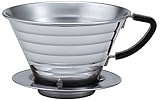
Kalita Wave 185 Dripper (Stainless Steel)
Best for: Beginners who want consistent results without mastering pour technique
Flat-bottom bed with three small drain holes — forgiving design that produces balanced cups even with imperfect pours
- +Flat-bottom design produces even extraction regardless of pour pattern
- +Three small drain holes naturally regulate flow rate
- +Stainless steel construction is virtually indestructible
- +Heats up faster than ceramic and stays hot throughout brewing
- −Wave filters are more expensive and harder to find than V60 filters
- −Stainless steel model drains faster than ceramic version — different behavior between materials
- −Less control over extraction compared to cone drippers
- −Higher price point than the V60 for a simpler brewing experience
✓ Free shipping with Prime · Affiliate link
Why we recommend it
The Kalita Wave is the dripper experienced brewers wish they’d started with. Its flat-bottom design and three small drain holes naturally regulate flow rate, producing balanced cups even when your pour pattern is erratic. One r/pourover user on day three with the Wave reported hitting “consistently every brew” — a timeline that would take weeks on a V60.
Where the V60 rewards precision, the Wave rewards showing up. The stainless steel model heats up faster than ceramic, survives drops, and is dishwasher-safe. It’s the brewer you hand to a friend who asks why you’re so particular about coffee.
Key features
- Flat-bottom brew bed: Even extraction regardless of pour pattern — the geometry does the work
- Three small drain holes: Self-regulating flow rate prevents both choking and gushing
- Polished stainless steel: More durable than ceramic or glass, retains heat during brewing
Who it’s best for
Beginners who want good coffee without mastering pour technique first, and experienced brewers who want a low-effort daily driver. If you’re upgrading from drip or a budget espresso machine and don’t want another learning curve, the Wave is the right call.
Potential downsides
- Wave 185 filters are more expensive and harder to find than V60 filters. You’ll pay a premium for the convenience, and local shops may not stock them.
- The stainless steel version drains faster than the ceramic model — same name, different brewing behavior. If you buy ceramic based on a stainless steel review, you’ll get different results.
Affiliate link
3. Chemex Classic Series (6-Cup) — The Multi-Serve Showpiece

Chemex Classic Series Pour-Over (6-Cup)
Best for: Households brewing for two or anyone who loves a clean, tea-like cup
Thick bonded filters remove oils and fines for an exceptionally clean cup — brews up to 30 oz in a single session
- +Thick Chemex filters produce the cleanest, brightest cup of any manual brewer
- +6-cup capacity (30 oz) — enough for two people or a morning's worth
- +Non-porous borosilicate glass won't absorb odors
- +Iconic mid-century design looks great on any counter
- −Glass is fragile — broken Chemexes are a recurring theme in coffee communities
- −Proprietary thick filters are more expensive than standard V60 filters
- −Wooden collar offers minimal grip protection during pouring
- −Thick filters and large batch size mean longer brew times
✓ Free shipping with Prime · Affiliate link
Why we recommend it
The Chemex produces the cleanest cup of any brewer on this list. Its proprietary bonded filters are roughly twice as thick as standard V60 filters, stripping out oils and micro-fines that other brewers let through. The result is a bright, tea-like clarity that’s divisive — some people love it, others miss the body. If you want to taste the origin character of a light-roast Ethiopian without any muddiness, the Chemex is unmatched.
It’s also the only brewer here that naturally handles multi-serve brewing. The 6-cup capacity (30 oz by Chemex’s 5 oz cup measurement) means you can brew for two people without running through the process twice.
Key features
- Thick bonded filters: Remove oils and sediment for the cleanest cup in manual brewing
- 6-cup capacity: Brew up to 30 oz — enough for two people or a morning’s worth
- Borosilicate glass: Non-porous, won’t absorb flavors between brews
Who it’s best for
Anyone brewing for two or more people who prioritizes clarity over body. The Chemex is also the right pick if you want a brewer that doubles as a carafe — brew, serve from the same vessel, and refrigerate what’s left.
Potential downsides
- Glass breaks. This isn’t hypothetical — “Every month on this sub, I hear about people breaking their Chemex” is a common r/pourover sentiment. The wooden collar provides minimal protection during pouring.
- Chemex filters are proprietary and more expensive than V60 filters. You’re locked into their filter ecosystem.
Affiliate link
4. AeroPress Original — The Swiss Army Knife

AeroPress Original Coffee Press
Best for: Travelers and experimenters who want one brewer that does everything
Pressure-driven immersion brewing produces a concentrated, low-acidity cup in under two minutes — doubles as a travel brewer
- +Incredibly versatile — immersion, pressure, and pseudo-espresso in one device
- +Brews a full cup in under 2 minutes including cleanup
- +Virtually indestructible plastic construction — ideal for travel and camping
- +25,000+ reviews and a dedicated competition scene speak to its following
- −Single-serve only — no batch brewing for multiple people
- −Not technically pour-over — uses pressure and immersion rather than percolation
- −Community sentiment has shifted since the private equity acquisition
- −Paper micro-filters produce a clean cup but limit body compared to metal filters
✓ Free shipping with Prime · Affiliate link
Why we recommend it
The AeroPress isn’t technically a pour-over brewer — it uses air pressure and immersion to extract coffee. We’re including it because “best pour over coffee maker” searchers frequently consider it, and the community has strong opinions about where it fits. The AeroPress brews a clean, low-acidity cup in under two minutes. It’s virtually indestructible, weighs 7 oz, and is the only brewer on this list you can throw in a backpack without a second thought.
On r/coffee, a highly upvoted comment captures the community split: “I would skip aeropress and move straight to a pour over setup. Aeropress can brew a good cup, but it just doesn’t stand up to pour over methods.” That’s the honest tradeoff — the AeroPress is excellent for convenience, travel, and experimentation, but dedicated pour-over drippers produce a more nuanced cup.
Key features
- Pressure + immersion brewing: Speeds up extraction for less bitterness in a shorter brew time
- Under 2 minutes: Fastest total time from grounds to cup, including cleanup
- Shatterproof plastic: The default travel and camping brewer for specialty coffee drinkers
Who it’s best for
Travelers who refuse to drink hotel coffee, and beginners who want something forgiving before committing to technique-dependent pour-over. If you already own a V60 or Wave for home use, the AeroPress earns its spot as your travel companion.
Potential downsides
- Single-serve only — no batch brewing. If you’re making coffee for two, you’re pressing twice.
- Community sentiment has shifted since AeroPress was acquired by a private equity firm. Long-time owners note changes to marketing and product positioning, though the brewer itself hasn’t changed.
Affiliate link
5. Hario Switch Immersion Dripper (Size 02) — The Community Darling

Hario Switch Immersion Dripper (Size 02)
Best for: V60 owners who want immersion brewing without buying a separate device
Ball-valve switch converts a V60 cone into an immersion brewer — percolation, immersion, or hybrid in one dripper
- +Two brewing methods in one — open for percolation, closed for immersion
- +Immersion mode is nearly impossible to mess up, even for beginners
- +Closed switch stops dripping during cleanup — no mess when dumping grounds
- +Uses standard V60 02 filters — same filters as the V60
- −Stock plastic switch mechanism feels cheap — aftermarket stainless upgrades exist (~$23)
- −Glass construction means it's more fragile than the plastic V60
- −Slightly more complex to learn than a dedicated immersion or percolation brewer
- −Smaller community and fewer recipes compared to the standard V60
✓ Free shipping with Prime · Affiliate link
Why we recommend it
The Switch is a V60 with a ball-valve mechanism that lets you toggle between percolation (open) and immersion (closed). This sounds like a gimmick. It isn’t. On r/pourover, multi-brewer owners who have five or six drippers consistently say the Switch is the one they reach for most: “I have an aeropress, kalita wave, pulsar, v60, and I use my switch the most.”
The immersion mode is where the Switch shines for beginners — close the valve, add coffee and water, wait, open the valve. It’s nearly impossible to mess up. One user with thirteen brewers calls it “the easiest brewer to use, and the most difficult to mess up.” When you’re ready for more control, open the valve and brew it like a standard V60.
Key features
- Ball-valve switch: Toggle between full immersion and standard V60 percolation
- Uses V60 02 filters: Same filters as the V60 — no proprietary filter lock-in
- Closed valve stops dripping: Cleanup is trivially easy — close the valve, carry to the bin, dump grounds without dripping
Who it’s best for
AeroPress owners who want more clarity and V60 owners who want an immersion option. The Switch replaces both. Multiple r/pourover users report their AeroPress “got relegated to a travel-exclusive brewer” and their V60 “got shelved” after buying the Switch.
Potential downsides
- The stock plastic switch lever feels cheap. Aftermarket stainless steel replacements exist (~$23 from Foundry Coffeeworks) and are a popular upgrade.
- Glass V60 cone is more fragile than the plastic V60. If durability is critical, the standard plastic V60 is safer.
Affiliate link
6. Bodum Pour Over Coffee Maker (34 oz) — Zero Ongoing Costs

Bodum Pour Over Coffee Maker (34 oz)
Best for: Budget-conscious buyers who want an all-in-one brewer with no recurring filter costs
Permanent stainless steel mesh filter eliminates ongoing paper filter expenses — brews up to 34 oz with a fuller-bodied cup
- +Under $20 — the most affordable complete pour-over setup available
- +Permanent stainless steel filter means zero ongoing filter costs
- +34 oz capacity brews enough for a full household
- +Cork grip is functional and elegant — dishwasher safe
- −Metal filter passes oils and fines — fuller body but less clarity than paper-filtered brewers
- −Less control over extraction compared to dedicated cone or flat-bottom drippers
- −Glass carafe is fragile — same breakage risk as Chemex
- −Community treats it as an entry-level brewer most people upgrade from
✓ Free shipping with Prime · Affiliate link
Why we recommend it
At $20 with a permanent stainless steel filter, the Bodum eliminates the recurring cost of paper filters entirely. It’s an all-in-one system: brewer, carafe, and filter in a single package. The metal filter produces a fuller-bodied cup than paper-filtered brewers — more oils, more mouthfeel, closer to French press character with pour-over convenience.
The community views the Bodum honestly. On r/pourover, one user’s girlfriend uses “the $20 Bodum from Walmart” while their V60, Switch, and Stagg X sit idle — and commenters joke she “probably accidentally makes a better cup.” It’s not the ceiling of pour-over quality, but it’s the floor of pour-over effort and cost. For someone upgrading from drip who isn’t ready to invest in a gooseneck kettle and precision grinder, the Bodum gets them in the door.
Key features
- Permanent stainless steel mesh filter: No filter purchases, ever — saves $30–$50/year vs paper
- 34 oz capacity: Brews 8 cups (by Bodum’s 4 oz measurement) — enough for a household
- Cork grip: Heat-insulated handle, dishwasher-safe borosilicate glass
Who it’s best for
Budget-conscious buyers who want pour-over without the accessory rabbit hole, and anyone who prefers a fuller-bodied cup with oils intact. If filter costs or waste concern you, the Bodum is the only brewer here with zero recurring expenses.
Potential downsides
- Metal filters pass oils and fines that paper filters catch. The cup is fuller-bodied but less clear — a genuine preference difference, not a flaw.
- Most experienced pour-over drinkers upgrade from the Bodum eventually. On r/pourover, it’s often described as “the first pour-over I bought” before users moved to a V60 or Wave.
Affiliate link
Buyer’s guide: what the brewer won’t tell you
The brewer matters less than you think
Unlike espresso machines, where a $500 machine defines your workflow, pour-over brewers cost $13–$48. The real variables are grind quality, technique, and — surprisingly — filter paper.
The most common mistake new pour-over brewers make is blaming the dripper when the grinder is the bottleneck. On r/pourover, users upgrading from budget hand grinders (Hero, generic Amazon models) to quality ones (1Zpresso K6, Timemore C3, Fellow Opus) report immediate, dramatic improvements in cup quality. If your budget is $100 total, spend $13 on the V60 and $80+ on a grinder.
Cone vs flat-bottom: the technique tradeoff
This is the core decision. Cone drippers (V60, Switch, Chemex) have a single drain point that makes water flow speed dependent on your pour pattern and grind size. Flat-bottom drippers (Kalita Wave) have multiple small holes that self-regulate flow, making them more forgiving of imprecise technique.
The Specialty Coffee Association’s brewing standards recommend a target extraction yield of 18–22%, achievable with either geometry. The practical difference is consistency: a flat-bottom dripper gets you to 19% extraction on autopilot, while a cone dripper might swing between 16% and 22% depending on how steady your pour is. That swing is either terrifying or exciting, depending on your temperament.
Pour-over vs. french press — different cups, different cleanup
Pour-over and french press produce fundamentally different cups — clean and bright vs full-bodied and oily — and demand different daily effort. Our full pour-over vs french press comparison breaks down which method fits which drinker across five decision axes.
The filter paper trap no one talks about
Hario’s own V60 filters have silently degraded in quality according to widespread community reports. Users who’ve brewed on V60s for years noticed their drawdown times increasing and flavor declining — then discovered the filters were the problem, not their technique. Switching to Cafec Abaca filters reduced drawdown times by roughly 30% and restored cup clarity.
This matters for your purchase decision. The V60 and Switch use the same V60 02 filters — and the best option isn’t the one in the box. The Kalita Wave uses proprietary filters that are more expensive but haven’t had the same quality issues. The Chemex uses its own thick bonded filters. Only the Bodum sidesteps the issue entirely with its permanent metal mesh.
What you actually need to start
A minimal pour-over setup: brewer + grinder + gooseneck kettle + scale + filters. Skip any of these (except filters on the Bodum) and you’ll fight the process. A regular kettle technically works — one r/pourover user’s girlfriend proves it daily — but a gooseneck gives you the flow control that makes brewing enjoyable rather than stressful.
Budget breakdown for a complete setup:
- Entry level (~$70): V60 ($13) + Timemore C3 hand grinder (
$50) + basic gooseneck kettle ($15 on Amazon). Paper filters add ~$5/100. - Mid-range (~$150): Switch ($32) + 1Zpresso K6 (
$100) + Fellow Stagg EKG or similar ($30–$50 used). Better grind consistency, immersion option. - No-compromise (~$250+): Any brewer + electric burr grinder (Baratza Virtuoso, Option-O Lagom Casa) + precision kettle. At this level, the brewer genuinely is the cheapest component.
Paper vs metal filters
Paper filters (V60, Kalita Wave, Chemex) remove oils and micro-fines, producing a cleaner, brighter cup. Metal filters (Bodum, aftermarket options) let oils through, producing a fuller-bodied cup closer to French press character. Neither is objectively better — it’s a preference, and the National Coffee Association’s brewing guidance acknowledges both approaches.
If you’re unsure: start with paper. Most pour-over drinkers prefer the clarity paper provides, and it’s easier to switch to metal later than to develop a taste for clean cups after starting with full-bodied ones.
Worth mentioning: brewers not on Amazon
Two drippers that r/pourover rates highly didn’t make our list because they’re not available through Amazon US:
- Origami Dripper: A versatile cone/flat-bottom hybrid with a cult following. Only knockoffs are on Amazon US — buy from specialty retailers if interested.
- Fellow Stagg X Dripper: A premium, aesthetically beautiful cone dripper with a vacuum-insulated base. Only 68 reviews on Amazon (well under our 1,000-review threshold), but worth considering if you’re shopping beyond Amazon.