The cup you drink your espresso from matters more than you probably think. Thick porcelain keeps espresso hot and lets you feel the warmth through the wall. Double-wall glass insulates your hands but creates a visual spectacle as crema floats between the layers. And the wrong size — a 2oz shot rattling around in an 8oz mug — kills the ritual entirely.
The biggest mistake most buyers make is not knowing what size they actually need. A traditional espresso is 1-2oz. A doppio is 2-3oz. A cortado is 4-5oz. A cappuccino is 5-8oz. If you search “best espresso cups” but you drink cortados every morning, a 2oz demitasse will frustrate you within a week. Our lineup spans 2oz to 5.4oz specifically to cover this range — and the buyer’s guide below walks you through matching cup size to your actual drink.
We compared six sets across three materials (double-wall borosilicate glass, porcelain, and tempered glass), five capacity sizes, and six different brands. Prices range from $14 to $27 for sets of two to six cups. Every pick is in stock on Amazon with at least 1,400 verified reviews.
How We Evaluated
- Material and thermal properties — how the cup handles heat, whether it insulates your hands, and how it affects the drinking experience
- Size accuracy — whether the stated capacity matches common espresso drinks (demitasse, doppio, cortado, cappuccino)
- Durability — resistance to chipping (porcelain), thermal shock (glass), and long-term structural integrity
- Value per cup — cost divided by set size, since sets range from 2 to 6 cups
- Daily usability — dishwasher safety, handle comfort, and how well the cup fits under standard espresso machine spouts
1. De’Longhi Espresso Double Wall Thermal Glasses — The Most-Reviewed Espresso Cup on Amazon

De'Longhi 3oz Espresso Double Wall Thermal Glasses, Set of 2
Best for: Espresso machine owners who want cups that match their De'Longhi setup — or anyone who wants the most-reviewed espresso glass on Amazon
Tulip-shaped double-wall borosilicate glass designed by De'Longhi to complement their espresso machines
- +Over 33,000 Amazon reviews — the most-reviewed espresso cup on the platform by a wide margin
- +Tulip shape channels aroma and fits neatly under most espresso machine spouts
- +Double-wall borosilicate glass keeps espresso hot while the outer surface stays cool to touch
- +Handmade mouth-blown construction gives each glass a slightly artisanal character
- −Set of 2 only — hosting requires buying multiple sets
- −No handle, which some owners find inconvenient with very hot drinks
- −3oz capacity is tight for anything beyond a straight espresso or cortado
- −Mouth-blown glass means minor variations between pieces
✓ Free shipping with Prime · Affiliate link
Why we recommend it
With over 33,000 Amazon reviews and a 4.6-star average, the De’Longhi glasses have more buyer validation than any other espresso cup on the platform. The tulip shape is not just aesthetic — it channels aroma upward and fits neatly under most espresso machine spouts, including De’Longhi’s own Dedica and Stilosa lines. If you own a De’Longhi machine, these are the natural pairing.
Key features
- Double-wall borosilicate glass keeps espresso hot while the outer surface stays cool enough to hold comfortably
- 3oz capacity is sized for a doppio or short cortado — the sweet spot for most home espresso drinkers
- Tulip shape concentrates aroma at the rim, which is a genuine sensory advantage over straight-walled cups
Who it’s best for
Anyone who wants the safest, most-validated choice in espresso glasses. The 33,000-review base means the failure modes are well-documented and the product has survived years of market pressure.
Potential downsides
- Set of 2 only — you will need multiple sets for hosting
- No handle, which matters if you overfill or run drinks hotter than typical
- On r/espresso, De’Longhi cups appear primarily as machine accessories rather than standalone recommendations — enthusiasts tend to gravitate toward artisan ceramics or specialty brands like Loveramics
Affiliate link
2. Bodum Pavina Double Wall Borosilicate Glass — The Design Classic

Bodum Pavina 2.5oz Double Wall Borosilicate Glass, Set of 2
Best for: Design-conscious espresso drinkers who appreciate award-winning Scandinavian aesthetics in a true espresso-sized glass
iF Design Award-winning double-wall borosilicate glass — the original "floating coffee" design from Bodum's iconic Pavina line
- +Winner of the European iF Design Award — the Pavina is one of the most recognized double-wall glass designs worldwide
- +2.5oz capacity is sized correctly for a single or double espresso without excess room
- +Mouth-blown borosilicate glass is heat-resistant and creates the signature floating-coffee optical effect
- +Bodum has been making coffee equipment since 1944 — proven brand with consistent quality
- −Set of 2 only — you'll need multiple sets for hosting
- −No handle — the double-wall insulation helps, but some users prefer a grip
- −2.5oz is too small for cortados, macchiatos, or anything beyond straight espresso
- −Hand-blown glass can develop stress cracks if thermal-shocked (e.g., cold glass + boiling water)
✓ Free shipping with Prime · Affiliate link
Why we recommend it
The Pavina is the double-wall glass that most people picture when they think of the “floating coffee” effect. Winner of the European iF Design Award, it is arguably the most recognized espresso glass design worldwide. Bodum has been making coffee equipment since 1944, and the Pavina line is their most enduring product alongside the Chambord French press.
Key features
- 2.5oz capacity is sized correctly for a single or double espresso — no wasted space, no awkward underfill
- iF Design Award-winning shape creates the signature optical illusion that makes double-wall glass worth buying in the first place
- Mouth-blown borosilicate glass is heat-resistant and more durable than standard soda-lime glass
Who it’s best for
Design-conscious espresso drinkers who appreciate Scandinavian aesthetics and want a true espresso-sized glass. The 2.5oz capacity is deliberately small — this is for straight espresso, not milk drinks.
Potential downsides
- Set of 2 at $15 — the per-cup cost is higher than the Gencywe 4-pack
- No handle, and at 2.5oz you are gripping close to hot glass even with double-wall insulation
- Bodum’s customer service has drawn complaints on r/Coffee — while the Pavina itself is well-regarded, post-purchase support is a known weak spot for the brand
Affiliate link
3. Sweese Porcelain Espresso Cups with Saucers — The Traditional Demitasse
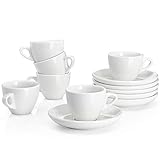
Sweese 2oz Porcelain Espresso Cups with Saucers, Set of 6
Best for: Anyone who wants a traditional Italian-style demitasse experience — porcelain cups with saucers for serving espresso the classic way
Set of 6 porcelain cups with matching saucers — the only traditional demitasse set in our lineup
- +Set of 6 with saucers at under $27 — roughly $4.50 per cup-and-saucer pair
- +Thick-walled porcelain retains heat better than thin glass and feels substantial in hand
- +Classic white porcelain matches any kitchen aesthetic and shows off crema color beautifully
- +Lead-free, dishwasher/microwave/oven/freezer safe — genuinely versatile daily-use porcelain
- −2oz capacity is small even by espresso standards — tight for a double shot
- −No insulation — the cup gets hot and the espresso cools faster than double-wall glass
- −Porcelain can chip if knocked against other dishes in the dishwasher
- −Saucers add bulk if counter or storage space is limited
✓ Free shipping with Prime · Affiliate link
Why we recommend it
Six cups and six matching saucers for $27 makes this the best per-unit value in our lineup. But the real case for the Sweese set is the material: thick porcelain retains heat differently from glass. You feel the warmth through the cup wall, which is part of the espresso ritual that double-wall glass deliberately eliminates. On r/espresso, multiple users document a pattern of starting with double-wall glass and eventually switching to ceramic or porcelain for daily use — the tactile warmth wins long-term.
Key features
- Set of 6 with matching saucers — enough for hosting and daily rotation without buying multiples
- Thick-walled porcelain retains heat and shows off crema color better than any glass
- Lead-free, dishwasher/microwave/oven/freezer safe — genuinely versatile daily-use porcelain
Who it’s best for
Anyone who has been through the double-wall glass phase and wants to land on porcelain. Or anyone who prefers the café tradition of a proper demitasse with a saucer — a small ritual that double-wall glasses cannot replicate.
Potential downsides
- 2oz capacity is small even by espresso standards — tight for a double shot, impossible for anything with milk
- No insulation — the cup gets hot to the touch and the espresso cools faster than in double-wall glass
- Porcelain can chip if knocked against other dishes in the dishwasher — hand washing extends lifespan significantly
Affiliate link
4. Bormioli Rocco Verdi Espresso Cup — Italian Glass with a Steel Handle

Bormioli Rocco Verdi Espresso Cup with Stainless Steel Handle, Set of 4
Best for: Anyone who wants the café aesthetic of glass espresso cups but needs a proper handle — a premium Italian-made set for daily use
Made in Italy by Bormioli Rocco (glassware experts since 1825) with removable stainless steel handles for easy cleaning
- +4.8-star average — the highest-rated espresso cup in our lineup
- +Made in Italy by Bormioli Rocco, a glassware house with nearly 200 years of craftsmanship
- +Removable stainless steel handle separates for dishwasher cleaning — unique in this category
- +Tempered glass is more durable than standard borosilicate and resists thermal shock better
- −Not double-walled — the glass gets hot to touch without the handle
- −Stainless steel handle can loosen over time with repeated dishwasher cycles
- −3.5oz capacity sits between espresso and cappuccino — slightly awkward for purists who want exactly 2oz
- −Gift box packaging is nice but adds to the price per cup
✓ Free shipping with Prime · Affiliate link
Why we recommend it
The highest-rated cup in our lineup at 4.8 stars, and for good reason: the Bormioli Rocco Verdi solves the single biggest complaint about espresso glasses. On r/espresso, among the most upvoted cup-related threads are catastrophic failure stories — double-wall glass handles snapping mid-sip, glasses shattering from thermal shock, and water leaking between double walls. The Verdi sidesteps all of these: tempered glass (not double-wall) with a removable stainless steel handle that keeps your fingers away from the hot surface. Made in Italy by a glassware house founded in 1825.
Key features
- Removable stainless steel handle separates for easy dishwasher cleaning — unique in this category
- Tempered glass is more resistant to mechanical impact than standard glass, and the single-wall design eliminates the glued-seal failure mode forum users complain about most
- Set of 4 in a gift box at $22 — roughly $5.50 per cup, competitive for the quality level
- Made in Italy by Bormioli Rocco, nearly 200 years in the glassware business
Who it’s best for
Anyone who wants the visual appeal of glass espresso cups but refuses to deal with the fragility of double-wall construction. The steel handle makes these practical daily drivers in a way that handleless glasses are not.
Potential downsides
- Not double-walled — the glass gets hot without the handle, and it will not produce the “floating coffee” visual effect
- Stainless steel handle means these are not microwave safe
- 3.5oz capacity sits between a doppio and a cortado — slightly awkward for purists who want exactly 2oz
Affiliate link
5. JoyJolt Savor Double Wall Insulated Glasses — Espresso Through Cappuccino in One Cup

JoyJolt Savor Double Wall Insulated Espresso Mugs, Set of 2, 5.4oz
Best for: Anyone who wants one cup that handles espresso, cortado, and cappuccino — the 5.4oz capacity bridges the gap between demitasse and coffee mug
5.4oz capacity in a double-wall design — large enough for cappuccino-sized drinks while still looking elegant with a straight espresso
- +5.4oz capacity handles everything from a single espresso to a small cappuccino or cortado
- +Over 26,000 reviews — second most-reviewed in our lineup, with strong community validation
- +Double-wall borosilicate glass keeps drinks hot while the outer surface stays cool
- +Elegant curved shape looks great whether you fill it with 1oz or 5oz
- −Too large for traditional espresso purists — a 1oz shot looks lost in a 5.4oz glass
- −No handle — the larger size means more surface area to grip, which some find awkward
- −Set of 2 only at $15.62 — not the best per-cup value compared to 4-packs
- −Some reviews report the glass is thinner than expected, raising durability concerns
✓ Free shipping with Prime · Affiliate link
Why we recommend it
The 5.4oz capacity makes the JoyJolt Savor the only cup in our lineup that handles everything from a straight espresso to a small cappuccino. If you are not sure what size you need — or if you make cortados on weekdays and cappuccinos on weekends — this is the cup that covers both. Over 26,000 reviews confirm the concept works in practice.
Key features
- 5.4oz capacity bridges the gap between demitasse and coffee mug — works for espresso, cortado, and cappuccino
- Double-wall borosilicate glass keeps drinks hot while the outer surface stays cool
- Elegant curved shape looks proportional whether you fill it with 1oz or 5oz
Who it’s best for
Anyone who makes milk drinks alongside straight espresso. Pair these with a milk frother and you have a cortado-to-cappuccino setup without needing separate cup sizes. Also the right choice if you are buying for a household where different people drink different sizes.
Potential downsides
- Too large for espresso purists — a 1oz shot looks lost in a 5.4oz glass
- No handle, and the larger size means more surface area to grip awkwardly
- Set of 2 at $16 — not the best per-cup value compared to 4-packs
Affiliate link
6. Gencywe Double Walled Espresso Cups — Four Cups for Under $15

Gencywe Double Walled Espresso Cups Set of 4, 3oz
Best for: Budget-conscious buyers who want double-wall insulated glass without paying premium-brand prices — four cups for under $15
50% thicker walls than standard double-wall glasses at a fraction of the price — set of 4 for less than most brands charge for 2
- +Set of 4 for $14 — roughly $3.50 per cup, the lowest cost-per-cup in our lineup
- +Claims 50% thicker walls than standard double-wall glasses, which may improve durability
- +Mouth-blown borosilicate glass with the same floating-coffee effect as premium brands
- +Microwave safe and dishwasher safe for easy daily use
- −Lesser-known brand without the track record of Bodum or De'Longhi
- −No handle — some owners find handleless 3oz glasses fiddly to hold
- −Quality control can be inconsistent — some reviews note uneven walls or bubbles
- −3oz capacity limits you to straight espresso or short cortados
✓ Free shipping with Prime · Affiliate link
Why we recommend it
Four double-wall cups for $14 is the lowest per-cup cost in our lineup. The Gencywe set delivers the same floating-coffee visual effect and hand insulation as the Bodum Pavina at a fraction of the price. If you want to try double-wall glass without committing to a premium brand, this is where to start.
Key features
- Set of 4 for $14 — roughly $3.50 per cup, the lowest in our lineup
- Claims 50% thicker walls than standard double-wall glasses, which should improve durability
- Mouth-blown borosilicate glass with the same material properties as premium brands
- 3oz capacity fits a doppio or short cortado
Who it’s best for
Budget-conscious buyers who want to test whether double-wall glass suits their daily routine before investing in De’Longhi or Bodum. Also a practical choice for households where cups get broken — at $3.50 each, replacing one is painless.
Potential downsides
- Lesser-known brand without the track record of Bodum or De’Longhi — quality control can be inconsistent based on Amazon reviews noting uneven walls or bubbles
- No handle, which is the standard tradeoff for double-wall glass at this price
- The community’s biggest complaint about double-wall glass in general applies here: the glued seal between inner and outer walls is a structural weak point that can eventually allow water intrusion
Affiliate link
Buyer’s Guide: How to Choose the Right Espresso Cup
Start with the drink, not the cup
This is the single most important decision, and the one most buyers get wrong. On r/espresso, size confusion is the most frequent topic in cup recommendation threads — people buy 2oz demitasse cups for cortados, or 8oz mugs for straight espresso, and wonder why the experience feels off.
| Your drink | Typical volume | Cup size to buy | Our pick |
|---|---|---|---|
| Single espresso | 1–1.5oz | 2–3oz | Bodum Pavina (2.5oz), Sweese (2oz) |
| Doppio | 2–3oz | 3–4oz | De’Longhi (3oz), Gencywe (3oz), Bormioli Rocco (3.5oz) |
| Cortado | 4–5oz | 5–6oz | JoyJolt Savor (5.4oz) |
| Cappuccino | 5–8oz | 6–8oz | JoyJolt Savor (5.4oz) for small caps; consider a larger mug for full-size |
If you mostly drink straight espresso but occasionally make cortados, the 3oz De’Longhi or Bormioli Rocco is a good compromise — big enough for a doppio with a splash of milk, small enough that a single shot does not look lost.
Porcelain vs double-wall glass vs tempered glass
The material debate is less about performance and more about what you value in the daily ritual.
Porcelain (Sweese in our lineup) is what cafés use worldwide. Thick walls absorb heat from the espresso, which cools the drink slightly on contact — this is actually desirable, since espresso straight from the machine is too hot to taste properly. The Specialty Coffee Association’s standards address optimal coffee serving conditions, and porcelain naturally brings espresso into a comfortable drinking temperature faster than insulated glass. The tradeoff: porcelain can chip, it is heavier, and you feel the heat through the wall (which many enthusiasts consider a feature, not a bug).
Double-wall borosilicate glass (De’Longhi, Bodum, Gencywe, JoyJolt) insulates your hands and creates the striking “floating” visual effect. The trapped air between walls is a poor heat conductor, so the drink stays hotter longer and the outer surface stays cool. The tradeoff: durability. Across r/espresso, the most-engaged threads about cups are catastrophic failure stories — handles snapping mid-sip, glasses shattering from thermal shock, and water leaking between the walls when the glued seal fails. One commenter put it plainly: “All these double-layer glass cups will eventually fail, because the plug is glued on and isn’t a structural part of the blown glass.”
Tempered glass with a steel handle (Bormioli Rocco) is the middle path. No double-wall insulation, but the stainless steel handle keeps fingers off the hot glass. Tempered glass is more resistant to mechanical impact than standard glass, and there is no inner wall to develop leaks. The tradeoff: no insulation effect — you need the handle, and the drink cools at a similar rate to porcelain.
The durability question nobody thinks about until it is too late
Nobody shops for espresso cups thinking about breakage. But some of the most intensely discussed cup threads on r/espresso — with 267, 196, and 179 upvotes respectively — are about cups failing. Double-wall glass is the most fragile option: thermal shock (pouring boiling espresso into a cold glass), handle stress fractures, and gradual water intrusion between the walls are all documented failure modes.
To extend the life of any espresso cup:
- Preheat before pulling a shot. Run hot water through the cup for 10 seconds, or leave it on your espresso machine’s cup warmer if it has one. This reduces thermal shock on glass and improves taste on porcelain. The NCA brewing guide covers optimal serving practices, and preheating is standard in specialty coffee shops.
- Hand wash double-wall glass if you want it to last. Dishwasher cycles stress the glued seal between the inner and outer walls.
- Store porcelain cups with felt separators to prevent chipping — the thin lip that makes a cup feel elegant is also the most fragile part.
How we picked: a note on brands
Two of our six picks — Bodum and De’Longhi — have genuine brand recognition in coffee enthusiast communities. The other four (Sweese, Bormioli Rocco, JoyJolt, Gencywe) are Amazon-marketplace brands that do not generate organic discussion on Reddit or coffee forums. This is typical for dishware: unlike espresso machines or grinders, cups do not inspire the same community fervor. We selected these four based on Amazon review volume, rating, specs, and value per cup — not on community endorsement.
The brands that enthusiasts organically recommend — Loveramics (particularly the Dale Harris cups), Fellow, and Hasami — are premium ceramics typically sold per individual cup rather than in sets. They are excellent, and if you are deep into the espresso ritual, they are worth seeking out. But they serve a different buyer: someone collecting artisan cups as part of the craft, not someone buying a practical set for daily use or gifting.