The De’Longhi Dedica is the best compact espresso machine for most people — at 5.9 inches wide, it fits in spaces where every other semi-automatic on the market would not. If you want the best balance of compact size and espresso quality, the Breville Bambino delivers 3-second heat-up and a 54mm portafilter in a 6.25-inch-wide body.
This roundup is organized by footprint, not price. Every machine was evaluated with dimensions first and espresso quality second — because if it doesn’t fit your counter, nothing else matters. We researched compact espresso machines across width, depth, steam performance, and total counter footprint to find these six.
If you’re shopping by budget instead, our best espresso machine under $500 and under $200 roundups organize by price. For beginners who want guidance on which type to buy, start with our espresso machine for beginners guide.
How We Evaluated
We focused on five criteria, with one difference from our other espresso roundups — footprint is the lead criterion, not a tiebreaker:
- Counter footprint — Width × depth in inches. We measured from the machine’s widest point, including portafilter insertion and drip tray when extended. A machine that’s 6 inches wide but needs 14 inches of depth plus portafilter clearance takes more real estate than the spec sheet suggests.
- Shot quality relative to size — Can it produce properly extracted espresso with good crema? We evaluated shot quality against what you’d expect at each size tier, not against a $2,000 prosumer machine.
- Steam wand performance — How well does it texture milk in a compact body? Compact machines often compromise on steam power — we noted where that matters.
- Heat-up time — Compact buyers on r/espresso consistently cite speed alongside footprint as a primary criterion. ThermoJet systems (3 seconds) versus traditional thermoblocks (25–40 seconds) is a meaningful daily difference.
- Total setup footprint — Your espresso machine doesn’t sit alone. We considered grinder pairing — a compact machine next to a large grinder defeats the purpose. We note compact grinder pairings where relevant.
Quick Size Comparison
Before diving into reviews, here’s every machine’s actual width — the dimension that determines whether it fits your counter:
| Machine | Width | Depth | Price |
|---|---|---|---|
| De’Longhi Dedica | 5.9” | 13.0” | $245 |
| De’Longhi Dedica Arte | 5.9” | 13.0” | $245 |
| Breville Bambino | 6.25” | 13.5” | $299 |
| Breville Bambino Plus | 7.5” | 13.5” | $498 |
| De’Longhi Stilosa | 8.1” | 11.2” | $148 |
| CASABREWS CM5418 | 10.4” | 10.0” | $140 |

De'Longhi Dedica EC685
Best for: Anyone with a small kitchen who wants real espresso in a 6-inch footprint
Just 5.9 inches wide — fits where other machines cannot, without sacrificing shot quality
- +Ultra-slim 5.9-inch width — smallest in this roundup
- +15-bar pump delivers genuine espresso pressure
- +Adjustable cup tray fits espresso cups to tall latte glasses
- +Manual steam wand gives you real frothing control
- −51mm portafilter — non-standard, limiting basket and tamper options
- −Pressurized baskets included; non-pressurized requires aftermarket purchase
- −Small water tank (35 oz) needs frequent refilling
- −Plastic internal components in some areas
✓ Free shipping with Prime · Affiliate link
Why We Recommend It
At 5.9 inches wide, the Dedica is the narrowest semi-automatic espresso machine you can buy from a major brand. That’s not a spec-sheet curiosity — it’s the entire reason this machine exists. For anyone in an apartment with a galley kitchen, sharing counter space with a partner’s stand mixer, or fitting espresso capability next to a drip brewer, the Dedica solves the space problem without giving up real espresso. The 15-bar pump and thermoblock heating deliver proper extraction, and the adjustable cup tray accommodates everything from demitasse cups to tall latte glasses.
De’Longhi has sold the Dedica platform for years, and the community feedback is consistent: it’s the machine for people who literally have no counter space. On r/espresso, the Dedica appears most often as what people upgrade from — which is actually a compliment to its role. It gets people into real espresso when space is the barrier, and when they’re ready for more, the upgrade path is clear.
Key Dimensions
- 5.9 inches wide — tied for narrowest in this roundup (with the Dedica Arte)
- 13.0 inches deep — typical for this class; account for portafilter extending 3–4 inches forward
- 12.0 inches tall — fits under standard kitchen cabinets with clearance
- 9.3 lbs — light enough to move to a shelf when you need the counter
Who It’s Best For
Anyone whose counter space is the binding constraint. Studio apartments, galley kitchens, shared counters, RV or boat setups. If you need espresso capability in under 6 inches of width, this is the only option from a brand with national service and parts availability.
Potential Downsides
The 51mm portafilter is De’Longhi proprietary — it limits your aftermarket basket and tamper options compared to Breville’s 54mm or the industry-standard 58mm. The included baskets are pressurized, which is forgiving for beginners but caps your extraction quality. Getting non-pressurized baskets requires aftermarket purchases. The 35 oz water tank is small — expect to refill after 3–4 drinks. For more compact options across all budgets, the Dedica Arte below uses the same slim body with an upgraded steam wand.
Affiliate link
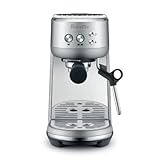
Breville Bambino
Best for: Budget-conscious beginners who want real espresso without the Plus markup
Same 3-second ThermoJet heat-up and 54mm portafilter as the Plus, minus auto-frothing — $150 saved
- +3-second heat-up — same ThermoJet system as the Bambino Plus
- +54mm portafilter with both pressurized and non-pressurized baskets
- +Compact footprint fits small kitchens
- +$150 cheaper than the Plus — spend the savings on a grinder
- −No automatic milk frothing — manual steam wand only
- −Portafilter and tamper feel lightweight and plastic
- −No on/off switch — always drawing standby power
- −No solenoid valve — water pools on puck after shot (cosmetic, not functional)
✓ Free shipping with Prime · Affiliate link
Why We Recommend It
The Bambino is the machine the r/espresso community reaches for when someone asks “what compact machine should I get?” — and the reason is the ThermoJet heating system. Three seconds from off to extraction temperature. No warming up, no waiting, no temperature surfing. For someone who makes one or two drinks before work, that speed is transformative.
At 6.25 inches wide, the Bambino is only slightly wider than the Dedica but meaningfully better equipped. The 54mm portafilter gives you access to Breville’s aftermarket ecosystem — precision baskets, bottomless portafilters, and a tamper that feels like it belongs in a coffee shop rather than a toy box. The low-pressure pre-infusion gradually increases pressure to draw flavors out evenly, and it shows in the cup.
On r/espresso, the Bambino is the default apartment recommendation. One commenter with 304 upvotes put it plainly: they “cannot find a good enough reason to change machine.” For 1–2 drinks a day, the Bambino delivers quality that most home drinkers won’t outgrow.
Key Dimensions
- 6.25 inches wide — smallest footprint in the Breville lineup
- 13.5 inches deep — portafilter extends another 3–4 inches forward when locked in
- 12.0 inches tall — same height class as the Dedica
- 11 lbs — heavier than the Dedica but still easily movable
Who It’s Best For
The compact buyer who prioritizes espresso quality and speed over absolute minimum width. If you have 6.5+ inches of counter width and want the best shot quality per square inch of counter space, the Bambino is the pick. Pair it with a compact hand grinder like the 1Zpresso JX-Pro or a small electric like the Eureka Mignon Notte to keep total setup footprint under 12 inches.
Potential Downsides
The manual steam wand is capable but requires technique — if you want hands-free milk frothing, the Bambino Plus adds automatic steaming for $200 more. The portafilter and tamper feel lightweight compared to commercial equipment, which bothers some users aesthetically more than functionally. There’s no on/off switch — the machine draws standby power continuously.
Affiliate link

De'Longhi Dedica Arte
Best for: Compact-kitchen latte drinkers who want the Dedica's slim body with a real steam wand upgrade
Same 5.9-inch width as the EC685, but the My LatteArt steam wand makes milk texturing far easier
- +Same ultra-slim 5.9-inch width as the original Dedica
- +My LatteArt steam wand — genuine upgrade over the EC685's manual frother
- +3-level temperature control for light, medium, and dark roast optimization
- +Professional tamper and large 18g filter basket included
- −3.9-star rating reflects some owners' frustration with the learning curve on the LatteArt wand
- −51mm portafilter — same non-standard limitation as the EC685
- −Small water tank needs frequent refilling for back-to-back drinks
- −The LatteArt wand requires more cleanup than the EC685's simpler frother
✓ Free shipping with Prime · Affiliate link
Why We Recommend It
The Dedica Arte is the same 5.9-inch-wide body as the original Dedica with one significant upgrade: the My LatteArt steam wand. Where the EC685’s manual frother requires you to find the sweet spot between steam and air yourself, the Arte’s wand is designed to produce textured microfoam with less technique. If you want the Dedica’s unmatched slim profile but plan to make lattes and cappuccinos regularly, the Arte closes the milk gap.
The Arte also adds 3-level temperature control — letting you optimize extraction temperature for light, medium, or dark roasts — and includes a professional tamper with a large 18g filter basket. These are practical upgrades that the original Dedica lacks, concentrated into the same footprint.
A note on transparency: the Dedica Arte is a variant of the extensively-discussed EC685 platform, and most community discussion of “the Dedica” on Reddit covers the original. The Arte’s specific differentiator — the My LatteArt wand — doesn’t have dedicated forum discussion. We’re recommending it based on the EC685’s proven form factor combined with the steam wand upgrade that addresses the original’s most common complaint.
Key Dimensions
- 5.9 inches wide — identical to the original Dedica
- 13.0 inches deep — same chassis, same counter footprint
- 12.0 inches tall — fits the same spaces
- 8 lbs — slightly lighter than the EC685
Who It’s Best For
Latte and cappuccino drinkers in tight kitchens who want the Dedica’s slim profile without the EC685’s steep milk-frothing learning curve. If you chose between the Dedica and a wider machine specifically because of the milk issue, the Arte resolves that tension.
Potential Downsides
The 3.9-star Amazon rating (2,071 reviews) is below the 4.0 threshold we use as a baseline for this roundup. Some owners report a learning curve with the LatteArt wand that makes the “easier milk texturing” promise feel overstated initially. The same 51mm portafilter limitation applies — non-standard size, limited aftermarket options. And the 35 oz water tank is the same small capacity as the original. If you don’t make milk drinks, save money with the original Dedica — the Arte’s only advantage is the steam wand.
Affiliate link

Breville Bambino Plus
Best for: Beginners who want great espresso with minimal learning curve
3-second heat-up with automatic milk frothing — closest to cafe-quality with zero barista skills
- +3-second heat-up — fastest in this price range
- +Automatic milk frothing produces decent microfoam
- +Compact footprint fits small kitchens
- +54mm portafilter with pressurized and non-pressurized baskets
- −Reliability concerns — some owners report failures within 12–18 months
- −Struggles with lighter roasts without temperature surfing
- −Thermoblock heating less durable long-term than traditional boilers
- −Amazon pricing fluctuates — check current price before buying
✓ Free shipping with Prime · Affiliate link
Why We Recommend It
The Bambino Plus is the machine for compact buyers who refuse to compromise on milk drinks. The automatic steam wand textures milk to a set temperature and stops — no technique required, no babysitting. Combined with the same 3-second ThermoJet heat-up as the base Bambino, you go from cold machine to finished latte in under two minutes. In a 7.5-inch-wide body, that’s remarkable capability density.
The 54mm portafilter, low-pressure pre-infusion, and PID-controlled temperature deliver shot quality that competes with machines twice its size. The 64 oz water tank is nearly double the Dedica’s — meaningful if you’re making back-to-back drinks for a household. On r/espresso, the Bambino Plus is the most recommended Breville for people who make daily milk drinks. For the full Breville lineup ranked by use case, see our best Breville espresso machine guide.
Key Dimensions
- 7.5 inches wide — 1.25 inches wider than the base Bambino; noticeable in tight spaces
- 13.5 inches deep — same depth as the Bambino
- 12.0 inches tall — same height class
- 12.4 lbs — heaviest compact machine in this roundup
Who It’s Best For
Compact buyers who make milk drinks daily and want to eliminate the steam wand learning curve. If you’re choosing between the Bambino Plus and a larger machine specifically because you want lattes without the manual steaming, this is the pick. Pair it with a compact espresso grinder to keep your total setup under 14 inches wide.
Potential Downsides
At $498, it’s the most expensive machine in this roundup — and the automatic milk frother, while convenient, produces decent microfoam rather than the silky, glossy results a skilled manual steamer achieves. If you plan to learn latte art, the base Bambino’s manual wand gives you more control for $200 less. The 7.5-inch width matters in very tight spaces — it’s 1.6 inches wider than the Dedica, which can be the difference between fitting and not fitting in a galley kitchen. The consistency ceiling is real but high: a 593-upvote r/espresso thread documents one Bambino Plus owner upgrading to a Lelit Mara X after “reaching the limits of consistency” — though that’s a significant prosumer-tier upgrade most daily drinkers won’t need. Our Bambino vs. Bambino Plus comparison breaks down exactly when the Plus premium is worth it.
Affiliate link

De'Longhi Stilosa EC260
Best for: First-time espresso buyers who want to try the hobby without a big investment
Under $100 with a real 15-bar pump and manual steam wand — lowest entry point for genuine espresso
- +Under $100 — lowest price in this roundup by far
- +15-bar pump produces real espresso crema
- +Manual steam wand for milk frothing
- +13,000+ Amazon reviews — battle-tested and well-documented
- −No PID — temperature consistency is basic
- −Pressurized portafilter only — limits shot quality ceiling
- −Build quality reflects the price — plastic-heavy construction
- −Small boiler means long wait between shots and steaming
✓ Free shipping with Prime · Affiliate link
Why We Recommend It
The Stilosa is the cheapest path to real espresso that still qualifies as compact. At $148 and 8.1 inches wide, it delivers what no pod machine or Moka pot can — 15 bar of pump pressure through ground coffee, producing genuine espresso with crema. The manual steam wand is basic but functional. The build feels appropriately budget — no stainless steel housing, no precision engineering — but it works.
For someone who wants to try home espresso without committing $300+ and a large counter footprint, the Stilosa lets you answer the question “do I actually want this?” for the cost of a month of cafe lattes. If the answer is yes, you’ll outgrow it within a year and upgrade to a Bambino or Dedica. If the answer is no, you’re out $148 instead of $500. That’s a reasonable bet.
Key Dimensions
- 8.1 inches wide — wider than the Dedica and Bambino; still compact by absolute standards
- 11.2 inches deep — shallower than the Dedica and Bambino models; good for narrow counters
- 11.5 inches tall — shortest machine here; fits under low cabinets
- 6.4 lbs — lightest machine in this roundup
Who It’s Best For
Budget-conscious buyers who want to try home espresso without a large investment. College students, first apartments, shared kitchens where a $500 machine feels irresponsible. Also works as a secondary machine — if you have a drip brewer and want to add occasional espresso capability, the Stilosa’s small footprint and low price make it a low-stakes addition. For other machines under $200, see our full budget roundup.
Potential Downsides
The pressurized portafilter caps your extraction quality — you’re getting drinkable espresso, not specialty-grade shots. The steam wand produces adequate foam but won’t create microfoam for latte art. Plastic construction throughout means this isn’t a machine built to last a decade. And the 51mm portafilter limits aftermarket upgrades — by the time you want better baskets and tampers, you’ll want a better machine. For $40 more, the CASABREWS CM5418 adds a pressure gauge and marginally better build quality, though at a wider footprint.
Affiliate link
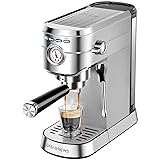
CASABREWS CM5418
Best for: Value-conscious buyers who want built-in pressure feedback to improve their technique
Built-in pressure gauge shows real-time extraction pressure — a feature usually found on machines 3x the price
- +Built-in pressure gauge for extraction feedback
- +20-bar pump with pre-infusion capability
- +Highest rating in this roundup at 4.4 stars across 7,600+ reviews
- +Stainless steel exterior with compact footprint
- −Must wait for machine to cool between steaming and brewing — no simultaneous operation
- −Amazon-native brand with limited long-term track record vs De'Longhi or Breville
- −34 oz water tank is smaller than competitors
- −Pressurized baskets only — non-pressurized requires aftermarket sourcing
✓ Free shipping with Prime · Affiliate link
Why We Recommend It
The CASABREWS CM5418 has 7,664 Amazon reviews at 4.4 stars — the highest rating of any machine in this roundup. The built-in pressure gauge is genuinely useful for beginners learning to dial in their shots, showing real-time extraction pressure so you can see when your grind is too fine or too coarse. At $140, it’s a solid value proposition with a stainless steel exterior and 34 oz removable water tank.
A note on dimensions: the CASABREWS markets itself as “compact,” but at 10.4 inches wide, it’s about 75% wider than the Dedica (5.9”) and significantly wider than the Bambino (6.25”). We’re including it in this roundup because it IS compact relative to full-sized espresso machines — but if your counter constraint is under 9 inches of width, the CASABREWS won’t fit. We’ve tiered our picks into three size categories in the buyer’s guide below so you can see where each machine falls.
Key Dimensions
- 10.4 inches wide — widest machine in this roundup; check your counter before buying
- 10.0 inches deep — shallowest depth in this roundup
- 12.2 inches tall — standard height
- 9.5 lbs — mid-weight
Who It’s Best For
Beginners who want a forgiving entry point with visual feedback on extraction. The pressure gauge takes guesswork out of learning. If your counter can accommodate 10+ inches of width and you’re looking for the most-reviewed, highest-rated compact machine on Amazon, this is it. For more options in this price range, see our espresso machine under $200 roundup.
Potential Downsides
The 20-bar pump pressure is a marketing number — espresso extraction happens at around 9 bar, and the excess pressure is reduced by an internal valve. It’s not harmful, but it’s not the advantage it sounds like. The 51mm pressurized portafilter limits long-term growth. The steam wand requires cooling time between frothing and brewing — you can’t froth and immediately pull another shot without waiting for the temperature to drop, and if you skip the cool-down the machine enters over-heating protection mode. That cool-down cycle is the CASABREWS’s biggest daily friction point.
Affiliate link
Buyer’s Guide: Compact Espresso, Honestly
How Small Is Small Enough?
“Compact” means different things to different machines. We’ve tiered our picks by actual width so you can match your counter to your options:
Ultra-compact (under 7 inches wide): De’Longhi Dedica (5.9”), De’Longhi Dedica Arte (5.9”), Breville Bambino (6.25”). These fit in genuinely tight spaces — next to a toaster, in a galley kitchen, on a narrow shelf. If your counter constraint is under 7 inches, these are your only options.
Compact (7–9 inches wide): Breville Bambino Plus (7.5”), De’Longhi Stilosa (8.1”). These need moderate counter space but still qualify as small compared to full-sized semi-automatics. The Bambino Plus is the sweet spot for people who want compact size with full capability.
Standard-compact (9–11 inches wide): CASABREWS CM5418 (10.4”). Compact by marketing standards, but meaningfully wider than the ultra-compact tier. If you have 10+ inches available, the CASABREWS works; if not, look higher in this list.
What About the Grinder?
Your espresso machine doesn’t sit alone on the counter. The grinder adds 3–6 inches of width to your total setup footprint. If you buy a 6-inch-wide Dedica and pair it with a 5-inch-wide Eureka Mignon Notte, your total setup is 11+ inches — plus clearance space between them.
Compact grinder pairings that work well with these machines:
- Hand grinders (0 counter footprint when stored): 1Zpresso JX-Pro, Comandante C40, Kinu M47 Phoenix. Best for true space minimalism — grind by hand, store in a drawer.
- Small electric grinders (4–5 inches wide): Eureka Mignon Notte, Baratza Sette 270. Add modest width but save time versus hand grinding.
- All-in-one machines: If total footprint is your absolute priority, our best espresso machine with built-in grinder roundup covers machines that eliminate the separate grinder entirely — though they’re wider than any machine here.
For a full grinder comparison, see our best coffee grinder for espresso guide.
What Do You Give Up for a Compact Machine?
Compact espresso machines make real tradeoffs. Being honest about them is how you avoid buyer’s remorse:
- Water tank size. The Dedica and Arte hold 35 oz — enough for 3–4 drinks before refilling. The Bambino Plus holds 64 oz. If you make espresso for a household, the refill frequency matters.
- Steam power. Compact machines use thermoblocks rather than dedicated steam boilers. Steam pressure is adequate for milk drinks but won’t match a dual-boiler machine. On r/espresso, “within-budget espresso machines” are cited for “weak or inconsistent steam power” — this is the tradeoff.
- Portafilter size. The Dedica, Arte, Stilosa, and CASABREWS use 51mm portafilters. The Bambino and Bambino Plus use 54mm. Both are smaller than the 58mm industry standard used in cafes. Smaller portafilter = fewer aftermarket options = lower upgrade ceiling.
- Consistency ceiling. Compact machines produce excellent espresso for daily use, but the shot-to-shot consistency plateaus below prosumer machines. The SCA’s brewing standards define optimal extraction parameters that larger machines maintain more reliably across consecutive shots. Most daily drinkers — making 1–2 drinks — won’t notice. If you pull 4+ drinks a day for a household, a larger machine’s boiler capacity and temperature stability earn their counter space.
When Compact Is the Wrong Answer
If any of these apply, you’re better served by our head-term espresso machine roundup:
- You pull 4+ drinks daily. Small water tanks and single-boiler recovery times create friction at volume.
- Milk drinks are your primary output and you want latte-art-grade microfoam. Compact steam wands are adequate, not excellent. A dedicated steam boiler makes a real difference.
- You plan to mod extensively. The Gaggia Classic Evo Pro (9.4 inches wide, $530) has the strongest mod community in home espresso — Gaggiuino turns it into a machine rivaling setups at ten times the price. That modability requires a standard 58mm portafilter and boiler access that compact machines don’t offer. At 9.4 inches, the Gaggia is technically narrower than the CASABREWS in this roundup — we excluded it because its 58mm group head, 17.6-pound weight, and mod-oriented design serve a different buyer than the footprint-first audience this article targets. If that buyer sounds like you, see our under-$1,000 roundup where the Gaggia earns a top spot.
- You want a compact super-automatic. Push-button machines that grind, brew, and froth automatically are larger than anything in this roundup (e.g., the Jura E4 at $1,394 in our super-automatic roundup).
What’s the Upgrade Path?
The most-discussed compact-to-prosumer upgrade on r/espresso is Bambino Plus to Lelit Mara X — a heat-exchange machine chosen specifically because it’s compact for a prosumer (roughly the same footprint as the Gaggia Classic but with a dedicated steam circuit). The upgrade typically happens when shot consistency or steam power becomes a daily friction point. If you’re buying a compact machine now and wondering where you’ll go next, the Mara X is the documented trajectory. But most owners — making 1–2 drinks a day — never reach that point.