“Best single-serve coffee maker” is a search query that contains three entirely different products pretending to be one category. A Keurig K-Mini, an AeroPress, and a WACACO Picopresso have about as much in common as a microwave, a cast-iron skillet, and a camping stove. They all heat food. They serve completely different people.
Here is the split: pod machines (Nespresso, Keurig) give you coffee at the push of a button with zero technique. Manual single-cup brewers (AeroPress, Clever Dripper) require 3–5 minutes of your attention and produce a noticeably better cup. Portable espresso makers (WACACO Picopresso) produce genuine espresso anywhere, with real crema, but demand skill and a good grinder. These are not quality tiers — they are attention tiers. The right one depends on how much of your morning you want to spend thinking about coffee.
If you just want our single pick: the Nespresso Vertuo Pop+ is the best pod machine for most people. If you want better coffee and do not mind 2 minutes of effort, the AeroPress Original is the community consensus best single-serve brewer, period. The rest of this guide explains why — and which of the three categories is right for you.
Most roundup articles rank a Keurig against an AeroPress as though they are competing for the same job. They are not. We organized this guide around the three actual categories, picked the best in each, and included honest cost-per-cup math that pod machine marketing prefers you never see. If you already know which type you want, skip to that section. If you are not sure, the buyer’s guide will help you decide.
If you want a full multi-cup brewer instead of single-serve, see our best coffee maker or best drip coffee maker guides. If you are specifically after espresso from a proper machine, see our espresso machine roundup.
How we evaluated
- Cup quality for its category — We did not compare a pod machine’s output against a hand-brewed AeroPress cup. That comparison is meaningless. We evaluated each product against others in its category: pod vs. pod, manual vs. manual.
- Per-cup cost over one year — Entry price tells half the story. A $74 Keurig plus 365 K-Cups at $0.50 each costs $257 in year one. A $40 AeroPress plus $0.30/cup in beans costs $150. We calculated the real numbers.
- Ease of use and cleanup — Pod machines win on speed. Manual brewers win on simplicity of parts. We noted the actual time investment for each, from unboxing to first cup.
- Build quality and longevity — On r/BuyItForLife, a pod machine insider confirmed these machines are designed with limited lifecycles. Manual brewers like the AeroPress and Clever Dripper are recommended as true buy-it-for-life options.
- What else you need — A pod machine needs pods and electricity. A Clever Dripper needs a kettle and filters. A Picopresso needs a quality hand grinder. We accounted for the full ecosystem cost.
The Pod Machines
1. Nespresso Vertuo Pop+ — Five Cup Sizes in One Compact Machine

Nespresso Vertuo Pop+
Best for: People who want one-touch coffee and espresso without any learning curve
Centrifusion brewing reads each Vertuo capsule's barcode and adjusts speed, water volume, and temperature automatically
- +Genuinely one-touch — insert capsule, close lever, press button
- +Five cup sizes from espresso to 12 oz coffee in a single machine
- +Compact footprint with side-mounted water tank saves counter space
- +Recyclable aluminum capsules through Nespresso's free program
- −Vertuo capsules cost $0.90–$1.35 each — significantly more per cup than ground coffee
- −Proprietary capsule system locks you into Nespresso's ecosystem with no third-party options
- −Coffee quality is consistent but limited by capsule selection — no custom grind or ratio control
- −25 oz water tank needs frequent refilling compared to larger Keurig reservoirs
✓ Free shipping with Prime · Affiliate link
Why we recommend it
If you want coffee at the push of a button and you want it to taste meaningfully better than a Keurig, the Nespresso Vertuo system is the community consensus answer. Across r/nespresso, the Keurig-to-Nespresso upgrade story is a genre unto itself — users consistently describe the switch as going from “brown water” to real coffee. One former barista noted the trajectory mirrors income growth: the Keurig in the broke-assistant days, the Nespresso after the promotion.
The Vertuo Pop+ is the current-generation entry point. It reads a barcode on each capsule and automatically adjusts spin speed, water volume, and temperature. Five cup sizes — from a 1.35 oz espresso to a 12 oz mug — from a machine that is smaller than most Keurigs. The 30-second heat-up time means you go from cold machine to drinking in under a minute.
We chose the Vertuo Pop+ over the VertuoPlus (previous generation) because it is the current-production model with active stock and support. We also considered a Nespresso Original Line machine — the OL system accepts cheaper third-party capsules from Lavazza and Illy, which significantly reduces the per-cup cost. If pod cost is your primary concern, an OL machine like the Essenza Mini is worth a look. We went with the Vertuo Pop+ because its five cup sizes (including full 12 oz coffee) serve a broader audience than the OL’s espresso-only format.
Key features
- Centrifusion barcode brewing — Each capsule is read and brewed to its specific parameters. No user adjustment needed or possible.
- Five cup sizes — Espresso, double espresso, 5 oz, 8 oz, and 12 oz from the same machine. The only pod system that covers both espresso and full-size coffee.
- Compact footprint — Side-mounted 25 oz water tank keeps the counter profile small. Fits where larger Keurig models cannot.
Who it’s best for
People who value speed and consistency above cup quality ceiling. Office workers who want a personal machine at their desk. Anyone upgrading from Keurig who wants a meaningfully better pod experience.
Potential downsides
- The Vertuo pod tax is real. Capsules cost $0.90–$1.35 each. At two cups a day, that is roughly $660–$985 per year in pods alone. Unlike the Nespresso Original Line, Vertuo capsules have no third-party alternatives — the patents are still active, and you are locked into Nespresso’s pricing.
- Pod prices have been increasing with no sales, and this is the single biggest source of dissatisfaction among otherwise happy Vertuo owners.
- The 25 oz water tank needs refilling more often than larger Keurig reservoirs (the K-Supreme Plus holds 78 oz).
- The Vertuo Next (a different model, not this one) has documented reliability issues. The Pop+ is newer and has fewer complaints, but pod machines in general have shorter lifespans than manual brewers.
Affiliate link
2. Keurig K-Mini — The Cheapest Way into Pod Coffee
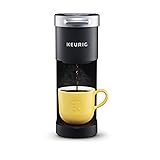
Keurig K-Mini
Best for: Dorm rooms, small kitchens, and anyone who wants a pod machine that disappears on the counter
Less than 5 inches wide — the most compact K-Cup brewer Keurig makes, with single-cup reservoir for fresh-fill-each-time brewing
- +Under 5 inches wide — fits where nothing else will
- +107,000+ reviews make it one of the most-purchased coffee makers on Amazon
- +Single-cup reservoir means fresh water every brew
- +Cord storage for clean portability between counter and cabinet
- −No reservoir — you must add water for every single cup
- −No strength or temperature adjustment — one brew profile only
- −K-Cup pods cost $0.40–$0.80 each, adding up over months
- −Brew quality is adequate but noticeably thinner than larger Keurig models or manual brewers
✓ Free shipping with Prime · Affiliate link
Why we recommend it
The coffee community is hard on Keurig — across every subreddit we researched, K-Cup coffee is consistently described as weak and watery compared to Nespresso or any manual method. A Buy It For Life insider confirmed that pod machines are designed with limited lifecycles, and Keurigs are the machines most commonly seen in office trash piles.
So why is the K-Mini on this list? Because 107,000+ people bought it and rated it 4.3 stars. The K-Mini serves a real audience: people who want hot coffee in their mug with zero effort, zero technique, and zero cleanup. At under $75 and less than 5 inches wide, it fits in a dorm room, a studio apartment, or a crowded office desk. For a buyer who prioritizes convenience and budget above everything else, it does the job.
Key features
- Under 5 inches wide — The most compact K-Cup brewer Keurig makes. Cord storage keeps it portable.
- Single-cup reservoir — Fresh water every brew. No stale-tank issues.
- 107,000+ reviews — The most-purchased single-serve coffee maker on Amazon. The general market has spoken.
Who it’s best for
Dorm rooms, hotel substitutes, offices with no kitchen. Budget buyers who want the lowest entry price into single-serve pod coffee. Households where convenience genuinely matters more than cup quality.
Potential downsides
- One brew profile. No strength, temperature, or size customization.
- K-Cup pods cost $0.40–$0.80 each. At one cup a day, that is $146–$292 per year on top of the machine.
- The single-cup reservoir means adding water for every single brew.
- Brew quality is noticeably thinner than Nespresso or any manual method. This is the trade-off for the price and the footprint.
Affiliate link
3. Keurig K-Supreme Plus — The Best a K-Cup Can Taste

Keurig K-Supreme Plus
Best for: K-Cup loyalists who want the best pod coffee can taste without switching systems
MultiStream Technology saturates grounds more evenly, with customizable strength and temperature settings plus programmable user profiles
- +MultiStream needle design extracts more flavor than standard Keurig models
- +Three strength settings and three temperature settings give real customization
- +Programmable favorites for up to 3 users
- +78 oz reservoir brews 9+ cups before refilling
- −At $157, it is the most expensive way to brew K-Cup coffee
- −4.1-star rating is notably lower than the K-Mini — owners report reliability concerns
- −Still limited by K-Cup pod quality ceiling — MultiStream improves but cannot overcome weak pods
- −Large footprint compared to the K-Mini; not ideal for tight counter space
✓ Free shipping with Prime · Affiliate link
Why we recommend it
The K-Supreme Plus is Keurig’s answer to the complaint that K-Cup coffee tastes watered down. MultiStream Technology uses a multi-needle design instead of the standard single needle, saturating the grounds more evenly for better extraction. Add three strength settings, three temperature settings, and programmable favorites for up to three users, and this is the most adjustable K-Cup brewer available.
Does it make the K-Cup taste as good as a Nespresso or an AeroPress? No. But it makes K-Cup coffee taste noticeably better than a standard Keurig, and for households already committed to the K-Cup ecosystem — with a pod drawer full of favorites — the K-Supreme Plus is a meaningful upgrade without switching systems.
Key features
- MultiStream Technology — Multi-needle extraction saturates grounds more evenly. Keurig’s own testing shows improved flavor and aroma versus standard models.
- Customizable strength and temperature — Three settings each. Programmable user profiles store preferences.
- 78 oz removable reservoir — Brews 9+ cups before refilling. No fill-per-brew requirement.
Who it’s best for
K-Cup loyalists who want the best possible cup from their existing pod collection. Households with multiple coffee drinkers who prefer different strengths. Anyone upgrading from a basic Keurig who does not want to switch to Nespresso or manual brewing.
Potential downsides
- At $157, it is the most expensive way to brew K-Cup coffee. The ongoing pod cost is the same as any Keurig.
- The 4.1-star rating is the lowest in our lineup. Owner complaints include reliability issues and inconsistent temperature.
- MultiStream improves extraction but cannot overcome the fundamental ceiling of K-Cup pods — pre-ground, sealed in plastic, sitting on a shelf.
- Large footprint compared to the K-Mini. Not ideal for tight counter space.
Affiliate link
The Manual Single-Cup Brewers
4. AeroPress Original — The Community’s Consensus Best Single-Serve Brewer

AeroPress Original Coffee Press
Best for: Travelers and experimenters who want one brewer that does everything
Pressure-driven immersion brewing produces a concentrated, low-acidity cup in under two minutes — doubles as a travel brewer
- +Incredibly versatile — immersion, pressure, and pseudo-espresso in one device
- +Brews a full cup in under 2 minutes including cleanup
- +Virtually indestructible plastic construction — ideal for travel and camping
- +25,000+ reviews and a dedicated competition scene speak to its following
- −Single-serve only — no batch brewing for multiple people
- −Not technically pour-over — uses pressure and immersion rather than percolation
- −Community sentiment has shifted since the private equity acquisition
- −Paper micro-filters produce a clean cup but limit body compared to metal filters
✓ Free shipping with Prime · Affiliate link
Why we recommend it
The AeroPress is the most recommended single-serve brewer across every coffee community we researched — not because it makes the absolute best cup (pour-over enthusiasts will argue), but because it makes a genuinely good cup with the widest margin for error. On r/Coffee, a thread with 337 comments asking whether AeroPress is the best way to make coffee at home produced broad agreement: it is the most forgiving starting point for anyone who wants better coffee than a pod machine without committing to a pour-over learning curve.
It brews in under two minutes. Cleanup takes ten seconds — push the puck into the bin, rinse, done. The plastic construction is virtually indestructible, and owners report years of daily use — one user has brewed with the same AeroPress for eight years straight. One user with a V60, Chemex, French press, moka pot, espresso machine, and Moccamaster reported using the AeroPress XL daily — the others come out when guests visit.
The Best Overall badge goes to the AeroPress because it delivers the best combination of cup quality, ease of use, durability, and value across the entire single-serve category — manual or electric. If you are willing to spend two minutes instead of thirty seconds, nothing else on this list matches the quality-to-effort ratio. The community is clear on one thing: skip the AeroPress Premium glass version, which shatters during normal use. Stick with the original plastic.
Key features
- Pressure-driven immersion brewing — Combines immersion steeping with gentle air pressure for a smooth, low-acidity cup. The Specialty Coffee Association recommends specific extraction parameters for optimal flavor; the AeroPress’s flexibility lets you dial these in with simple recipe adjustments.
- Sub-2-minute brew time — Add grounds, add water, wait 30 seconds, press. Total time from kettle to cup is under two minutes including cleanup.
- 20,000+ Amazon reviews at 4.7 stars — One of the highest-rated coffee products on Amazon, with a dedicated competition scene (the World AeroPress Championship) and an enormous recipe community.
Who it’s best for
Anyone upgrading from pod coffee who wants a better cup without a steep learning curve. Travelers who refuse to drink hotel coffee. Office workers who want something better than the communal Keurig. If you have never brewed coffee manually, this is where to start.
Potential downsides
- Single-serve only — if you need to brew for two or more people, you are pressing twice.
- Experienced pour-over users find AeroPress cups less nuanced compared to a well-executed V60 or Hario Switch. The ceiling is lower than technique-dependent methods.
- Price has increased since the company was acquired by a private equity firm — from ~$20 to $40 for the original, with filters jumping from $4 to $10. Community sentiment around the brand’s direction has shifted.
- Requires a kettle to heat water. It is not a self-contained appliance like a pod machine.
Affiliate link
5. Clever Coffee Dripper — The Easiest Good Cup You Can Make

Clever Coffee Dripper
Best for: Beginners who want great single-cup coffee without learning pour-over technique
Patented shut-off valve combines immersion brewing with paper-filtered clarity — steep, set on mug, walk away
- +Genuinely foolproof — no pouring technique, no gooseneck kettle required
- +Immersion brewing is forgiving of grind-size inconsistency
- +Paper filter produces a clean cup without French press sediment
- +Includes 100 filters, coaster, and lid in the box
- −BPA-free plastic construction feels less premium than glass or ceramic brewers
- −Single-serve only — 18 oz maximum, no batch option
- −Requires separate kettle to heat water — not a self-contained appliance
- −Slower than pod machines — 3-4 minute steep plus heating time
✓ Free shipping with Prime · Affiliate link
Why we recommend it
The Clever Dripper is the manual brewer for people who do not want to learn manual brewing. It uses immersion — add grounds, add hot water, wait 3–4 minutes, set it on your mug. A patented shut-off valve holds the coffee until contact with the mug triggers the drain. No pouring technique, no gooseneck kettle, no pulse-pour choreography. If you can boil water and set a timer, you can make excellent coffee with a Clever Dripper.
On r/BuyItForLife, the Clever Dripper is recommended alongside the AeroPress as a true buy-it-for-life single-serve brewer. One commenter captured the value proposition precisely: the Clever Dripper will not reach the highs of a mastered pour-over setup, but it gives a reliable, easy, genuinely good cup of coffee every single time.
The paper filter produces a clean cup without the sediment of a French press, and the immersion method is more forgiving of grind inconsistency than any pour-over dripper. At $39 with 100 filters included, the ongoing cost is pennies per cup.
Key features
- Immersion brewing with shut-off valve — Steep, set on mug, walk away. The valve releases automatically on contact. No active pouring required.
- Paper-filtered clarity — Produces a clean, sediment-free cup. Uses standard Melitta #4 cone filters or Clever-branded filters (100 included).
- 4.7-star rating across 4,300+ reviews — Tied with the AeroPress for the highest rating in our lineup.
Who it’s best for
True beginners who want a meaningful upgrade from pod coffee without any learning curve. Anyone who finds pour-over technique intimidating. People who value consistency over peak cup quality. A strong choice for offices where multiple people need to brew without training.
Potential downsides
- BPA-free plastic construction feels less premium than glass or ceramic brewers. Functional but not beautiful.
- Requires a separate kettle — this is not a self-contained appliance.
- The quality ceiling is lower than technique-dependent methods. Experienced users who master the Hario Switch or V60 will outperform the Clever Dripper — but that requires skill the Clever does not demand.
- Slower than pod machines. 3–4 minutes of steeping plus kettle heating time adds up to 5–7 minutes total.
Affiliate link
The Portable Espresso Option
6. WACACO Picopresso — Real Espresso, No Outlet Required

WACACO Picopresso
Best for: Travelers and coffee enthusiasts who want café-quality espresso in a pocket-sized package
18g commercial-style naked portafilter in a fully portable, manually operated design — produces lever-machine-quality extraction
- +Naked portafilter with 18g commercial basket produces genuinely rich, syrupy espresso
- +Compact and fully portable — no electricity or batteries needed
- +Build quality is excellent — metal construction, precise engineering
- +Closest portable espresso to real lever machine quality
- −Requires ultra-fine grind — pre-ground coffee will not work well
- −Dialing in grind size takes practice and patience
- −Small water chamber limits to single shots
- −Cleanup on the go is fiddly with the naked portafilter
✓ Free shipping with Prime · Affiliate link
Why we recommend it
The Picopresso produces genuine espresso — with crema, body, and the syrupy mouthfeel that pod machines approximate but never deliver. It uses an 18g commercial-sized naked portafilter and manual pump pressure up to 18 bars. One owner reported that their partner sometimes thinks the Picopresso’s shots are better than those from their Gaggia Classic, a well-regarded home espresso machine.
This is a niche product for a specific audience: travelers who cannot go without real espresso, campers who want cafe-quality shots at the campsite, and espresso enthusiasts who want a genuinely portable backup brewer. On r/espresso, the Picopresso is described as the most budget-friendly way to get into real espresso — no plumbing, no $500 machine, no learning how to tune a grinder-to-machine workflow. Just hot water, finely ground coffee, and arm strength.
The Editor’s Pick badge reflects that the Picopresso solves a problem nothing else in this lineup addresses. It is not for everyone, but for its audience, nothing else comes close at this price.
Key features
- 18g commercial portafilter — Naked/bottomless design lets you see the extraction. Same basket size as cafe machines.
- Up to 18 bars of manual pressure — Enough for proper espresso extraction with crema.
- Fully portable — No electricity, no batteries. Metal and robust polymer construction at 350g.
Who it’s best for
Travelers who take their espresso seriously. Campers and motorcyclists who want cafe-quality shots on the road. Espresso enthusiasts who want a portable option alongside their home machine.
Potential downsides
- Requires an ultra-fine grind. Pre-ground coffee will not work. You need a capable hand grinder ($60–$120 for models like the 1Zpresso Q Air or Timemore C3) on top of the $130 Picopresso. Budget the full kit at $190–$250 total.
- Dialing in grind size takes practice. Light roasts are particularly tricky — dark roasts are more forgiving.
- Small water chamber limits output to single shots. No americanos without extra hot water.
- Cleanup on the go is fiddly. The naked portafilter is harder to knock out than a standard one.
Affiliate link
Buyer’s guide: What kind of single-serve person are you?
The biggest mistake in choosing a single-serve coffee maker is comparing across categories. A Keurig and an AeroPress are not competing products — they serve different relationships with coffee. Before looking at features and prices, figure out which category you belong in.
The zero-attention buyer: Pod machines
You want coffee in your mug with no decisions, no technique, and no cleanup beyond dropping a pod in the bin. You are optimizing for time, not taste. Your ideal morning involves pressing one button, and you are comfortable paying $0.40–$1.35 per cup for that convenience.
Go Nespresso if you want the best-tasting pod coffee available and you accept the ongoing capsule cost. The Vertuo system covers both espresso and full-size coffee. Go Keurig if budget is the priority and you value the enormous K-Cup selection over cup quality.
One thing most pod machine reviews skip: the ongoing cost. At two Nespresso Vertuo pods per day, you spend $660–$985 per year on capsules alone. A Keurig habit at one K-Cup per day runs $146–$292. An AeroPress with good beans costs roughly $110 per year. The National Coffee Association provides brewing guidance that applies across all methods — but the per-cup economics vary dramatically.
The 3-minute-ritual buyer: Manual brewers
You do not mind spending a few minutes with your coffee. You might even enjoy it. You want a cup that is noticeably better than anything a pod can produce, and you are willing to boil water and wait. Your equipment costs $30–$50 and lasts for years.
Go AeroPress if you want versatility, portability, and the largest recipe community. Go Clever Dripper if you want the most foolproof manual method with zero technique required. Both produce excellent single cups at roughly $0.25–$0.35 each (cost of beans and filter).
Worth knowing: the Hario Switch has emerged as the enthusiast community’s “if I could only have one brewer” choice. It combines immersion brewing (like the Clever) with pour-over capability (like a V60) in one device. It appears in our pour-over roundup and sits one step above the AeroPress and Clever on the attention spectrum — more technique, higher ceiling.
The portable-espresso buyer: Travel espresso
You want genuine espresso — 9+ bars of pressure, crema, the whole experience — without being tethered to a counter or an outlet. You own a good grinder or are willing to buy one. This is a niche within a niche, and the Picopresso owns it.
Budget the full kit: Picopresso ($130) + a capable hand grinder ($60–$120) + a small kettle. Total entry cost is $190–$250. Per-shot cost after that is just beans — roughly $0.40–$0.60 depending on your bean choice.
The real cost comparison
| Brewer | Entry cost | Per-cup cost | Year 1 total (1 cup/day) | Year 1 total (2 cups/day) |
|---|---|---|---|---|
| AeroPress Original | $40 | ~$0.30 | $150 | $259 |
| Clever Dripper | $39 | ~$0.30 | $149 | $258 |
| Keurig K-Mini | $74 | $0.40–$0.80 | $220–$366 | $366–$658 |
| Keurig K-Supreme Plus | $157 | $0.40–$0.80 | $303–$449 | $449–$741 |
| Nespresso Vertuo Pop+ | $130 | $0.90–$1.35 | $459–$623 | $787–$1,115 |
| WACACO Picopresso | $190–$250* | ~$0.50 | $373–$433 | $555–$615 |
*Picopresso entry cost includes a hand grinder ($60–$120), which is required for espresso-quality grinding.
The manual brewers cost roughly half what pod machines cost over a year, and the gap widens every month. This is the “pod tax” — low entry price, high recurring cost. Whether that tradeoff is worth it depends entirely on how you value your time against your money.