The moka pot is not an espresso machine. We should get that out of the way now, because the internet will fight about it anyway. A moka pot brews at roughly 1.5–2 bars of pressure. Espresso requires 9 bars. They produce different drinks — and both are worth making.
What a moka pot actually does is brew strong, concentrated coffee with a body and intensity that drip machines and pour-over setups cannot match. On r/mokapot, the highest-voted thread of all time is someone describing their migration from an espresso setup to a moka pot — not as a downgrade, but as a relief. The ritual is simpler. The equipment costs a fraction. The coffee is genuinely good. Alfonso Bialetti patented the Moka Express in 1933, and the fundamental design has barely changed because it didn’t need to.
Three of our six picks are Bialetti. That isn’t lazy curation — it reflects the market. Bialetti owns the moka pot category the way Bodum owns the french press: competitors exist and some are excellent, but the conversation starts and ends with the original. We anchored on Bialetti’s lineup and selected non-Bialetti picks that earn their spot by solving specific problems (induction compatibility, build quality, budget, aesthetics) rather than by being generically different.
If you’re here because you actually want true espresso — 9-bar extraction, crema, milk texturing — you want an espresso machine, not a moka pot. If you want strong stovetop coffee with almost no learning curve and a $20–$50 buy-in, keep reading.
How we evaluated
- Brew quality — A moka pot’s job is to push hot water through a bed of ground coffee at low pressure, producing concentrated coffee in 3–5 minutes. We evaluated how each pot’s design affects extraction consistency: material (aluminum vs. stainless steel), basket depth, and valve engineering all influence the cup.
- Build quality and longevity — Moka pots should last decades. On r/BuyItForLife, users post 13-year, 23-year, and 30-year-old Bialetti pots still in daily use. We evaluated materials, gasket quality, and whether replacement parts are still available.
- Cooktop compatibility — Aluminum moka pots do not work on induction cooktops. This is the single most common purchase trigger in forum discussions: someone buys a new cooktop and needs a new pot. We note which pots work on which surfaces.
- Ease of use and cleanup — The #1 beginner complaint is bitter, over-extracted coffee from too-high heat. We evaluated how forgiving each pot is for new users and how easy it is to disassemble and clean.
- Value per dollar — A $20 moka pot brews the same style of coffee as a $200 one. The premium buys materials, longevity, induction compatibility, and design. We evaluated whether each product’s price is justified by what it adds.
1. Bialetti Moka Express 6-Cup — The One That Started Everything

Bialetti Moka Express 6-Cup
Best for: Anyone who wants the original moka pot — the design that defined the category in 1933 and remains the best-selling stovetop coffee maker in the world
you want the reference-point moka pot with the deepest owner base and easy replacement parts.
you have an induction cooktop and do not want to use an adapter plate.
Iconic octagonal aluminum body with patented safety valve, produces rich, full-bodied moka coffee in under 5 minutes on any gas or electric stovetop
- +The original moka pot — Alfonso Bialetti's 1933 design is essentially unchanged because it works
- +90,000+ Amazon reviews with a 4.6-star rating make this one of the most validated coffee products on the platform
- +Available in sizes from 1-cup to 12-cup, so you can match it to your household's daily volume
- +Simple three-piece design (boiler, funnel, upper chamber) means nothing to break and nothing to learn
- −Aluminum body cannot go on induction cooktops without a separate adapter plate
- −Not dishwasher safe — Bialetti explicitly warns that detergent damages the aluminum and alters coffee flavor
- −You must brew a full pot every time — there's no half-batch option without buying a smaller size
- −The handle gets hot on high flames if the burner isn't sized to the pot base
✓ Free shipping with Prime · Affiliate link
Evidence notes
Community signal: Default recommendation in moka-pot discussions, with long-term owner posts spanning 13, 23, and 30 years of use.
Main tradeoff: Aluminum body means no native induction support and more care around heat, washing, and flame size.
Evidence note: Article 19 cites 64 moka-relevant forum threads plus 90,000+ Amazon reviews for this model.
Why we recommend it
The Bialetti Moka Express is the moka pot. Not a moka pot — the moka pot. Alfonso Bialetti’s 1933 design created the category, and with 90,000+ Amazon reviews, the ownership data is deeper than any other stovetop coffee maker available. On r/BuyItForLife, owners post their 13-year, 23-year, and even 30-year-old Moka Express pots — still in daily use, still producing the same cup, with nothing replaced except the occasional gasket and filter plate.
It earns Best Overall because the competition is ultimately responding to this design. The octagonal aluminum body, the three-piece assembly, the gurgling sound when it’s done — this is the reference point for every other moka pot on the market.
Key features
- Iconic three-piece design — Boiler, funnel basket, and upper chamber. No moving parts beyond the safety valve. Nothing to break, nothing to learn.
- Available in 8 sizes — From 1-cup (50ml) to 12-cup (670ml). The 6-cup is the most popular and produces roughly one large American mug of coffee.
- Replacement parts available decades later — Gaskets, filter plates, handles, and funnels are all sold separately. Forum users note this as a key advantage over competitors.
Who it’s best for
Anyone buying their first moka pot, or anyone replacing one. The Moka Express is the default recommendation in virtually every moka pot discussion on Reddit, and the 6-cup size is the most commonly suggested starting point.
Potential downsides
- Aluminum body means it will not work on induction cooktops without a separate adapter plate (~$15–$30). If you have induction, look at the Venus below.
- Not dishwasher safe. Bialetti warns that detergent damages the aluminum and alters coffee flavor. Rinse with warm water only — modern dish soap is fine despite the Italian tradition of never washing with soap (that tradition dates to the era of lye-based soaps that genuinely damaged the finish).
- You must brew a full pot every time. There is no half-batch option without buying a smaller size.
Affiliate link
2. Bialetti Brikka 2-Cup — The Only Moka Pot That Makes Foam

Bialetti Brikka 2-Cup
Best for: Anyone who wants the closest thing to espresso crema from a stovetop brewer — the Brikka's pressurized valve creates a thicker, more concentrated shot than a standard moka pot
you specifically want the richest, foamiest cup a moka pot can make.
you want the simplest beginner moka pot or need to brew for more than one or two people.
Patented pressurized valve system builds approximately 4 bar of pressure (vs ~2 bar in a standard moka pot), producing a visible crema layer on top of the coffee
- +The only stovetop brewer that reliably produces visible crema — the pressurized valve genuinely changes the extraction
- +Closest a moka pot gets to espresso-style body and concentration without an electric machine
- +Same Bialetti build quality and Italian manufacturing as the Moka Express
- +Compact 2-cup size is ideal for single servings of concentrated coffee
- −4.0-star average is lower than the Moka Express — owners report a steeper learning curve for heat management
- −Only available in 2-cup and 4-cup sizes, so it's not practical for brewing for a group
- −The pressurized valve mechanism adds a part that can wear out and needs periodic replacement
- −Aluminum body means no induction compatibility without a separate adapter plate
✓ Free shipping with Prime · Affiliate link
Evidence notes
Community signal: Divisive but memorable: loyalists praise the foam and body, while purists call the crema-style effect a gimmick.
Main tradeoff: The valve makes heat management less forgiving and can stick if extraction runs too hot or too long.
Evidence note: The moka-pot brief includes long-term Brikka owner posts and failure-mode threads about stuck valves.
Why we recommend it
The Brikka is Bialetti’s answer to the question everyone asks: “Can a moka pot make crema?” The answer is technically no — what the Brikka produces is foam, not crema — but the distinction matters less than the result. A weighted valve restricts the flow and builds approximately 4 bars of pressure (vs. ~2 bars in a standard moka pot), pushing the coffee out with enough force to create a visible, stable foam layer.
On r/BuyItForLife, one owner posted their Brikka from 1998 — 26 years of daily use and still producing foam every morning. The community is genuinely split: loyalists say the foam changes the mouthfeel and brings the drink closer to espresso. Skeptics call it a marketing gimmick. We think it is a real improvement in body and concentration, and the Editor’s Pick badge reflects that — it is not the best moka pot for everyone, but it is the most interesting one.
Key features
- Patented pressurized valve — Builds ~4 bars of pressure (vs. ~2 bars standard), producing visible foam on the surface of the coffee.
- Concentrated output — The 2-cup size makes about 100ml of coffee — a single, concentrated serving closer to espresso in strength.
- Same Bialetti build quality — Aluminum construction, Italian engineering, replacement parts available.
Who it’s best for
Anyone who wants the richest, most concentrated cup a stovetop brewer can produce. The Brikka rewards careful technique — community recipes specify 60/40 arabica-to-robusta blends, medium-low heat, and removing from the burner during mid-extraction.
Potential downsides
- The 4.0-star average is lower than the Moka Express (4.6 stars). The learning curve is steeper — heat management is more critical because the pressurized valve amplifies errors.
- Only available in 2-cup and 4-cup sizes. Not practical for brewing for more than one or two people.
- The weighted valve can stick, causing dramatic eruptions. Community advice: give the pot a short wiggle if extraction takes too long, and always use medium-low heat.
Affiliate link
3. Bialetti Venus 6-Cup — Induction-Compatible Without Adapters

Bialetti Venus 6-Cup
Best for: Anyone with an induction cooktop who wants a Bialetti moka pot — the Venus is full stainless steel and works on every hob type without adapters
you need native induction compatibility or prefer stainless steel to aluminum.
you want the classic octagonal Bialetti flavor profile and do not need induction support.
18/10 stainless steel construction makes it compatible with all cooktop types including induction, and it's more durable than aluminum models
- +Works on induction cooktops natively — no adapter plate needed, unlike every aluminum Bialetti model
- +18/10 stainless steel won't pit, corrode, or react with acidic coffee over years of daily use
- +30,000+ reviews at 4.4 stars — one of the best-reviewed stainless steel moka pots on Amazon
- +Sleek contemporary design with a rounded body that's a visual upgrade from the classic octagonal shape
- −Stainless steel changes the flavor profile slightly — some owners say it tastes cleaner but less rich than aluminum models
- −Still not dishwasher safe despite being stainless steel — Bialetti warns against detergent contact
- −The rounded body makes it harder to grip when unscrewing compared to the octagonal Moka Express
- −No pressurized valve like the Brikka — you get standard moka extraction, not enhanced crema
✓ Free shipping with Prime · Affiliate link
Evidence notes
Community signal: Most forum mentions frame the Venus as the practical answer when an aluminum moka pot stops working on induction.
Main tradeoff: Stainless steel can taste a little cleaner and thinner than the classic aluminum Moka Express.
Evidence note: The article pairs induction-purchase forum threads with a 30,000+ Amazon review base.
Why we recommend it
If you have an induction cooktop, this is your moka pot. The Venus is full 18/10 stainless steel — no adapter plate needed, no workarounds. Forum users consistently report that buying the Venus is cheaper than buying an induction adapter plate for a Moka Express: the adapter runs $15–$30, while the Venus itself starts at $42 for the 4-cup and $50 for the 6-cup.
With 30,000+ reviews at 4.4 stars, the Venus is not a niche product. It is the second most popular Bialetti model after the Moka Express, and the most popular induction-compatible moka pot on Amazon by a significant margin.
Key features
- 18/10 stainless steel construction — Works on gas, electric, ceramic, and induction cooktops. No adapter plate needed.
- Corrosion-resistant — Unlike aluminum, stainless steel will not pit, oxidize, or react with acidic coffee over decades of use.
- Contemporary design — Rounded body instead of the classic octagonal shape. A visual departure from the Moka Express that some owners prefer.
Who it’s best for
Anyone with an induction cooktop, anyone who prefers stainless steel to aluminum, or anyone who wants a moka pot that is unambiguously compatible with every heat source they might encounter — including camping stoves and induction plates in rental kitchens.
Potential downsides
- Some owners report the Venus produces a slightly thinner, cleaner-tasting cup compared to aluminum models. Stainless steel’s thermal properties differ from aluminum, and some users prefer the traditional flavor profile.
- Still not dishwasher safe despite being stainless steel — Bialetti warns against detergent contact.
- Water-to-coffee ratios may need adjustment. Forum users note the Venus’s basket capacity can produce watery results if you fill the boiler to the maximum — some recommend using less water than the maximum line suggests.
Affiliate link
4. GROSCHE Milano 6-Cup — Best Non-Bialetti Alternative

GROSCHE Milano 6-Cup Moka Pot
Best for: Anyone who wants a non-Bialetti moka pot that addresses the most common complaints — the Milano has a larger burn-guard handle and comes in multiple colors
you want a well-reviewed non-Bialetti pot with a safer, more comfortable handle.
Italian manufacturing or strong moka-community consensus matters more than ergonomics.
Italian safety valve in a redesigned aluminum body with an oversized soft-touch handle and integrated burn guard that prevents the finger-scorching problem common on traditional moka pots
- +The oversized handle with burn guard solves the single most common moka pot complaint — hot handles burning fingers
- +25,000+ reviews at 4.4 stars — the most popular non-Bialetti moka pot on Amazon
- +Available in multiple colors (black, red, blue, chrome) if you want something other than silver aluminum
- +Uses a silicone gasket instead of rubber, which lasts longer and doesn't impart off-flavors
- −Aluminum body means no induction compatibility — same limitation as the Bialetti Moka Express
- −Despite the Italian safety valve, the body itself is not made in Italy — manufactured overseas with Italian components
- −The handle design changes the classic moka pot silhouette, which matters if aesthetics are part of the appeal
- −The silicone gasket, while more durable, is slightly harder to seat properly than a standard rubber gasket
✓ Free shipping with Prime · Affiliate link
Evidence notes
Community signal: The forum brief found weak direct GROSCHE discussion, so this pick is driven mainly by owner reviews and the hot-handle problem it solves.
Main tradeoff: It is a non-Bialetti aluminum pot: no induction support and less category heritage.
Evidence note: Included as a specific problem-solver, not as a community-favorite replacement for Bialetti.
Why we recommend it
The GROSCHE Milano is the moka pot for people who have read the forums and decided to address the most common complaint before it happens: hot handles burning fingers. GROSCHE redesigned the handle with an oversized soft-touch grip and an integrated burn guard that wraps around the base of the handle where fingers naturally rest. It is a small change that solves a real problem — the Bialetti Moka Express’s handle sits close to the body and gets hot on gas burners.
At 25,000+ reviews and 4.4 stars, the Milano is the most popular non-Bialetti moka pot on Amazon. It uses a silicone gasket (more durable and less likely to impart off-flavors than rubber) and an Italian-made safety valve.
Key features
- Oversized handle with burn guard — Solves the #1 comfort complaint about traditional moka pot handles.
- Silicone gasket — Lasts longer than rubber gaskets and does not degrade as quickly under heat.
- Available in multiple colors — Black, red, blue, and chrome options if you want something beyond the standard silver aluminum.
Who it’s best for
Anyone who wants a well-reviewed moka pot at a competitive price but does not feel compelled to buy the Bialetti specifically. The GROSCHE Milano brews the same style of coffee in the same way — the ergonomic improvements are the differentiator, not the brewing result. The Imusa is another popular budget alternative with loyal forum defenders who say it brews identically to a Bialetti — if you find one locally, it is worth considering alongside the GROSCHE.
Potential downsides
- Aluminum body means no induction compatibility — the same limitation as the Bialetti Moka Express.
- Despite using an Italian-made safety valve, the body itself is not manufactured in Italy. If Italian manufacturing is important to you, look at the Bialetti models.
- The silicone gasket is slightly harder to seat properly than a standard rubber gasket. Not a major issue, but new users sometimes report leaking until they get the gasket positioned correctly.
Affiliate link
5. Primula Classic 6-Cup — Under $20 Entry Point

Primula Classic 6-Cup Moka Pot
Best for: Anyone who wants to try moka pot coffee without committing to a Bialetti price — the Primula makes the same style of coffee for under $20
you want the cheapest credible way to find out whether moka coffee belongs in your routine.
you already know you will use a moka pot daily and want decade-scale parts support.
Cast aluminum construction with a flip-top lid and heat-resistant handle, brews 6 espresso-sized cups of stovetop coffee for a fraction of the Bialetti price
- +Under $20 makes this the lowest-risk way to find out if moka pot coffee is for you
- +17,000+ reviews at 4.4 stars — the most popular budget moka pot on Amazon by a wide margin
- +Works on gas, electric, ceramic, and propane stoves — genuinely portable for camping
- +Flip-top lid with heat-resistant knob is more convenient for pouring than the Moka Express hinged lid
- −Thinner aluminum than the Bialetti — some owners report the handle loosening after heavy use
- −No safety valve of the same quality as Bialetti's patented design
- −The gasket seal wears faster than Bialetti's and replacement parts are harder to find
- −The brewing experience produces a slightly thinner, less concentrated cup than the Moka Express
✓ Free shipping with Prime · Affiliate link
Evidence notes
Community signal: Budget-pot owner comments suggest similar taste can be possible, but the brief found stronger named support for Imusa than Primula.
Main tradeoff: Lower price brings thinner aluminum, weaker parts availability, and a less buy-it-for-life ownership story.
Evidence note: This is a price-and-review-base pick, with the article explicitly separating it from the Bialetti longevity story.
Why we recommend it
The Primula Classic is the lowest-risk way to answer the question “is moka pot coffee for me?” At under $20, it costs less than a bag of specialty beans. On forums, multiple owners report they cannot tell the difference between the Primula and a Bialetti in a blind taste test. The brewing physics are identical — hot water, ground coffee, steam pressure — and the price difference comes down to materials, brand heritage, and build tolerances.
With 17,000+ reviews at 4.4 stars, the Primula has enough ownership data to confirm that it works. It is not the moka pot you buy for life — it is the one you buy to find out if you want to buy one for life.
Key features
- Under $20 price point — The most affordable way to try moka pot coffee. Less than the cost of four lattes at most cafes.
- Flip-top lid — More convenient for pouring than the Moka Express’s hinged lid design.
- Broad stovetop compatibility — Works on gas, electric, ceramic, and propane camping stoves.
Who it’s best for
First-time moka pot buyers who are not sure they will like stovetop coffee enough to invest in a Bialetti. Also a solid choice for camping, travel, or keeping at the office — situations where losing or damaging a $50 pot would be annoying.
Potential downsides
- Thinner aluminum than the Bialetti. Some owners report the handle loosening after months of heavy daily use.
- Replacement gaskets are harder to find than standard Bialetti parts, which are available everywhere.
- The brew tends to be slightly thinner and less concentrated than the Moka Express. The margin is small, but side-by-side comparisons do surface it.
Affiliate link
6. Alessi 9090 6-Cup — Design Object That Brews Coffee
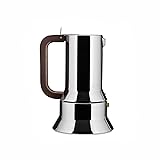
Alessi 9090 6-Cup Stovetop Espresso Maker
Best for: Anyone who wants a moka pot that's also a design object — Richard Sapper's 1979 design is in the permanent collection of MoMA and still functions beautifully
you want induction-ready stainless steel and care about the object as much as the brew.
you are optimizing purely for cup quality per dollar.
Mirror-polished 18/10 stainless steel with magnetic induction-compatible base, designed by Richard Sapper — the only moka pot in MoMA's permanent collection
- +Arguably the most beautiful moka pot ever made — Richard Sapper's 1979 design won the Compasso d'Oro award
- +Full 18/10 stainless steel with magnetic base works on induction cooktops natively
- +Mirror-polished finish and precision engineering justify the premium if you care about kitchen aesthetics
- +The flip-top lid clicks open with one hand — a genuine ergonomic improvement over traditional designs
- −At nearly $200, it costs 4x the Bialetti Moka Express for functionally the same cup of coffee
- −1,268 reviews is lower than other picks — it's a niche product with a smaller ownership base
- −The sleek cylindrical shape requires more careful heat management on gas burners to avoid scorching the handle
- −Replacement gaskets are harder to source than standard Bialetti gaskets
✓ Free shipping with Prime · Affiliate link
Evidence notes
Community signal: The strongest premium non-Bialetti signal in the moka brief, including a 40-year owner post and high-quality stainless recommendations.
Main tradeoff: It costs roughly four times the Moka Express without making meaningfully better coffee.
Evidence note: The article treats the 9090 as a design-and-longevity pick, not a better-extraction claim.
Why we recommend it
The Alessi 9090 is the only moka pot in MoMA’s permanent collection. Designed by Richard Sapper in 1979 and awarded the Compasso d’Oro (Italy’s highest design prize), it is a mirror-polished stainless steel cylinder that looks like it belongs on a Milanese architect’s shelf — and it does, because that is exactly where many of them end up.
But it is also a functional coffee maker, and a good one. On r/BuyItForLife, one owner posted their parents’ 9090 — purchased for camping in the south of France 40 years ago, still in daily use. Full 18/10 stainless steel with a magnetic base means it works on induction cooktops. The flip-top lid clicks open with one hand, which is a genuine ergonomic improvement over any other moka pot’s lid design.
The question is whether the coffee justifies the price. It does not. A $50 Bialetti Moka Express brews functionally equivalent coffee. What you are buying is a stainless steel object that you will not replace for decades, that works on any cooktop including induction, and that looks beautiful on your counter. For some buyers, that matters.
Key features
- Richard Sapper design (1979) — Compasso d’Oro winner. In MoMA’s permanent design collection. Mirror-polished 18/10 stainless steel.
- Induction-compatible — Magnetic stainless steel base works on all cooktop types without adapters.
- One-hand flip-top lid — Clicks open and closed cleanly. Genuinely better lid engineering than any competitor.
Who it’s best for
Design-conscious buyers who want a moka pot that doubles as a kitchen object. People who already own a Hario V60 and a Fellow Tally scale and care about how their coffee equipment looks on the counter. Anyone who wants stainless steel and induction compatibility at a premium they can afford.
Potential downsides
- At ~$198, it costs nearly 4x the Bialetti Moka Express for functionally the same cup of coffee. The premium is for materials, design, and induction compatibility — not for better extraction.
- Replacement gaskets are harder to source than Bialetti’s widely available parts.
- The cylindrical shape requires more careful flame sizing on gas burners to avoid heating the handle.
Affiliate link
Buyer’s Guide — What the Forums Actually Argue About
The “is it espresso?” question
It is not espresso. A moka pot brews at roughly 1.5–2 bars of pressure. The Specialty Coffee Association defines espresso as requiring 9 bars. The drinks are physically different — different extraction, different body, different crema (moka pots produce foam if anything, not crema).
But here is what matters more than the technical definition: on r/mokapot and r/Coffee, the most passionate moka pot advocates are people who came from espresso setups. They are not settling — they are choosing. The ritual is simpler, the equipment costs a fraction, and the coffee is strong enough to mix with milk, serve over ice, or drink black with genuine satisfaction. The moka pot is its own category of coffee, and trying to rank it against espresso misses the point.
If you want genuine 9-bar espresso at home, we have an espresso machine roundup for that. If you want the strongest coffee you can make on a stovetop for under $50, a moka pot is the tool.
What grind size to use
This trips up more new moka pot users than anything else. The right grind is between drip and espresso — roughly 300–600 microns. Pre-ground “moka grind” exists but is hard to find outside Italy. In practice:
- Pre-ground espresso (like Lavazza or Illy) works and is what most Italian households use. It may be slightly too fine for some pots, producing slower extraction and bitter notes.
- Pre-ground drip is too coarse. The water passes through too quickly, producing thin, under-extracted coffee.
- A burr grinder set between drip and espresso is the ideal. If you already own a coffee grinder, try a setting 2–3 clicks coarser than your espresso setting.
Do not tamp the grounds. Fill the basket level and leave it loose. The community consensus on this is universal.
One more thing about grind: upgrading your grinder will improve your moka pot coffee more than upgrading your moka pot. A blade grinder produces wildly inconsistent particle sizes that cause channeling and bitterness — the most common complaint from new moka pot users. Even a basic burr grinder (see our grinder roundup) produces a dramatically more even extraction.
How to brew — the Hoffmann method
James Hoffmann’s moka pot technique video is the most referenced resource in moka pot discussions. The community treats it as the correct method. Three key steps:
- Start with pre-heated water. Boil water in a kettle first, then pour it into the moka pot’s base. This reduces the time the grounds spend exposed to heat before extraction begins, which reduces bitterness.
- Use medium-low heat. The #1 beginner mistake is using too-high flame. The coffee should rise slowly and steadily into the upper chamber. If it spurts and splatters, the heat is too high.
- Remove from heat early. Take the pot off the burner when the upper chamber is about 80% full — before the sputtering and gurgling phase. Some users cool the base under cold running water to stop extraction immediately.
This technique produces a smoother, less bitter cup than the traditional Italian method of cold water and high heat. The difference is noticeable on the first try.
Induction compatibility — the real purchase driver
Aluminum moka pots do not work on induction cooktops. This is the most common reason people buy a new moka pot — they upgrade their kitchen and their old pot stops working. Your options:
| Option | Cost | Compromise |
|---|---|---|
| Buy a stainless steel moka pot (Venus, Alessi 9090) | $71–$311 | Slightly different flavor profile vs. aluminum |
| Buy an induction adapter plate | $15–$30 | Adds another item to store; less stable on the burner |
| Keep your aluminum pot for non-induction burners | $0 | Only works when you have access to gas or electric |
If you are buying specifically for induction, the Bialetti Venus at $71 is the practical choice. The Alessi 9090 at $311 adds design and full stainless construction but brews the same coffee.
Aluminum vs. stainless steel — material and safety
Four of our six picks are aluminum. This is worth addressing because the question comes up in forums: aluminum moka pots react slightly with acidic coffee, and some buyers prefer to avoid aluminum cookware entirely. The community does not cite specific health studies, and we are not qualified to make health claims in either direction.
If aluminum is a concern for you, two of our picks are full stainless steel: the Bialetti Venus ($71) and the Alessi 9090 ($311). Stainless steel does not react with coffee, will not pit or corrode, and is generally considered inert for food contact. The tradeoff is a slightly different thermal behavior — some owners report a cleaner but thinner-tasting cup from stainless models.
One related note: Bialetti’s ownership changed in recent years, and some production has shifted outside Italy. The Moka Express product listing states “Made in Italy,” and the Venus states the same. We recommend checking the product page at purchase time if manufacturing origin matters to you, as production locations can change between batches.
Moka pot sizes — what the “cups” actually mean
Moka pot sizing uses Italian espresso cups (~50ml each), not American coffee cups. This confuses nearly everyone:
| Moka pot size | Output | Roughly equals |
|---|---|---|
| 1-cup | ~50ml / 1.7oz | One demitasse shot |
| 3-cup | ~150ml / 5oz | One small mug or two espresso-sized servings |
| 6-cup | ~270ml / 9oz | One large mug — the most popular size |
| 9-cup | ~420ml / 14oz | Two standard mugs |
| 12-cup | ~670ml / 22oz | Three mugs — brewing for a group |
The 6-cup is the most commonly recommended starting point. Buy based on how much coffee you drink per session, not how many people are in your household — you must brew a full pot every time.
Should you wash your moka pot?
Yes. The Italian tradition of “never use soap” dates to an era of lye-based soaps that genuinely damaged aluminum finishes. Modern dish soap is fine. The NCA’s brewing guidance emphasizes that clean equipment produces better coffee — oils left in the pot from previous brews turn rancid over time and produce off-flavors, not “seasoning.”
Rinse all three pieces with warm water and a soft sponge after every use. Mild dish soap is fine. Do not put any moka pot — aluminum or stainless steel — in the dishwasher. Replace the rubber or silicone gasket every 6–12 months, or when you notice the seal weakening.