The grinder matters more than the machine. If you have a fixed budget for a home espresso setup, put more of it into the grinder than the espresso machine. This is the single most-repeated recommendation in the coffee community — across 47 forum-research briefs covering 772 Reddit threads, we found it surfaced 51 times, making it the most cross-cutting theme in the entire dataset. More than budget anxiety (39 instances), more than the learning curve (20), more than cleaning and maintenance (16).
This isn’t a hot take. On r/espresso and r/Coffee, “grinder > machine” hasn’t been a debate in years — it’s settled doctrine. Not a single comment in our grinder-focused research briefs challenged it. What the community does still debate is how much more to spend on the grinder, when the rule stops applying, and which grinder to buy at each price point. That’s what we’ll cover here.
Why the Grinder Matters More
Grind consistency dominates extraction
A $250 espresso machine with a pressurized portafilter will pull a drinkable shot from well-ground coffee. A $1,000 espresso machine with a blade grinder will not. The grinder determines particle size distribution — how uniformly your coffee is ground — and particle size distribution is the single largest variable in espresso extraction. The Specialty Coffee Association’s brewing standards define optimal extraction as 18–22% of the coffee’s soluble material, and hitting that window consistently requires consistent particle sizes. A cheap grinder produces a mix of boulders and dust; the boulders under-extract (sour) while the dust over-extracts (bitter), and no amount of machine-side temperature stability can fix that. The National Coffee Association’s espresso guide emphasizes that extraction depends on grind fineness and consistency — variables controlled entirely by the grinder, not the machine.
Machines plateau; grinders keep going
Entry-level espresso machines — the Breville Bambino at $250, the Gaggia Classic Evo Pro at $530 — already deliver the core fundamentals: 9 bars of pressure, adequate temperature stability, and a steam wand. Moving from a $250 machine to a $500 machine gets you faster heat-up times and better temperature control. Moving from $500 to $1,000 gets you a dual boiler (brew and steam simultaneously). Beyond that, the returns diminish sharply for most home users.
Grinders don’t plateau the same way. The jump from a $69 hand grinder to a $150 electric burr grinder is enormous. The jump from $150 to $300 is clearly noticeable. From $300 to $600, you’re getting flat burrs, lower retention, and single-dose workflow capability. Enthusiasts with $3,000+ grinders paired with $700 machines are common on r/espresso — and the community validates this balance. In one thread (122 upvotes), a user paired a Weber EG-1 — widely cited as an endgame-tier grinder on r/espresso — with a mid-range Lelit Mara machine. The top response: “Plenty balanced. You don’t need a machine much better than a Mara, but you will see better and more noticeable results with a grinder much better than the Silenzio.”
The community’s verdict is asymmetric
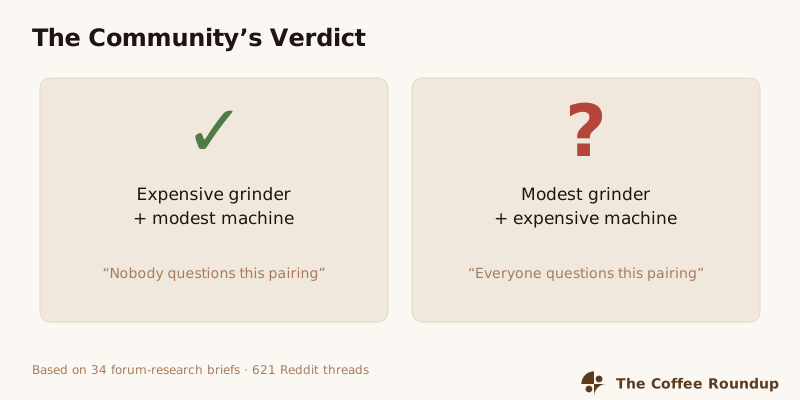
Nobody questions an expensive grinder with a modest machine. Everyone questions a modest grinder with an expensive machine. In a 580-upvote thread, a user with a Bezzera Magica (obtained cheaply through a family connection) asked about grinder upgrades at $600 CAD. The community never questioned the machine — only the grinder. This asymmetry is consistent across the entire corpus: machine posts get “looks great”; grinder posts get “here’s what to upgrade to.”
The Honest Counterargument
The “grinder > machine” rule is real, but it oversimplifies at certain price points and for certain use cases.
Milk drinks are machine-dependent. If you make lattes and cappuccinos daily, the steam wand matters. The Breville Bambino Plus’s auto-frothing produces decent foam, but if latte art matters to you, you need a machine with a manual steam wand and enough steam pressure to texture milk properly. No grinder upgrade fixes weak steam.
Temperature stability matters for light roasts. Light-roast espresso is more sensitive to temperature fluctuations than medium or dark roasts. Single-boiler machines (which lose temperature during back-to-back shots) struggle here. If you pull light-roast espresso, the machine’s thermal system matters more than the “grinder > machine” rule suggests.
Some entry-level machines genuinely can’t keep up. A thermoblock machine under $150 with a 15-bar (non-OPV) pump and no pre-infusion can waste even excellent grinds. The community’s advice assumes you’re pairing a good grinder with at least a competent machine — something like the Bambino ($250), the De’Longhi Dedica ($245), or the Gaggia Classic Evo Pro ($530). Below that floor, the machine becomes the bottleneck regardless of grind quality.
Pressure profiling is machine-side. Advanced techniques like declining pressure profiles, flow control, and pre-infusion pressure ramping are machine features. If you’re deep enough into espresso to care about flow profiling, you’ve already bought the grinder — and the machine upgrade makes sense.
How to Split Your Budget
These tiers are based on the products in our catalog, verified at current Amazon pricing. The principle: at every budget level, allocate at least half to the grinder — and at lower budgets, skew even harder toward the grinder.
Under $400: start with the Bambino + Encore
The true entry point for home espresso is a Breville Bambino ($250) paired with a Baratza Encore ($150) — $400 total. The Encore is a filter-first grinder that can handle espresso at pressurized-portafilter settings, and the Bambino ships with a pressurized basket that’s forgiving of slight grind inconsistency. This is the floor the community considers workable for espresso.
If your budget is tighter, a hand grinder can close the gap — but not just any hand grinder. The 1Zpresso Q Air ($69) is excellent for pour-over and AeroPress, but it’s optimized for filter brewing and not suitable for espresso-fine grinding. For espresso-capable hand grinders, the community points to the 1Zpresso JX-Pro and J-Max ($150–$200 range), which outperform same-price electric grinders on espresso grind consistency. We don’t carry those in our catalog yet, but they’re worth researching if $400 is a stretch.
$550 total: $150 grinder + $400 machine
If you can stretch past the entry tier, keep the Encore ($150) and upgrade the machine to a Bambino Plus ($400). The Plus adds auto-frothing for milk drinks and a solenoid valve that keeps your puck dry between shots — genuine workflow improvements over the base Bambino. The Encore isn’t perfect: retention is a known issue for single-dosing (one owner opened the burr chamber to find a hidden stash of trapped grounds), and it’s not the sharpest espresso grinder at this price. But it’s reliable, repairable, and the community treats it as the baseline standard for “good enough to start with.”
$700–$800 total: $250 grinder + $530 machine
At this budget, you can afford a real upgrade on both sides. The Baratza Virtuoso+ ($250) adds a better burr set and a timer — noticeably better grind consistency than the Encore, especially at espresso-fine settings. The Gaggia Classic Evo Pro ($530) is the community’s workhorse: a single-boiler machine with a commercial-style 58mm portafilter, a real steam wand, and decades of aftermarket support. The Gaggia grows with you — PID mods, OPV adjustments, and the Gaggiuino project give it an upgrade path that extends for years.
At this tier, you’ll also hear about the DF64 — the most-debated grinder on r/espresso, appearing in 11 threads in our research corpus. It’s a budget flat-burr single-doser with serious upgrade potential (aftermarket SSP burrs), but the community is deeply split: static cling, burr alignment hassles, and vendor trust issues are persistent complaints. We don’t carry it in our catalog, but it’s worth researching if you’re comfortable navigating those tradeoffs.
$1,000+ total: this is where machine investment starts paying off
Once your grinder budget crosses the $300–$500 range — the tier where the community places grinders like the DF64 with aftermarket burrs and the Eureka Mignon Specialita — the grinder-side returns start flattening for most home users. (The Niche Zero, often named as an “endgame for many” single-doser, sits a step above at roughly $600 retail.) At this point, putting additional budget into the machine — dual-boiler for simultaneous brew and steam, PID temperature control, a larger boiler for back-to-back drinks — makes real quality-of-life difference. The Rancilio Silvia ($995) paired with a $400+ grinder is a setup the community considers a long-term platform — built to last and moddable for years.
Don’t forget beans and water
The grinder-vs-machine question dominates buying discussions, but the community is equally emphatic about two other variables: bean freshness and water quality. A $400 grinder paired with stale supermarket beans and hard tap water will disappoint. Buy whole beans from a local roaster (or see our best coffee beans roundup), grind them within two weeks of the roast date, and use filtered water. These don’t require a budget allocation — they require a habit change — but they matter as much as the grinder at the entry level.
If You Do Nothing Else
If you already own an espresso machine and you’re unhappy with your shots, buy the Baratza Encore before you buy anything else. At $150, it’s the single most cost-effective upgrade in home espresso — the community has validated this across 9 of our 47 research briefs, spanning espresso, drip, coffee-maker, and grinder-specific discussions. It won’t be your forever grinder (the community consensus is “fine for starting, but you’ll upgrade”), but it eliminates the most common bottleneck in home espresso: inconsistent particle size from a blade grinder or a cheap burr grinder.
If you don’t own any equipment yet, the Bambino ($250) plus Encore ($150) at $400 total is our recommended starting point. For context, many buyers spend $676 on a Barista Express expecting the built-in grinder to be sufficient — but the Express’s built-in grinder is the known ceiling that drives most owners to eventually buy a standalone grinder anyway. The Barista Express appears in more buying contexts than any other espresso machine in our community census data — 20 labeled mentions across 9 briefs — and is the most ambivalently received: owners defend its longevity, but grinder-quality and upgrade-pressure warnings run through the conversation.
The Bigger Picture
The “grinder > machine” doctrine isn’t just about extraction science — it’s about how the espresso hobby scales. The community treats grinder investment as having no ceiling relative to your machine. Users pair endgame-tier grinders with mid-range machines, and nobody blinks. The inverse — a budget grinder with a premium machine — would get you roasted on r/espresso.
This matters for your buying sequence. Start with a good grinder and a basic machine. Upgrade the machine when the grinder no longer limits your shots — you’ll know because your espresso will taste balanced, consistent, and distinctly better than café espresso, at which point the machine’s thermal stability or steaming power becomes the next frontier. Most home baristas reach that point somewhere around the $300–$600 grinder level.
For specific grinder recommendations, see our best coffee grinder roundup. For espresso machines at each price point, start with best espresso machine under $500 or best espresso machine under $1,000.